
By Douglas V. Gibbs
Laissez Faire, as defined in today’s dictionaries, means “a policy or attitude of letting things take their own course, without interfering.”
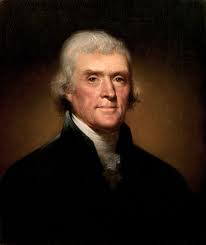
Thomas Jefferson believed that Laissez Faire was a policy that must be applied to the federal government regarding all issues, aside from those that were necessary for the preservation of the Union. The “hands off” attitude of Jefferson’s political philosophies included economics. He believed the role of government was to be absent from interfering in the workings of the free market.
“[A] rigid economy of the public contributions and absolute interdiction of all useless expenses will go far towards keeping the government honest and unoppressive.” – Thomas Jefferson
Jefferson’s mentality towards government interference in people’s lives, including economically, stood in opposition with the views of Alexander Hamilton. As the first Secretary of the Treasury, Hamilton believed government was tasked with keeping an eye on everything, including regarding the way things were bought and sold, and the access people had to their rights. Jefferson argued that people, and the business sector, should be left to do what they needed to do without government getting in the way. While the federal government could be involved with trade with other countries, when it came to internal trade between the States, and all other domestic economic policies, the federal government’s role was largely supposed to be a “hands off” way of doing things. According to Jefferson the only time the federal government had any authority to involve itself in commerce between the States was when there was a dispute between the States. Then, and only then, the federal government could get involved, acting as a mediator between the States until an agreement was reached.
Hamilton’s desire that the federal government be a strong central government with a consolidation of all power stood in direct opposition to Jefferson’s laissez faire attitude. Jefferson supported agrarian self-sufficiency, and he believed that the less government was involved in the economy, the better off the economy, and society, would be as a whole. He believed that economic competition was a part of the Laws of Nature, a natural order of things that led to natural self-regulation which historically had proven to be the best type of regulation. Otherwise, business and industrial affairs might be complicated by government intervention, a type of interference that had been proven to be detrimental to the proper workings of a free market economy.
This is not to say that Jefferson believed that absolutely no regulations should be applied to economic matters. The States, if they felt it was necessary, may apply laws constitutionally. Jefferson’s views were a combination of laissez faire, and localism. While the federal government must not interfere with the economy in any way, shape, or form, unless it was concerning external aspects of the issue (such as trade with other countries), or to act as a mediator in disputes between the States, the States retained all authorities regarding laws or regulations related to their internal prosperity.
Jefferson argued that if individuals were incentivized to serve their own personal interests, society as a whole would ultimately benefit. Laissez Faire economics encourages self-responsibility, innovation, competition, and a natural self-correcting series of economic cycles that provides increased opportunities for stability in the system, as opposed to the boom-bust cycles that exist in a centrally planned economy.
“Determine never to be idle. No person will have occasion to complain of the want of time, who never loses any. It is wonderful how much may be done, if we are always doing.” – Thomas Jefferson, letter to Martha Jefferson, 1787
— Political Pistachio Conservative News and Commentary
* Excerpt from A Promise of Truth Self-Evident: Part I – Early American History (A Promise of Truth Self-Evident, A History of the United States) by Douglas V. Gibbs