
By Douglas V. Gibbs
The Constitution is often referred to as a “living and breathing document.” My friend and constitutional colleague Alan Myers, who co-hosts with me on Constitution Radio each Saturday, likes to quip: “Of course it is living and breathing. It isn’t dead.” While I appreciate his attitude, that is not what the purveyors of the phrase mean.
When advocates call the Constitution “living and breathing,” they liken it to a living organism. They argue that, like us, it grows, expands, and evolves with time. As a living being learns, adapts, and changes with its surroundings, so too, they claim, should the Constitution. But this metaphor is misleading. The Constitution is not a living organism, nor was it ever meant to be. In fact, the Founding Fathers deliberately rejected that very idea.
The Founding Father sought to escaping the fluidity of English Common Law, which was considered to be living and breathing. English Common Law was not written down but understood by the people, shaped by cultural shifts, parliamentary acts, and judicial rulings. The British Constitution adjusted itself like an organism, bending to the whims of society and politics. The Founders saw this fluidity as a flaw. If the supreme law of the land could be altered by politicians, judges, or popular sentiment, it could be manipulated into tyranny.
Thus, the American Constitution was written on parchment for all to be able to read. Fixed in text. Agreed upon by the States. Changeable only through amendment. And the amendment process itself was not designed to be a casual process. It requires the approval of three-quarters of the States, ensuring that change reflects broad consensus among the parties who wrote and ratified the Constitution in the first place, rather than changes being made based on fleeting passions.
The Constitution is a compact between the States, creating a federal government designed to serve both the people and the States. Its powers were intentionally limited, checked and balanced to prevent tyranny.
The States were originally deeply involved in its operations. Senators were appointed by state legislatures, ensuring that the federal government could not act without the States’ consent. Treaties, appointments, and other federal actions requires Senate approval, and in the beginning those Senators served the voice of the states. Even the President was not chosen by direct democracy. Citizens voted for electors, some of whom were appointed by state legislatures, and those electors selected the President. This system kept the States engaged while restraining the dangers of pure democracy.
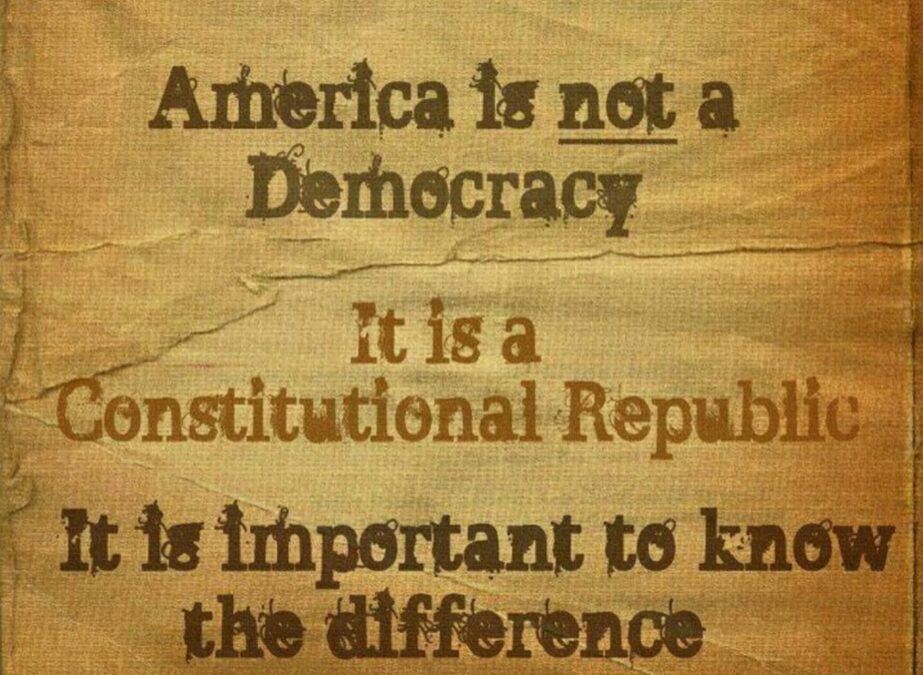
The Founders understood that democracy, unchecked, can be dangerous. America was established as a republic, using democracy sparingly and always within a framework of checks and balances. At the federal level, most of those checks were managed by the States.
If the Constitution were truly “living and breathing,” its meaning would be defined by politicians and judges. Sadly, over the last century, that is precisely what has happened. But this was never the original intent. The Constitution was meant to be a written, stable foundation, anchored against the tides of whim, preserving liberty by limiting power, and maintained by a powerful presence of the voice of the States… a presence over the last century and a half eroded by those screaming that we must save our democracy, which is the very thing that will destroy the republic if we don’t stop its advance.
— Political Pistachio Conservative News and Commentary