
By Douglas V. Gibbs
There are five cases (Birthright Citizenship, National Emergency Tariffs, Firing Independent Agency Heads, Bans on Transgender Athletes in Women’s Sports, and Banning Conversion Therapy) that will be heard by the Supreme Court of the United States in coming weeks that has America on edge, and while I don’t know how they will rule as a body, I do know how they should if they were following the Constitution of the United States. I plan to write a new article regarding each.
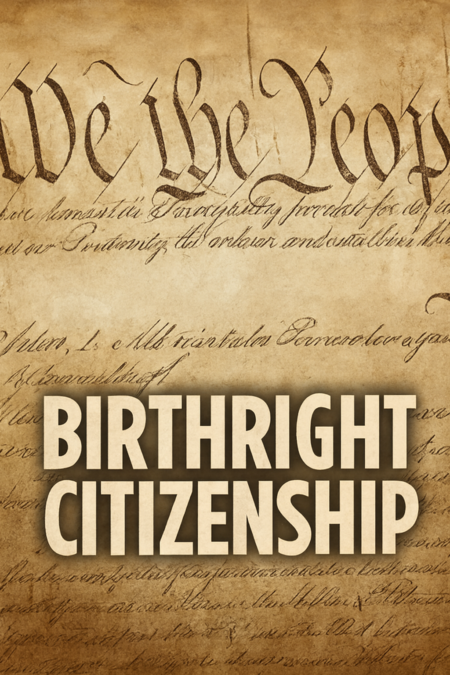
Birthright Citizenship is the topic I’ve been talking about the longest, of the five, even addressing it in my book, “25 Myths of the United States Constitution” back in 2014. In the current context, the issue is a part of President Trump’s Executive Order defining Birthright Citizenship as not applying to the children born on American soil to illegal migrants, or to those whose visit to the United States is temporary.
Executive Orders are instruments the President may constitutionally use to provide proclamations, and to transmit instructions to his executive branch regarding the execution of existing law. So, if we are to determine if the Executive Order is constitutional, the first step in the process is to make sure it is supported by existing law. In this case, the Executive Order is supported by the Civil Rights Act of 1866, which explicitly states: “All persons born in the United States and not subject to any foreign power, excluding Indians not taxed, are hereby declared to be citizens of the United States.” So, the question is, are the children born on American soil to illegal migrants subject to any foreign power? They are too young to decide where their allegiance lies when they are born on American soil, so to decide if they are subject to a foreign power, we must move to their parental guardians. If the parents broke the law to enter the country, and have taken no actions to legally make permanent their stay in America, and the child is born before such actions to legalize their permanency are taken, then the parents remain subject to a foreign power. As a result, their children are also subject to the same foreign power that their parents are. Therefore, as per the language of the law, President Trump’s Executive Order is consistent with the law.
Then we must ask if the law itself is constitutional. The Civil Rights Act of 1866 was passed into law two years before the Citizenship Clause of the Fourteenth Amendment became the law of the land upon the ratification of the amendment. So, the Civil Rights Act of 1866 technically was not required to fall under the provisions of the Citizenship Clause at the time of its passing because the Fourteenth Amendment did not exist, yet. The Citizenship Clause, however, since it is a constitutional amendment, supersedes the law passed two years before it, and the only way the Civil Rights Act is still valid law is if it is consistent with the Citizenship Clause. So, we need to determine if the Citizenship Clause is consistent with the Civil Rights Act of 1866, and what the language of the clause in the Fourteenth Amendment truly means. This, unfortunately, is typically determined by a plain reading of the text. But the textualist interpretation is not consistent with true constitutional law. If we want to determine the original intent of the clause, we need to dig into original documents and notes regarding the clause. To do this, we must examine the congressional testimony of Senators Howard and Trumbull, the primary writers of the Citizenship Clause.
During congressional testimony on May 23, 1866, Senator Jacob Howard said, “This will not, of course, include persons born in the United States who are foreigners, aliens, who belong to the families of ambassadors or foreign ministers…” On May 30, 1866, Senator Lyman Trumbull said, “What do we mean by ‘subject to the jurisdiction of the United States’? Not owing allegiance to anybody else. That is what it means.” Trumbull then clarified that the Civil Rights Act of 1866 and the Fourteenth Amendment were aligned: “The provision is simply declaratory of what I regard as the law of the land already, that every person born within the limits of the United States, and subject to their jurisdiction, is by virtue of natural law and national law a citizen of the United States…Subject to the jurisdiction means complete jurisdiction; not a partial or temporary one.”
Finally, the court will look to other legal cases that may be related to this issue. Wong Kim Ark (1898) is the case typically dragged into the discussion regarding Birthright Citizenship, and to date it is the only case that addresses the matter. The supporters of the modern interpretation of Birthright Citizenship use this case as supporting evidence for their conclusion. However, if one digs into the actual language of the ruling, it does not support their modern interpretation, after all. Wong Kim Ark was born in San Francisco to immigrant parents from China. When it was determined that they should be deported, and that he must go with them, he refused, stating he was an American Citizen because he was born in the United States. Once the case was heard by the United States Supreme Court, they recognized that there were two criteria that must be met according to the Citizenship Clause. First, that the person was, “born or naturalized in the United States.” Having been born in San Francisco, Wong Kim Ark satisfied the first hurdle. The next word in the Citizenship Clause is the word “and,” which makes the second part mandatory. The second part reads, “subject to the jurisdiction thereof.” While those who support the modern definition of Birthright Citizenship argue that means within the borders and subject to the laws, we must be reminded that Senator Trumbull was clear that it meant, “complete jurisdiction; not a partial or temporary one.” So the question for Wong Kim Ark’s argument was simply, when he was born was there legally identifiable conditions that revealed his parents had taken actions to make their stay in the United States a permanent one? The ruling recognized that since his parents had applied for and achieved “permanent resident status,” that though that status had been revoked since then and his parents were being deported, they possessed that status at the time of his birth giving his arrival on this Earth a legal condition of permanency in the United States. As a result, Wong Kim Ark won his case, and was considered a citizen of the United States.
One other supporting reality, though perhaps indirectly related, is the process of becoming a naturalized citizen. My wife naturalized in 2007, and she was required to renounce her citizenship and loyalties to Mexico before she could become an American Citizen; a requirement that is specifically a part of the naturalization process to satisfy “and subject to the jurisdiction thereof” portion of the Citizenship Clause of the Fourteenth Amendment.
Regarding Birthright Citizenship, we have one law supporting President Trump’s Executive Order, we have a single provision in the Constitution supporting his Executive Order, we have one court case which made it all the way up to the Supreme Court of the United States supporting the President’s Executive Order, and we even have a provision in our naturalization laws that supports the President’s Executive Order. If this Supreme Court is to follow the constitutional path to their decision, they will rule in favor of President Trump.
— Political Pistachio Conservative News and Commentary