
By Douglas V. Gibbs
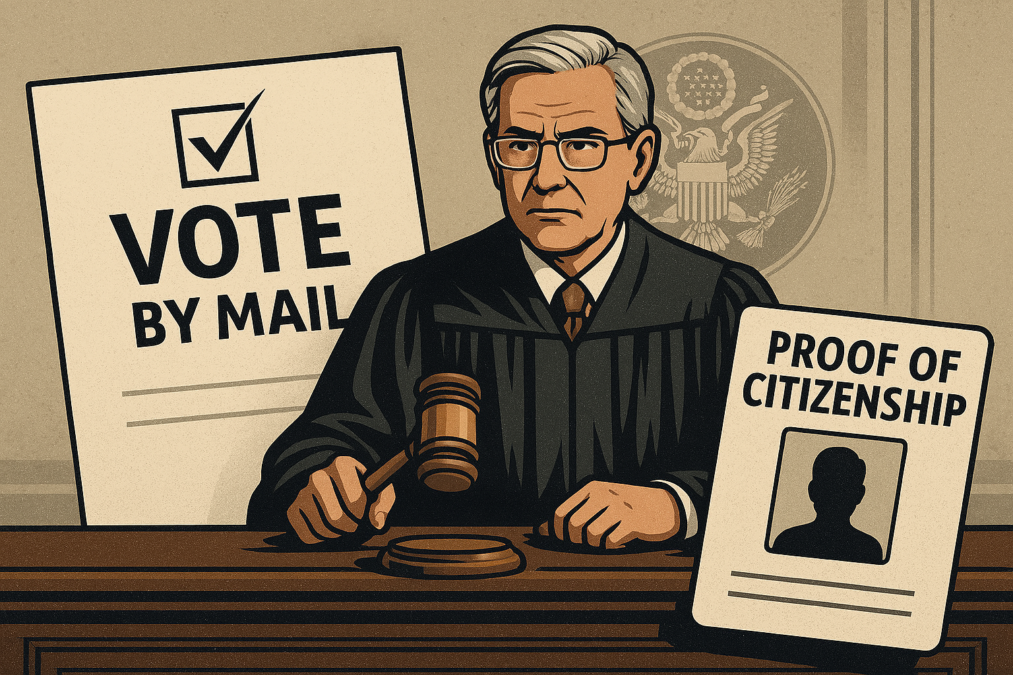
A recent ruling on Oregon & Washington v. Trump (2025 Executive Order on Elections) by U.S. District Judge John H. Chun where the judge issued a ruling blocking Trump’s order regarding mail-in-balloting was technically correct regarding the mail-in-balloting part. The problem is that a lower court judge has no authority to be ruling on the case. According to Article III of the Constitution, whenever a state (or states) are parties in a lawsuit, the United States Supreme Court has original jurisdiction.
As for the ruling, the reality is that without a federal law being passed disallowing vote-by-mail, the President of the United States may not by executive order outlaw the practice. Executive orders are for the purpose of declaring proclamations which are not legally binding, and to instruct the executive branch regarding executing an existing law on the books. Executive orders may not create, modify, or repeal law. Legislative powers are assigned to Congress by Article I, Section 1 of the U.S. Constitution.
I understand the reason the President issued an executive order regarding vote-by-mail balloting practices. It opens up the opportunity for fraud. But, as established by Article I, Section 4 of the Constitution, “The Times, Places and Manner of holding Elections for Senators and Representatives, shall be prescribed in each State by the Legislature thereof; but the Congress may at any time by Law make or alter such Regulations.” Based on that language, the manner of how a state holds its federal elections are up to the state unless Congress chooses to pass law that alters those practices. The manner in which a state conducts its local elections totally belongs to the state as long as they don’t violate any constitutional provision directed at the states regarding elections, or pass laws that would be contrary to federal laws made in pursuance of the Constitution.
The executive order in question was issued on March 25, 2025. Executive Order 14248, titled: “Preserving and Protecting the Integrity of American Elections.” The order broadly seeks to reshape how elections are administered in the country by, among other things, purporting to enforce a requirement that all voters prove their citizenship by way of formal documentation and by putting a stop to vote-by-mail systems that count ballots postmarked by, but received after, Election Day. A month later, Oregon and Washington sued because the default voting mechanism in each state is a postal ballot. In Oregon, the vote-by-mail system has been in place since 1998.
In May 2025, those two Pacific Northwest states moved for summary judgment, asking U.S. District Judge John H. Chun, a Joe Biden appointee, to permanently enjoin multiple sections of Trump’s order as unconstitutional and ultra vires, or, beyond the president’s power. Last Friday, the court ruled in the plaintiffs’ favor.
According to the judge, the primary issue is one of a separation of powers. “Separation of powers was designed to implement a fundamental insight: Concentration of power in the hands of a single branch is a threat to liberty,” wrote the judge in one section of the judicial opinion regarding the order.
While constitutionally Congress may seek to codify President Trump’s desire to get rid of mail-in-balloting for federal elections, the only way that the practice can be eliminated throughout the electoral system (even at the local level) would be by amendment to the Constitution banning the practice, and giving Congress the authority to have the power to enforce the amendment by appropriate legislation.
While the ruling prevents the federal government from requiring proof of citizenship when voters register using federal forms, Congress can override that limitation through legislation. The Constitution states five separate times that only citizens may vote, and it makes no distinction between federal and state elections. Therefore, a federal law requiring proof of identification and/or other ways to prove citizenship for all elections, including local ones, is entirely consistent with constitutional authority.
— Political Pistachio Conservative News and Commentary