
By Douglas V. Gibbs
President Trump is weighing the use of the Insurrection Act in response to escalating violence against federal ICE agents. His political opponents accuse both ICE and the President of acting unconstitutionally, yet the actual violations stem from activists obstructing lawful federal operations.
Article VI of the Constitution declares that the Constitution and all federal laws made in pursuance of it “shall be the supreme Law of the Land,” binding every State “any Thing in the Constitution or Laws of any State to the Contrary notwithstanding.” In plain terms, constitutionally authorized federal law, such as immigration law, supersedes all conflicting state or local measures, as well as any contrary international norms or agreements.
Article II, Section 3 charges the President with the duty to “take Care that the Laws be faithfully executed.” When a law is federal, it is the President’s responsibility, using the tools of the executive branch, to execute it.
The Constitution grants Congress explicit authority over immigration through Article I, Section 8’s Naturalization Clause and Article I, Section 9’s Migration Clause, empowering the federal government to create and enforce immigration law.
Article I, Section 8 also authorizes the federal government to call forth the militia “to execute the Laws of the Union, suppress Insurrections, and repel Invasions,” while Article IV, Section 4 obligates the United States to protect each State against invasion, including unlawful entry into the country.
Taken together, these provisions affirm President Trump’s actions regarding immigration law as legal and constitutional.
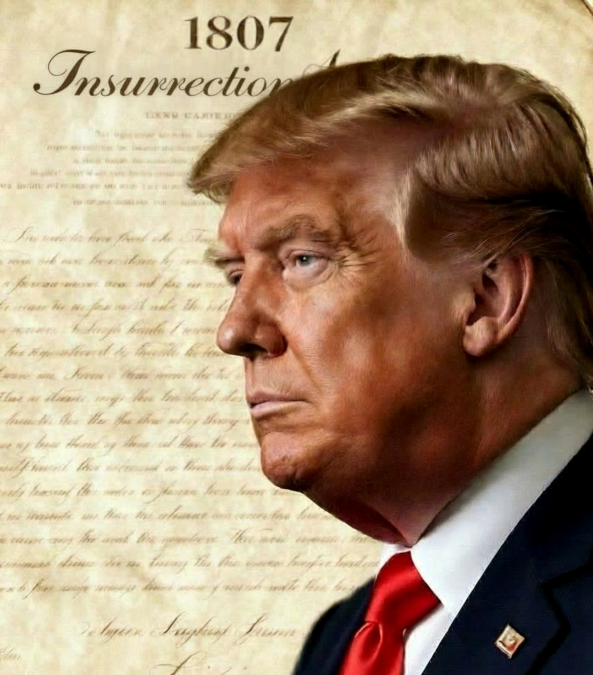
In 1807, Congress enacted the Insurrection Act, giving the executive branch statutory authority to act on the Constitution’s provisions for suppressing rebellion and enforcing federal law. Signed during Thomas Jefferson’s presidency, the Act permits a president to deploy U.S. military forces on American soil when necessary to quell unrest, uphold federal authority, or protect civil rights (an issue highlighted recently when anti‑ICE protesters trespassed into a church to protest a pastor they accused of supporting ICE). In response to escalating, unlawful violence against ICE agents in Minneapolis and other cities, President Trump has indicated he is considering invoking the Insurrection Act to restore order.
The First Amendment enumerates some natural rights, such as peaceable assembly. When demonstrations turn into assaults on federal officers, those actions are neither lawful nor legally protected. The ICE rioters, through their violence, are violating both federal law and the Constitution, while the agents they attack are carrying out their duties within constitutional authority.
The Insurrection Act empowers the President to deploy U.S. Armed Forces domestically when federal law is obstructed, when insurrection or rebellion arises, or when State authorities cannot – or refuse to – address natural rights (10 U.S.C. §§ 251–255). Although critics argue that the Posse Comitatus Act bars military involvement in domestic law enforcement, the Insurrection Act is the primary statutory exception.
While historical record is extensive, several modern examples illustrate how presidents have invoked the Insurrection Act. In 1957, Eisenhower used it to enforce desegregation in Little Rock after refusal to comply with federal court orders. Kennedy relied on it in 1962 and 1963 to ensure desegregation at University of Mississippi and University of Alabama. Johnson deployed troops during the 1967–68 unrest in Detroit and Chicago to restore order. In 1992, George H. W. Bush invoked the Act during the Los Angeles riots.
President Trump now suggests invoking the Insurrection Act in Minnesota may be necessary because protests against ICE have escalated into violence, injuring federal agents and leading to shootings that would not have occurred had demonstrators remained peaceful. Instead, well‑funded progressive groups are orchestrating coordinated violent “resistance” intended to provoke conflict and create the conditions for a Marxist‑style upheaval. Their aim is disruption. They manufacture chaos to obstruct federal agents from carrying out their lawful duties, a stark contrast to states where protests remain nonviolent and local authorities cooperate. Compounding the unrest, Minnesota’s state and local officials have inflamed tensions with rhetoric demanding ICE leave Minneapolis and by threatening to use state resources to confront and obstruct federal personnel.
Despite claims to the contrary, executive actions taken are fully consistent with Federalism. State sovereignty is vital, but the division of authority between the States and the federal government depends on where the Constitution assigns authority. Under the Tenth Amendment, States retain authority over matters not delegated to the federal government. The Constitution grants immigration authority to the federal government. Enforcing those laws, including apprehending and detaining those who violate it, is a concurrent power. Local law enforcement has a duty to assist until federal agents arrive to take custody. The relationship is no different from a bank robbery: local police pursue and secure, then turn the case over to federal authorities once they arrive. They don’t stand by and let criminals escape simply because the crime falls under federal jurisdiction.
Concerns naturally arise whenever the federal government operates within a State. If Washington exceeds its authority, States are right to respond through reasonable, peaceable dialogue. In a virtuous society, the deployment of military forces on U.S. soil would never be necessary. When citizens or local leaders object to federal actions in their region, there are constructive ways to engage aside from increased federal presence and violent street protests.
Democrats are correct comparing military boots on city streets to images of totalitarian crackdowns. It raises legitimate concerns about due process, excessive force, and the chilling of lawful protest. But that is not what is happening here. ICE agents are not randomly selecting people, nor are they targeting individuals based on ethnicity or skin color. They are not even pursuing most illegal aliens on the streets. Their focus is narrow: the worst offenders – those with established criminal records. Despite claims from Trump’s opposition, these operations are not “white supremacists” hunting “brown people” – a baseless, last‑ditch narrative of radicals fueling unrest. ICE and the Border Patrol are not goon squads or a modern Gestapo; they are immigration officers apprehending individuals who have already demonstrated, through criminal activity, that they pose a danger to the public. It is also worth noting that roughly 24% of ICE agents are Hispanic/Latino, and the U.S. Border Patrol has long had a majority‑Latino workforce, with Hispanics comprising more than half of all agents.
The Insurrection Act’s language grants broad presidential discretion. As Commander in Chief, the President is responsible for national security. The Founders, though wary of standing armies and concentrated executive power, understood that protecting the homeland sometimes requires swift action free from delay or interference.
The dilemma is stark. If the Insurrection Act is not invoked, violence will continue to escalate, with more churches, federal buildings, and pro‑ICE locations targeted, and with rising injuries and shootings. If the Act is invoked, something agitators appear to be provoking, It’ll escalate the chaos, intensify the rhetoric, and trigger even more violent confrontations. Disorder is not incidental to their movement; it is the goal. They are no longer seeking another Kent State‑style flashpoint. They are pursuing something far more catastrophic: a revolutionary clash that leaves hundreds dead, a moment they can present as the event that “justifies” their violent insurrection.
— Political Pistachio Conservative News and Commentary