


By Douglas V. Gibbs
Saw a meme…
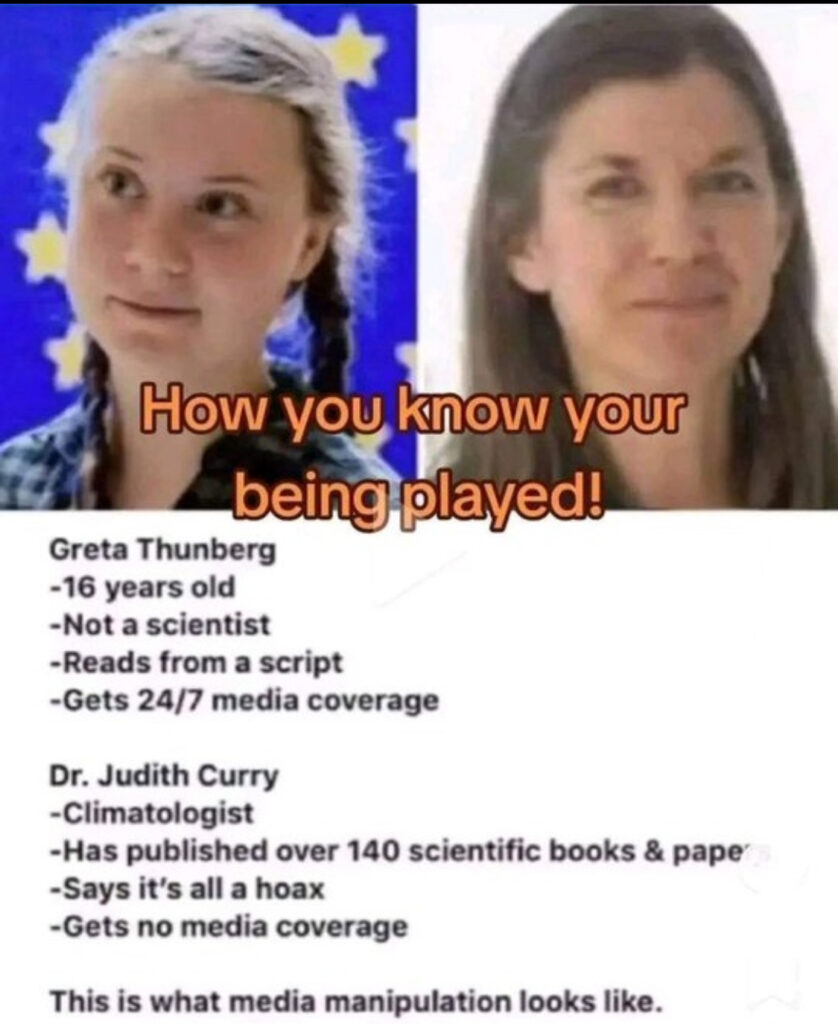
Judith Curry: The Climatologist Who Refused to Bow to the Orthodoxy
In an era when climate science has been weaponized into a political bludgeon, Dr. Judith Curry stands out because she refuses to surrender scientific integrity to ideological pressure. Curry, an accomplished climatologist and Professor Emerita at Georgia Tech, built her career on the hard sciences: climate dynamics, hurricanes, and the complex behavior of polar systems. She chaired the School of Earth and Atmospheric Sciences, published extensively, and earned the respect of her peers long before she ever became a public figure.
What makes Curry important today is not merely her résumé. It’s her willingness to say what many in her field whisper privately: the climate debate has drifted away from science and into the realm of political theater.
Curry’s shift didn’t come from politics, but from experience. After Hurricane Katrina, she stepped into the public conversation expecting a rational exchange of ideas. Instead, she found what she later described as “craziness”: a climate community increasingly intolerant of dissent, increasingly allergic to uncertainty, and increasingly eager to label any deviation from the approved narrative as heresy.
Rather than retreat, Curry did what real scientists are supposed to do. She questioned assumptions. She examined the data. She refused to treat computer models as sacred scripture. She insisted that uncertainty, an unavoidable feature of any complex system, must be acknowledged, not buried.
Curry’s central argument is simple: climate science is not settled, because the climate itself is not a settled system.
She doesn’t argue for complacency; she argues for clarity. She advocates risk‑based approaches rather than apocalyptic predictions. She calls for humility in the face of complexity. And she warns that when science becomes a political tool, both science and policy suffer.
This is precisely why she draws fire. Not because she is wrong, but because she refuses to play the role assigned to her by the climate establishment.
Curry runs the widely read blog Climate Etc., where she dissects climate research with the precision of a seasoned scholar and the candor of someone who no longer needs tenure committees to approve her existence. She has testified before Congress, spoken on major platforms, and has become a go‑to voice for those who believe climate policy should be grounded in evidence, not fear.
Predictably, the guardians of orthodoxy have tried to paint her as a contrarian, a skeptic, even a traitor to her field. The more they attack, the more obvious it becomes that their real grievance is not with her science, but with her independence.
Through the Climate Forecast Applications Network (CFAN), Curry has taken her expertise into the real world, helping industries and governments manage climate‑related risks with actual data rather than political slogans. It is the kind of practical, grounded work that exposes the gap between climate rhetoric and climate reality.
Judith Curry’s journey is not the story of a scientist who “turned against” her field. It is the story of a scientist who refused to let her field turn against science. She represents the kind of intellectual courage that once defined academia, before conformity became the price of admission.
In a debate dominated by absolutists, Curry reminds us that uncertainty is not weakness. It is honesty. And honesty, in today’s climate conversation, is the rarest commodity of all.
— Political Pistachio Conservative News and Commentary