
By Douglas V. Gibbs
The recent revelations surrounding Arctic Frost, the federal codename for the multi‑agency investigation into Donald Trump’s post‑2020 election challenges, have reopened a debate that the political establishment hoped was settled, and pushed deep under the rug in the basement of the Deep State’s bubbling swamp. Senator Chuck Grassley’s explosive disclosures, including evidence that the FBI collected tolling data on sitting Republican senators, have forced the country to confront a question that should trouble every constitutionalist: When does law enforcement cross the line from investigating crime to policing political dissent?
Arctic Frost was originally framed as a probe into Trump’s efforts to contest the 2020 election. But the newly released documents show something far broader. The investigation swept up communications metadata from senators who objected to the 2020 certification or raised concerns about election irregularities. Grassley argues that this was not a narrow inquiry into alleged wrongdoing. It was a political dragnet, a “means to an end,” targeting Trump’s allies in Congress.
Mainstream outlets like The New York Times have attempted to downplay these revelations, portraying Grassley’s oversight as partisan interference. But Grassley’s rebuttal is blunt: the Times ignored key documents, mischaracterized whistleblowers, and glossed over internal rule violations. The result is a widening gap between what conservative Americans see happening and what legacy media insists is happening.
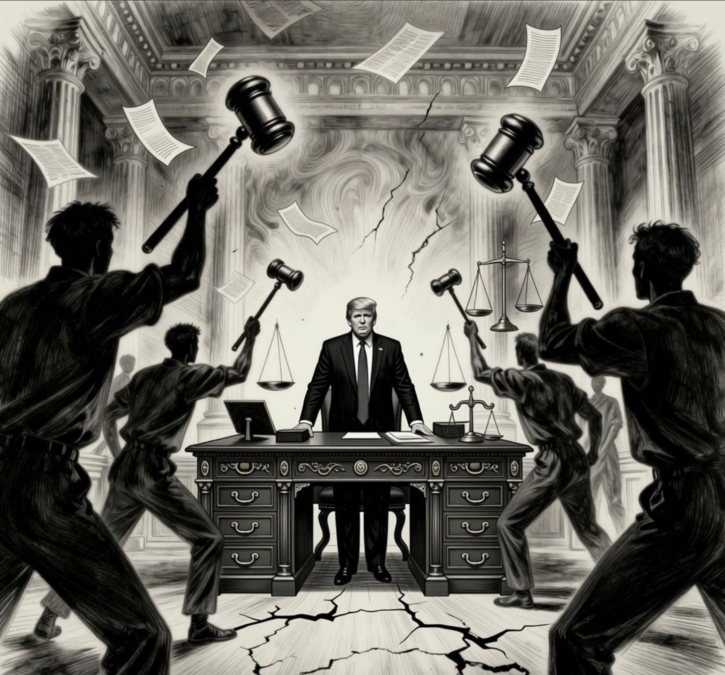
Arctic Frost, mind you, is only a small part of a much larger and broader conspiracy against Donald Trump his supporters. The attempt to stop him any way they could led to the Democrats using lawfare as a vicious political weapon. Arctic Frost, and all of the other attacks were not independent events occurring in a vacuum. As Trump challenged the 2020 election, arguing that emergency rule changes, mass mail‑in voting, and statistical anomalies demanded scrutiny, he was simultaneously hit from all directions with media attacks, and an unprecedented wave of legal actions.
No modern political figure has ever faced such a concentrated, simultaneous barrage:
• Two federal indictments
• State prosecutions in New York and Georgia
• Civil suits from political opponents
• Ballot‑removal attempts in multiple states
• Congressional investigations
• Administrative disputes with the National Archives
The most striking example is the New York case, where prosecutors took what would normally be a single misdemeanor bookkeeping dispute and multiplied it into 34 felony counts. The legal theory used to elevate those charges had never been applied in that way before. To conservatives, this was not justice; it was political escalation and a message that the system would use every available mechanism to break Trump.
From my point of view, the 2020 Election was not a criminal conspiracy as much as it was a constitutional crisis. From a conservative constitutional perspective, Trump’s actions after the 2020 election were not an attempt to “overturn” the results, but an attempt to challenge them in the hopes of exposing the truth. Millions of Americans recognized that there were irregularities that pointed to the possibility of election tampering.
• Sudden late‑night vote spikes
• Mass mail‑in ballots with loose chain‑of‑custody
• Courts and executive officials altering election rules without legislatures
• Statistical anomalies in key counties
• A record turnout by Democrats in just the places they needed, and then later a collapse in Democratic turnout in those same counties in later elections – which, by the way, defied otherwise reliable bell-weather county voting patterns.
Whether one believes these irregularities changed the outcome or not, they created a crisis of confidence that deserved investigation, not criminalization.
Arctic Frost ignored the need for investigation and treated Trump’s objections as criminal intent. It treated constitutional challenges as conspiracies. It treated political disagreement as evidence of wrongdoing.
For many conservatives, the January 6 narrative became the final piece of a larger pattern: the rapid transformation of political dissent into criminal suspicion. While the official narrative frames January 6 as an insurrection, I believe the event was exploited, if not orchestrated, to justify the expansion of surveillance, prosecutions, and political suppression. It was a Hollywood production. A false flag event. And I believe the truth is working its way to the surface on that issue, as well.
Even without endorsing my view as fact, it is undeniable that January 6 became the pretext for:
• Expanding federal investigative powers
• Intensifying scrutiny of Trump supporters
• Justifying Arctic Frost’s broad scope
• Cementing the “threat to democracy” narrative used to delegitimize dissent
The result has been a political environment where challenging election procedures is treated as sedition, and questioning institutional authority is treated as extremism.
The deeper issue is not Trump himself. It is warfare against a stick in the spokes called MAGA that derailed the Democrat Party’s plans to turn America into a one-party system. And to get back on track, all they needed to do was set some precedents.
If federal agencies can:
• surveil sitting senators for objecting to an election
• multiply misdemeanors into dozens of felonies
• criminalize political challenges
• coordinate overlapping prosecutions
• shape narratives through selective leaks
• and rely on media allies to sanitize their actions
then the constitutional balance between the people and the government is fundamentally altered.
A republic cannot survive if dissent becomes criminalized.
A constitutional system cannot function if political opposition becomes prosecutable.
A free people cannot remain free if the state decides which political movements are legitimate.
The real questions are now bubbling to the surface. Arctic Frost is not just a scandal. It is a warning. If this level of investigative and prosecutorial power can be deployed against one man and his supporters, it can be deployed against anyone. The issue is not whether one supports Trump. The issue is whether one supports a system where the government can use its full weight to crush political opposition.
That is the constitutional crisis at the heart of Arctic Frost.
— Political Pistachio Conservative News and Commentary