
By Douglas V. Gibbs
At 2:30 am Eastern Time on February 28, 2026, the United States military began “major combat operations in Iran,” according to President Donald Trump. The objective was to defend the American People by “eliminating imminent threats from the Iranian regime.” President Trump has repeatedly indicated that Iran “can never have a nuclear weapon,” and he has been negotiating with Iran after crippling their nuclear ambition with Operation Midnight Hammer conducted on June 21-22, 2025. The operation involved B-2 bombers that targeted three sites using bunker-buster bombs.
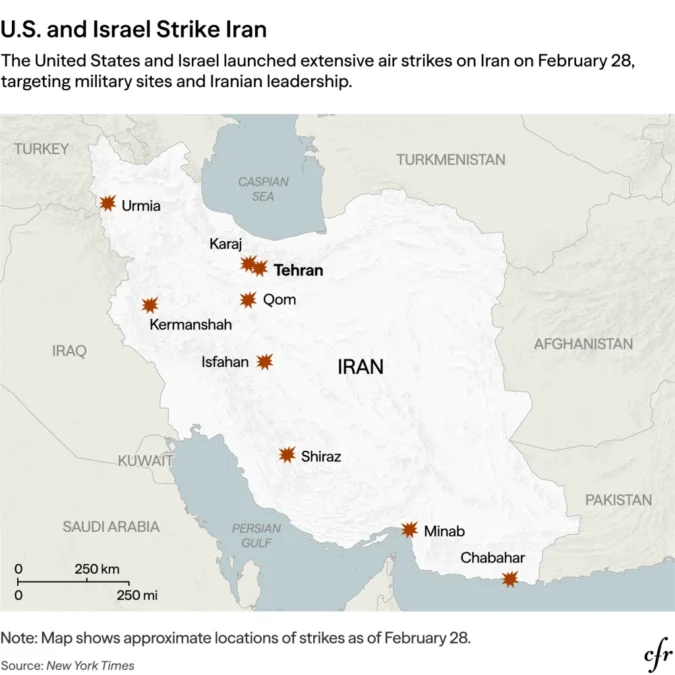
Multiple specific targets were hit in various cities around Iran, with two of the blasts over Tehran. According to reports, Iran used the post-ceasefire period to construct deeper, hardened nuclear sites, while blocking IAEA inspectors from its sites for nine consecutive months. On February 19, President Trump issued a ten-day ultimatum, which Iran has not honored, refusing to transfer its highly enriched uranium stockpile abroad, and they would not discuss the country’s ballistic missile program under any framework, with Secretary Marco Rubio calling the refusal “a big, big problem.”
The signs that a strike was coming were apparent. The New York Post published yesterday that Ambassador to Israel Mick Huckabee instructed U.S. Embassy staff in Iran to leave the country. Two carrier strike groups led by the USS Abraham Lincoln and the USS Gerald R. Ford have been positioned in the region, with the latter joining the party a few days ago. And of course, there was Trump’s ultimatum. Unlike the Democrats, if his line in the sand is crossed, Trump makes sure to move on to providing a consequence for it.
Unlike typical moves by President Trump, this one won’t be an in-and-out operation. Trump has signaled it will be a large-scale campaign, designed to overwhelm Iran’s missile production facilities, launchers, stockpiles, and air defense systems before the regime can fully organize a response.
That said, there has been a response. Iran’s regime responded within hours, launching ballistic missiles toward Israel and American military installations throughout the Persian Gulf region. Defensive systems intercepted the threat to Israel.
Iranian missiles struck near the headquarters of the U.S. Navy’s Fifth Fleet, the critical hub of American naval power in the Persian Gulf which is located in Manama, Bahrain. The missile did not hit the base, and the installation was largely empty by that time. There were no reported casualties.
Iran also launched strikes on U.S. bases in Jordan, Kuwait, Abu Dhabi, Qatar, with no significant damage or any casualties.
President Trump said the US will now destroy Iran’s missile capabilities, its navy, and its “terrorist proxies” in the region.
He also called on the Iranian people to “take over your government” once the military operation is finished.
The National Council of Resistance of Iran, an anti-Iranian regime group, has announced it is establishing a “provisional government to transfer sovereignty” to the Iranian people and establish a democratic republic after the United States and Israel completes its mission against the regime. Their ten-point plan includes, “freedom of speech, freedom of political parties, freedom of assembly, freedom of the press and the internet” as well as the “dissolution and disbanding of the Islamic Revolutionary Guard Corps (IRGC), the terrorist Qods Force, plainclothes groups, the unpopular Bassij, the Ministry of Intelligence, Council of the Cultural Revolution, and all suppressive patrols and institutions in cities, villages, schools, universities, offices and factories.”
The group’s plan calls for “commitment to individual and social freedoms and rights in accordance with the Universal Declaration of Human Rights. Disbanding all agencies in charge of censorship and inquisition” as well as “seeking justice for massacred political prisoners, prohibition of torture, and the abolishment of the death penalty.” It also recommends “separation of religion and state, and freedom of religions and faiths.”
While the Democrats claim President Trump acted unilaterally without even notifying Congress, Secretary Marco Rubio did provide congressional notification by contacting all members of the Gang of Eight prior to the attacks, and he was able to reach and brief seven of the eight members.
While congressional Democrats have given the President no support over his attack against Iran, one must remember that last June Senator Chuck Schumer criticized President Trump for taking a weak stance regarding Iran, posting on X: “If TACO Trump is already folding on Iran, the American people need to know about it.” Democrat Senator John Fetterman backed President Trump’s strikes against Iran, stating that “the President is correct.” On X he wrote, “President Trump has been willing to do what’s right and necessary to produce real peace in the region.”
Bret Baier made a comment about the fact that the operations were carried out in daylight, stating that by it “not under the cover of darkness,” it evoked “confidence” in the U.S. military’s capabilities to carry out the mission even if the Iranian regime saw it coming.
Several Senate Democrats argued that Congress must reconvene immediately to debate and vote on military authorization. Their concern was less about defending the Iranian regime and more about preventing what they described as an open‑ended conflict without legislative approval.
Sen. Tim Kaine (D‑Va.) reiterated his longstanding position that military action against Iran requires explicit congressional authorization. Other Democrats, including Sen. Andy Kim (D‑N.J.) and Sen. Mark Warner (D‑Va.), publicly signaled support for forcing a War Powers vote.
House Democrats moved in a similar direction. Minority Leader Hakeem Jeffries indicated that House Democrats would push for a vote when members return to Washington. Rep. Jim Himes (D‑Conn.), the ranking member on the House Intelligence Committee, warned that military operations without a clearly defined strategic endgame risk spiraling into broader conflict.
The language from this faction has been consistent: avoid escalation, demand clarity on objectives, and reassert Congress’s constitutional role.
If Democrats were successful with their War Powers Resolution, they argue, any use of the military for offensive strikes would require congressional approval. House Rep. Ro Khanna, (D-CA), said Congress “must” reconvene on Monday. “Trump says his goal is to topple the Iranian regime, but the American people are tired of regime change wars that cost us billions of dollars and risk our lives,” Khanna said in a video posted to social platform X. “We don’t want to be at war with a country of 90 million people in the Middle East.”
Sen. Andy Kim of New Jersey said it was “the same dangerous and foolish decision President Bush did a generation ago,” and he said it was “all done against our Constitution, against the will of the American people, and without Congress’ approval.”
Minority Leader Chuck Schumer called for Congress to pass the War Powers Act.
The problem with the argument is that it is false. The Constitution recognizes two war powers: the power to declare war and the power to wage war. In Article I, Section 8, the Constitution delegates the power to declare war to Congress. In Article II, the Constitution delegates the power to wage war to the President by establishing him as Commander in Chief. As with tariffs, foreign policy negotiations, and border security, the President operates in the real world while Congress debates inside conference rooms and offices in committees and as a legislative group. While the President’s authority largely rests on executing the law, as established in Article II, Section 3 of the Constitution, he is also given the authority to ensure national security and to conduct foreign affairs. If the President needed to consult with Congress at every turn, he would not be able to effectively perform his duties, and our very country would be at risk.
History is also on the President’s side when it comes to taking actions for national security without the necessity of consulting Congress first or waiting for a declaration of war. When it came to military operations, both Presidents Jefferson and Madison waged the Barbary Wars, without a congressional declaration of war. Could you imagine what it would be like if a President were required to allow Congress to micromanage his duties? When a negotiation, at its most critical moment, comes to a crossroads, do we really believe the President’s team, or the President himself, must then pause the negotiations to talk to Congress, with the legislators then taking it to committees and debating the issue on the floor and perhaps getting back to him in a few weeks or months? Would military operations, or even the decision to make a necessary strike, with time as a key component, work better if the President asked Congress and then, perhaps down the road, they said, “go ahead,” while leaking our plans to the enemy? It is ludicrous on its face.
Because of swift action and no leaks, the strikes on Iran resulted in the death of the leaders of the Iranian regime, who would have plenty of time to flee and prepare a counter-move should the strike have been delayed by Congress, and the President’s intentions leaked to the enemy. Thanks, but no thanks. It is critical that Congress not step outside its lane and try to act like the executive branch’s puppeteer. The Separation of Powers demands that they stay in their own lane. In short, while they scream Trump is violating the Constitution, it is actually they who desire to usurp constitutional authorities and rip to shreds that sacred document.
— Political Pistachio Conservative News and Commentary