

By Douglas V. Gibbs
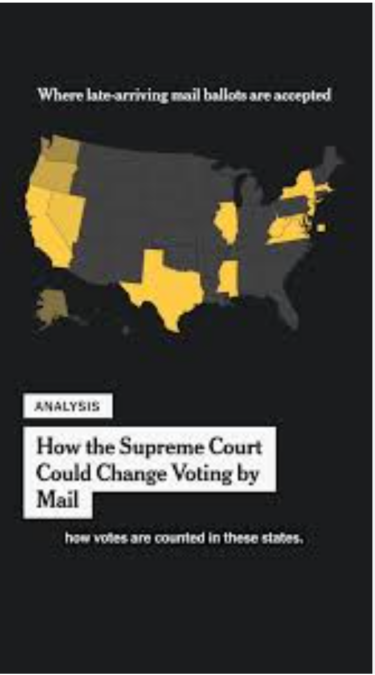
A legal dispute over allowing mail-in ballots that arrive after election day to be counted has worked its way to the United States Supreme Court. Watson v. RNC challenges federal laws that establish an election day for federal races. More than a dozen states permit the countine of late-arriving ballots as long as they are postmarked before election day.
Article 1, Section 4 of the United States Constitution establishes that federal elections are to be handled locally by the states, but if the times, places and manner of holding elections for any reason needs to be adjusted according to Congress, the federal legislature may at any time by law make or alter such regulations. So, the key in this lawsuit is simply, “is there federal law that requires all ballots must be received and handled by election day.”
The key federal laws being used to argue that late-arriving ballots cannot be counted are the statutes that Congress has passed to set a uniform Election Day for federal elections. These are primarily found in the United States Code at 2 U.S.C. § 7, 2 U.S.C. § 1, and 3 U.S.C. § 11.
These federal statutes establish “the Tuesday after the first Monday in November, in every even-numbered year” as the single “election” day for federal offices. The Republican National Committee’s position, which was upheld by the Fifth Circuit Court of Appeals, is that these laws create a hard deadline requiring ballots to be both cast by voters and received by state officials by the end of Election Day.
The Fifth Circuit specifically ruled that Mississippi’s grace period violated federal law, stating that federal law “does not permit the state of Mississippi to extend the period for voting by one day, five days or 100 days” and that the statutes require ballots to be in the custody of state officials by the end of Election Day.
This interpretation is contrasted with Mississippi’s argument that “election” has historically meant when voters make their “choice” by marking and submitting their ballots — not necessarily when they are received and counted. The Supreme Court’s decision will effectively determine whether “Election Day” is a voter deadline or an administrative cutoff for receiving ballots.
— Political Pistachio Conservative News and Commentary