

By Douglas V. Gibbs
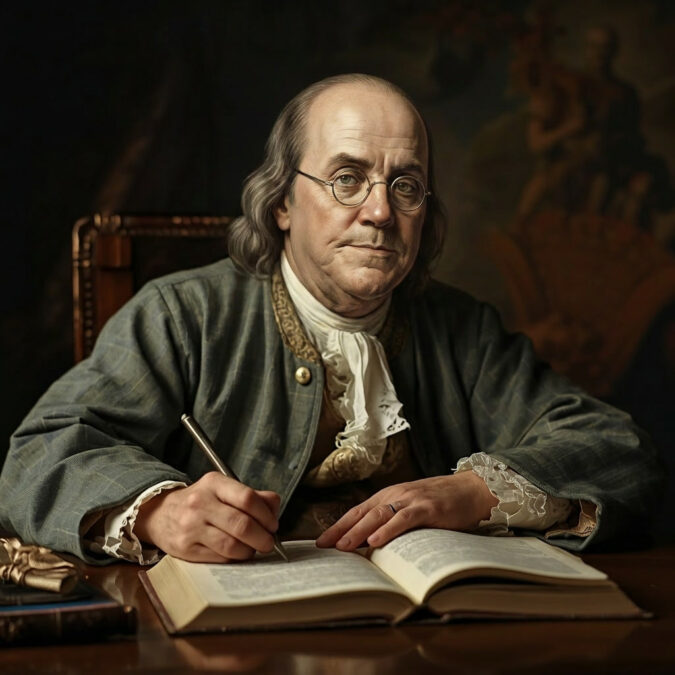
The Founding Fathers issued warnings that echo with chilling relevance today. Benjamin Franklin’s declaration that “Only a virtuous people are capable of freedom” wasn’t mere philosophical musing – it was a diagnostic truth about the American experiment. John Adams went further, insisting “Our Constitution was made only for a moral and religious People,” while Patrick Henry warned that “A vitiated state of morals, a corrupted public conscience, is incompatible with freedom.” These were more than mere idle concerns; they were foundational principles upon which our republic was built.
Ben Franklin developed thirteen virtues:
- Temperance
- Silence
- Order
- Resolution
- Frugality
- Industry
- Sincerity
- Justice
- Moderation
- Cleanliness
- Tranquility
- Chastity
- Humility
He systematically cultivated these virtues, admitting he was “surprised to find myself so much fuller of faults than I had imagined.” His humility in this endeavor reveals a crucial truth: virtue isn’t achieved through self-congratulation, but through honest self-assessment and disciplined effort.
The connection between personal virtue and political liberty cannot be overstated. As James Madison stated, “To suppose that any form of government will secure liberty or happiness without any virtue in the people, is a chimerical idea.” The Founders understood that self-government requires self-governed individuals who embrace virtue, embrace lawfulness, and embrace order. John Adams expressed this succinctly: “Public virtue cannot exist in a Nation without private Virtue, and public Virtue is the only Foundation of Republics.”
Today we witness the consequences of abandoning this wisdom. Our political divisions reflect a deeper moral fragmentation. When we lose the capacity for honest self-assessment, when we abandon responsibility for our actions, when we reject the biblical understanding that motives matter as much as actions, we create the vacuum that tyranny fills. As Franklin warned, “As nations become more corrupt and vicious, they have more need of masters.”
The biblical principle that sin is often defined by motive rather than action alone offers a path forward. Eating is not sinful, but gluttony is; speaking truth is virtuous, but speaking truth to destroy is sinful. This nuanced moral vision, rooted in Scripture, provides the framework for the kind of virtue the Founders deemed essential for liberty. It calls us to honesty without cruelty, responsibility without self-flagellation, firmness without harshness, and joy without frivolity.
Andrew Breitbart’s observation that “politics is downstream from culture” diagnoses our current crisis accurately. We cannot get our political house in order until our religious and moral house is put in order. This requires returning to the kind of intentional virtue cultivation Franklin practiced. It is a necessary foundation for freedom.
The path forward demands both personal and national renewal. We must recover the understanding that freedom requires virtue, that liberty demands responsibility, and that constitutional government depends on moral citizens. As we face increasing challenges to our constitutional order, we would do well to remember Franklin’s warning and Adams’ conviction: without virtue, there can be no liberty, and without a moral and religious people, there can be no American Constitution.
The question before us is whether we will heed these warnings from our Founding Fathers and the biblical wisdom they used as the foundation of our system, or continue down the path of moral fragmentation that inevitably leads to political fragmentation. The future of American freedom hangs in the balance – and the war is as much spiritual as it is political… if not more so.
— Political Pistachio Conservative News and Commentary