

By Douglas V. Gibbs
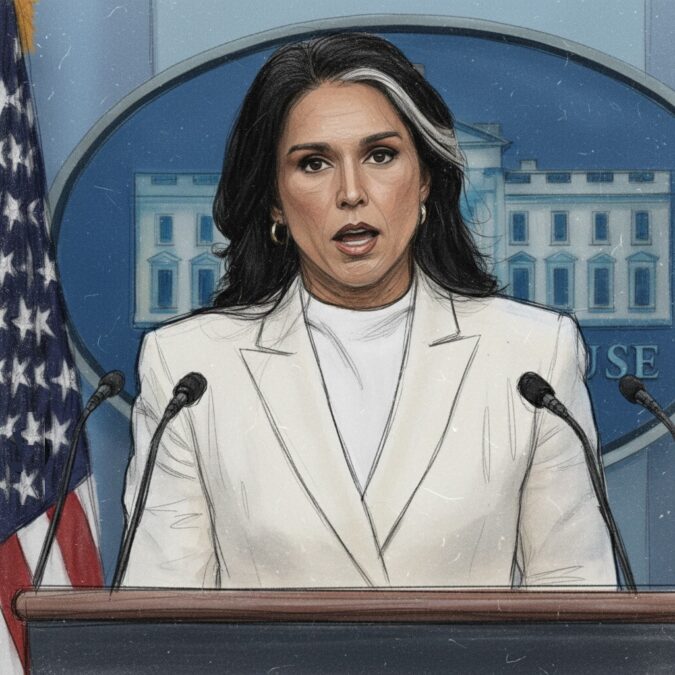
Tulsi Gabbard, one of the most fearless members of President Trump’s national security team, has been a key figure in exposing the Deep State’s inner workings. Gabbard has announced she will resign as Director of National Intelligence effective June 30, 2026. Her departure raises an immediate and serious question: who will replace her in a Senate still largely controlled by the opposition? My concern is that the confirmation process may be weaponized to block a worthy successor. Fortunately, if necessary, that process does not have to begin until after the mid-term elections.
Gabbard released her resignation letter on X, and the reason she gave is heartbreaking. Her husband, Abraham, is battling what she described as “an extremely rare form of bone cancer.”
She did not specify the exact diagnosis, but based on her description, my mind immediately went to multiple myeloma. A close friend of mine has been fighting that same disease. Multiple myeloma begins in the plasma cells of the bone marrow and is notorious for creating lytic lesions (literal holes in the bones) that weaken the skeletal structure and can lead to sudden fractures, including vertebral compression fractures. It’s sometimes called “myeloma bone disease” because of how aggressively it destroys bone tissue by throwing the body’s bone-building and bone-destroying cells into chaos.
Other rare bone cancers, such as Ewing sarcoma, could also fit the description. Whatever the exact diagnosis, these cancers are brutal, debilitating, and life‑altering. My friend’s cancer advanced rapidly at first, but is now in remission. I pray Gabbard’s husband experiences the same mercy.
In her letter, Gabbard wrote that Abraham “faces major challenges in the coming weeks and months,” and that she must step away from public service to support him fully. “Unfortunately, I must submit my resignation, effective June 30, 2026,” she wrote.
She also expressed gratitude to President Trump for the trust he placed in her and for the opportunity to lead the Office of the Director of National Intelligence for the past year and a half.
Gabbard, once a Democrat before witnessing firsthand the rot within the Swamp, said she believes she made “significant progress at the ODNI,” including advancing transparency and restoring integrity to an intelligence community long plagued by politicization.
And she’s right. Her tenure has been one of the most consequential in modern intelligence history. She initiated a restructuring of the ODNI that streamlined operations and rooted out entrenched political actors who had weaponized intelligence for years. She dismissed, reassigned, or revoked the clearances of individuals she believed were responsible for manipulating intelligence for political ends.
She also pushed aggressively for transparency, releasing long‑buried information that exposed corruption and criminality within the intelligence apparatus, including details about the intelligence community’s role in manufacturing the Russian‑collusion narrative during the 2016 election.
Gabbard acknowledged that “there is still important work to be done,” and pledged to ensure a smooth transition. I suspect these final weeks will be intense. With the clock ticking, she may accelerate the release of information she’s been preparing. Whether that leads to handcuffs and orange jumpsuits remains to be seen.
Her resignation comes at a critical moment. The mid‑term elections are approaching, and the Senate may attempt to stall or block confirmation of her replacement. Fortunately, the law allows an acting director to serve for up to 210 days after the vacancy occurs, and longer if a nomination is pending. That means President Trump still has room to maneuver. If no nomination is submitted, an acting director could serve until roughly January 26, 2027.
Gabbard will continue to oversee intelligence operations for the next five weeks, including matters related to U.S. actions against Iran and any potential moves involving Cuba.
President Trump has already announced that Aaron Lukas, currently the Principal Deputy Director of National Intelligence, will serve as Acting Director beginning June 30. Lukas has more than 20 years of intelligence experience and previously served under Trump during his first term. The President has called him “highly respected,” and there are indications he views Lukas as a trustworthy potential permanent replacement.
The transition is expected to begin within days.
— Political Pistachio Conservative News and Commentary