

By Douglas V. Gibbs
With the emergence of foreign‑born members of Congress advocating policies viewed by many native‑born Americans as fundamentally anti‑American, Representative Nancy Mace (R‑SC) has introduced a proposed joint resolution (H.J.Res.188) to amend the Constitution. Her amendment would require all members of Congress, federal judges, and Senate‑confirmed executive officers to be natural‑born citizens of the United States. At present, the Constitution reserves that requirement only for the president and vice president. Members of the House and Senate need only have been citizens for seven and nine years, respectively. Under today’s interpretation of citizenship, particularly the modern doctrine of “Birthright Citizenship,” which grants citizenship to anyone born on American soil regardless of parental allegiance, even anchor babies may serve in Congress.
While the proposal is designed to disqualify foreign‑born individuals from election or appointment to Congress or service in the federal government, it would not apply retroactively to those already serving. And realistically, the joint resolution faces steep odds: securing two‑thirds support in both chambers is improbable, and ratification by three‑fourths of the states even more so. But, my interest here is not in handicapping its chances, nor in the predictable accusations from the Democratic Party that such an amendment is racist, unfair, or a slide toward isolationism or nationalist extremism. My concern lies elsewhere.
Article II of the Constitution requires only the president and vice president to be natural‑born citizens. Representative Mace’s proposal seeks to extend that requirement to Congress, but it does so on a flawed assumption: that native‑born citizen and natural‑born citizen are interchangeable terms. They are not.
If the Framers had intended “native‑born” to carry the same meaning as “natural‑born,” they would have used the former term in Article II. They did not. And for good reason. During the Founding Era, there was deep suspicion toward certain native‑born inhabitants, specifically the Tories. Though born in the colonies, Tories maintained allegiance to Britain and considered themselves subjects of the Crown. Some were openly hostile to American independence; others acted as spies or sought to infiltrate the new government. The Framers understood that mere birth on American soil did not guarantee American loyalty.
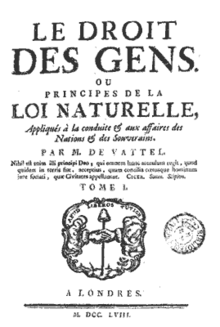
Instead, the Framers relied on the established term natural‑born citizen, consistent with Emer de Vattel’s Law of Nations, a work present in the Constitutional Convention (two English copies and one French). While the Constitution does not define the term, Vattel did: “The natives, or natural‑born citizens, are those born in the country, of parents who are citizens” (Book I, Chapter 19, §212). In the original French, Vattel used the term les naturels, rendered in the 1760 English edition, the edition available to the Founders, as “natives, or natural‑born citizens.”
As an interesting additional note, while the Framers relied on this well‑established term, there is no evidence that the phrase “native‑born citizen” existed in American legal vocabulary during the Founding Era. It appears nowhere in Vattel, nowhere in Blackstone, nowhere in the Naturalization Acts of 1790, 1795, or 1802, and nowhere in the records of the Constitutional Convention. The term native‑born emerges only later, in the nineteenth century, as American jurists confronted new questions surrounding birthright citizenship, territorial expansion, and the status of freed slaves and Native Americans. By the time of the Fourteenth Amendment in 1868, legal commentators had begun informally referring to persons “born… in the United States” as native‑born citizens. By the early twentieth century, particularly during debates surrounding the Indian Citizenship Act of 1924, the term had become normalized in federal discourse. In short, native‑born is a modern classification reflecting the evolution of statutory birthright citizenship, not the Founders’ understanding of natural‑born citizen as a term of art rooted in the law of nations.
Taken together, the historical record makes the distinction unmistakable: natural‑born citizen and native‑born citizen are not the same. To the Framers, a natural‑born citizen was someone born in the country to citizen parents. A native‑born citizen, as the term later evolved, simply meant someone born on American soil, regardless of parental allegiance or citizenship.
Which brings me back to Congresswoman Mace’s proposal. If her amendment were somehow to pass Congress and be ratified by the states, the Constitution would then require that all members of Congress be born of citizen parents – because that is what the term natural‑born citizen meant to those who wrote it in 1787. While I do not believe the amendment has any realistic chance of advancing, it is troubling that members of Congress who have sworn an oath to the Constitution appear unable to grasp the meaning of its own language.
— Political Pistachio Conservative News and Commentary