
By Douglas V. Gibbs
The Preamble’s phrasing offers a compelling interpretation of the Founding Fathers’ intent regarding American identity and citizenship.
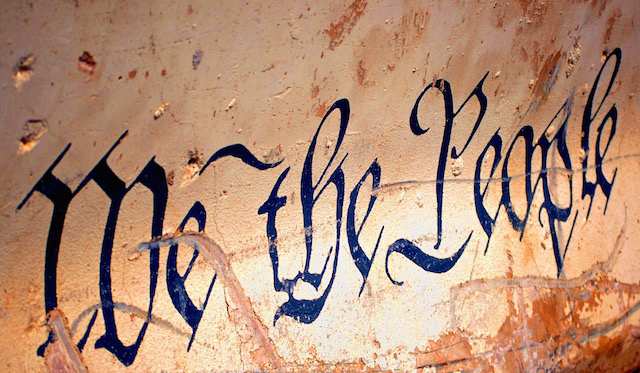
The phrase “We the People of the United States” represents a significant departure from previous governing documents. While the Magna Carta addressed “freemen” specifically, the American Founders chose a more inclusive term that theoretically encompassed all inhabitants. The word “people” meant “all people” of the United States. It was used also to describe slaves during that period; the term “people” was commonly used in legal and political discourse to refer to enslaved individuals, often in contexts like “the people of color” or “the people held in servitude.”
Jefferson’s drafting of the Declaration of Independence, and the opening line of the Preamble to the U.S. Constitution (We the People) are viewed as contradictions to the reality of the time when one considers the presence of slavery in America, but if one looks deeper into the context of the era and the individuals behind those documents much more becomes particularly revealing. In his original draft of the Declaration, Thomas Jefferson condemned the slave trade as a “cruel war against human nature itself, violating its most sacred rights of life & liberties” and specifically blamed King George for “suppressing every legislative attempt to prohibit or to restrain this execrable commerce.” He also wrote about “all men” being created equal – after using the word “MEN” (a word he put in all caps and underlined) in his anti-slavery section of 168 words when referring to the slaves of the time – a section ultimately removed from the Declaration of Independence due to protest by South Carolina and Georgia (anti-slavery language the other eleven states agreed to). It is true that Jefferson himself enslaved hundreds of people, but even his ownership of slaves adds a layer to the complexity once the context of the situation is explored. Jefferson rarely purchased slaves, with one story stating that after seeing that a family would be separated at a slave auction, he bought the whole family (parents and children) to keep the family together. Most of the slaves he owned he inherited, and he was too cash poor to successfully free the slaves he owned.
During, and after, the Revolutionary War the animosity toward Tories and European class structures was central to revolutionary thinking. The Founders were consciously creating a new political identity distinct from European models of society based on hereditary status and class divisions. The phrase “We the People” was a radical departure from monarchical language like “We, the King” or “We, the Parliament” or even “We, the Freemen,” and suggested sovereignty residing in the collective populace rather than a monarch or aristocracy.
In America, the intent of the word “of” in the Preamble (We the People “of” the United States) signified a deeper connection than mere residency. The distinction between being “in” America versus being “of” America appears to have been significant to early American political thought. This perspective helps explain why the Naturalization Act of 1790 was passed so quickly, establishing that citizenship required not just presence but a meaningful connection to the American project.
The Fourteenth Amendment’s Citizenship Clause, with its “subject to the jurisdiction thereof” language, can be seen as an attempt to codify this distinction between those merely present on American soil and those with a more substantive connection to the Union of States. This interpretation suggests that American citizenship was conceived not just as a legal status but as a form of national belonging with corresponding obligations.
The question of whether “We the People” was intended to create a unified national identity that transcended particular group identities is particularly relevant today. The Founders appear to have been attempting to forge a new political identity based on shared commitment to constitutional principles rather than inherited status or particular group affiliations.
This conception of American identity has evolved over time, particularly through the Reconstruction amendments, the Reconstruction Era, the Civil Rights Movement, and contemporary debates about citizenship and belonging. The tension between the universalist aspirations of “We the People” and the particular experiences of different groups in American history provides a particularly interesting opportunity to study, but in the end we are reminded that the Founding Fathers were well aware of the schemes of identity politics, while they likely did not call such tactics by that name back then.
Historical context and the complexity of evaluating historical figures through a contemporary lens is important when attempting to dissect history and what was originally intended by the Founding Fathers. The Jefferson-Hemings controversy, for example, indeed exemplifies how historical narratives can be shaped by incomplete evidence, political motivations, and changing standards of proof. The claim that Thomas Jefferson fathered children with Sally Hemings was more about a newspaper columnist attempting to cause damage to Jefferson’s character than seeking the truth that may or may not have any validity.
Jefferson’s situation with slavery is an interesting and complex study in its own right. Virginia law in the late 18th century created significant barriers to manumission. An 1782 law had eased some restrictions, but it still required slaveholders to provide provisions and ensure that freed slaves could support themselves, which presented financial challenges for many plantation owners. Additionally, Jefferson’s substantial debts, particularly inherited from his father-in-law John Wayles, made it legally and financially difficult to free his enslaved workers.
As for the Jefferson-Hemings question, the historical record is indeed more complex than often presented. DNA testing in 1998 established that a male from the Jefferson line fathered Eston Hemings, but the testing couldn’t definitively identify Thomas Jefferson as the father. Randolph Jefferson, Thomas’s brother, was documented as visiting Monticello during the relevant periods, and other male Jefferson relatives lived nearby. It’s important to maintain a cautious stance on this question, acknowledging the DNA results are not definitive to Thomas Jefferson while noting the limitations of all the evidence.
Today, certain historical narratives become entrenched despite contrary evidence, and historical evidence and challenges to mainstream narratives are always worth exploring further. The process by which historical interpretations gain scholarly and public acceptance often involves factors beyond the evidence itself, including prevailing ideological frameworks, institutional biases, and the influence of prominent historians. In Jefferson’s case, his complex legacy as both a champion of liberty and a slaveholder has made him a particularly contested figure in American historical memory.
This connects back to the original thesis about “We the People of the United States.” If we recognize that the Founders were working within complex historical constraints and that their actions often involved difficult compromises, it might inform how we understand their constitutional design. Perhaps their conception of “We the People” was aspirational, pointing toward a more inclusive vision of American identity that they themselves could not fully realize, but that later generations could work toward achieving.
In that context, we need to consider exploring how the tension between the universalist aspirations of the founding documents and the particular limitations of the historical period shaped the American constitutional project. This may provide a nuanced perspective on how “We the People” has evolved over time while maintaining its core significance as a statement of a unified identity.
The reality is, especially in modern times, America requires constant maintenance like a car, needing direct action to ensure the machinery continues to properly operate due to the dynamic nature of constitutional governance. The phrase “We the People of the United States” wasn’t just a static declaration but an ongoing invitation to participate in the American experiment; a project that remains unfinished and requires continuous renewal.
The reality is that we have not fully realized the vision embedded in the Preamble. The concept of being “of” America rather than merely “in” America remains incomplete, as evidenced by the persistent divisions and identity politics that characterize much of contemporary discourse. However, this doesn’t mean the aspiration is invalid; rather, it suggests we need new and energetic approaches to civic engagement that can bridge these divides.
We need to revitalize civic education that emphasizes our shared constitutional heritage rather than our differences. We should encourage more local community engagement. As I like to tell people, “We complain about the cockroaches in Washington, but we breed them locally. Stop breeding them!” That is only possible if we become locally engaged. And, by focusing on local problem-solving, we can rebuild the sense of shared purpose that transcends ideological differences. We also need to create more opportunities for meaningful participation in governance. When residents are involved it helps develop a stronger sense of ownership and belonging. This could include citizens’ advisory boards, public forums, and other mechanisms that give people a voice in shaping policies that impact their lives. We must leverage media and storytelling to inspire action beyond our immediate circles. Personal narratives that emphasize our shared American identity can help counteract the divisive forces that promote identity politics. By highlighting stories that demonstrate what it means to be “of” America, we can create a more unifying public discourse. And finally, we should recognize that civic engagement takes many forms beyond voting. If voting was all that mattered, the Founding Fathers would have established this country as a democracy. In a republic, it takes much more civic engagement to maintain the system be it volunteering in the community, being informed about local issues, or actually directly engaging in civic activities like attending meetings, speaking at gatherings or running for local office. Each of these activities contributes to the maintenance of our constitutional system and helps strengthen the bonds that unite us as one people.
The lesson of “We the People of the United States” is that citizenship is not a passive status but an active commitment to the strength of our system of liberty and a free market. By focusing on what unites us and by creating opportunities for meaningful participation in our communities, we can move closer to realizing the vision of “We the People of the United States,” without using identity politics that classifies people as a part of a race, economic class, or ideology. In the end, the importance is our shared commitment to constitutional principles and the American experiment in self-government.
— Political Pistachio Conservative News and Commentary