
By Douglas V. Gibbs
This is not an attack piece. I like Dagen McDowell of FOX News. But, as I’ve seen before by guests on Gutfeld, and by Greg himself, their historical and constitutional ignorance disqualifies them from speaking about history and the Constitution in the manner that they do. If you are going to make a statement and frame it as fact, you better know what you are talking about.
I am referring to a statement made by Dagen McDowell on Gutfeld’s Friday June 5, 2026 episode. The discussion centered around Scott Bessent, who serves as the United States Secretary of the Treasury, and during a hearing with the House Ways and Means Committee, a Congress-critter complained that Trump’s military operations in Iran are illegal because Iran didn’t attack us. Quick as a whip, Bessent challenged the Democrat asking if his questioner knew who Woodrow Wilson was. They said they didn’t know, and he explained that Wilson was President during World War I against Germany, and Germany never attacked us.
Technically, Germany did attack us with unrestricted submarine warfare which resulted in the sinking of American merchant ships, but I know what Bessent was trying to get across. Germany never attacked the homeland directly with bombs, troops, and/or military equipment (like planes, tanks, or mortar fire) in a manner along the lines as the Japanese did during their attack on Pearl Harbor. But, that’s not the topic, here, so let’s get back on the correct path.
When asked about Bessent’s comment, McDowell began to fume about Woodrow Wilson. You could see the disgust in her face. And, I am right there with her. If I was to create a file of the worst Presidents ever, Wilson hovers close to the top of the list. She said, “Woodrow Wilson signed the income tax into law, he was the worst President.”
As always, there is much more context to the situation than most people realize. McDowell was likely referring to the emergence of the Sixteenth Amendment, and her answer was basically an oversimplification of the matter and was, technically, incorrect.
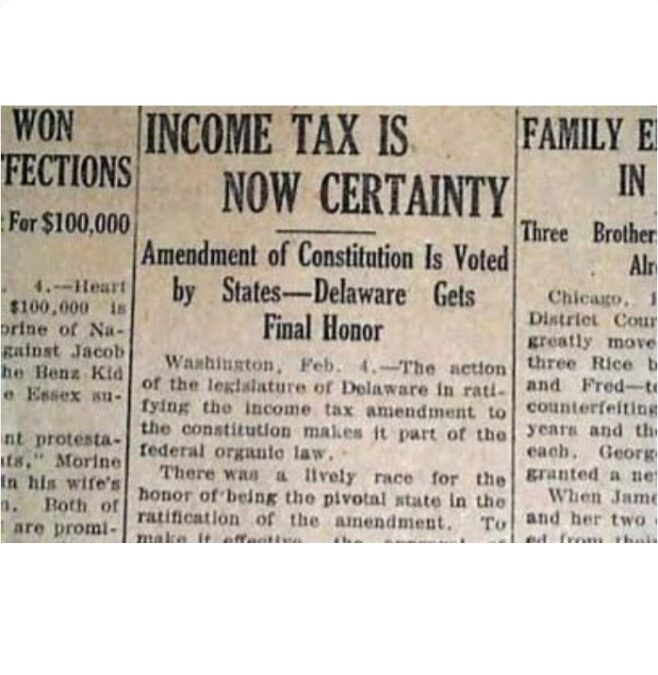
The Sixteenth Amendment, which established the federal income tax that changed taxation from indirect taxation to direct taxation of the American People, was ratified in 1913. It became the constitutional Law of the Land during President Wilson’s tenure; that much is true. However, Presidents have no formal role in the constitutional amendment process. They don’t sign amendments, nor their proposals. The amendment process requires proposal by Congress (with a two-thirds majority in both houses) or a proposal by the States (with a two-thirds majority by the States in convention) and then ratification by three-fourths of the states.
However, Woodrow Wilson did indeed sign a law related to income taxation: The Revenue Act of 1913. This act re-imposed the federal income tax after the Sixteenth Amendment removed the constitutional barriers that had prevented such a tax. The first income tax was signed into law by Abraham Lincoln: The Revenue Act of 1861. It was later updated by the Revenue Act of 1862, becoming America’s first progressive income tax. The law expired and was repealed in 1872. After the repeal, a legal challenge to it finally reached the Supreme Court in 1881, Springer v. United States, and the Supreme Court ruled the tax had been an indirect excise duty, which would make it constitutional according to the High Court. The Wilson-Gorman Tariff Act (Representative William Lyne Wilson is the “Wilson” in that one) of 1894 revived the federal income tax, and in 1895 the Pollock v. Farmers’ Loan & Trust Co. case reached the Supreme Court, and the High Court reversed its previous logic and struck down the law as unconstitutional. Congress then sought to bypass the Supreme Court entirely, which was among the reasons for the drafting and eventual ratification of the Sixteenth Amendment in 1913.
Wilson didn’t technically sign the Sixteenth Amendment itself, but he did sign the legislation that actually implemented the federal income tax under the authority granted by that amendment. I am willing to bet McDowell is not such a historian that she knew the details about The Revenue Act of 1913, and was probably referring to the Sixteenth Amendment – and her wording made it sound that way. If I am wrong about her knowledge, then forgive me, but in that case then maybe she should have been more specific by saying something like, “Wilson was President when the Income Tax became the Law of the Land, and signed the first piece of legislation following the ratification of the Sixteenth Amendment.”
— Political Pistachio Conservative News and Commentary