
By Douglas V. Gibbs
The country elected President Trump for results, with the understanding that a firm hand produces measurable outcomes. Progressive talking heads insist everything is static and binary. If you don’t love and accept someone, you must hate them. If you don’t speak only favorably about certain groups, you’re labeled racist, homophobic, Islamophobic, or assigned whatever new phobia they invent. If you refuse to appease your enemies, you’re a warmonger. If you oppose taxing the rich, you must hate the poor. If you questioned Presidents Obama or Biden, you’re an insurrectionist. If you don’t question everything President Trump does, you’re also an insurrectionist. And of course, if you act against another country, even one that has committed war crimes against the United States, you’re suddenly a warmonger guilty of war crimes yourself.
While the commie Democrats operate through partisan theatrics, President Trump and the MAGA movement operate through common sense and measurable outcomes. President Trump campaigned on prosperity and security, and central to that security has been immigration enforcement, the mass deportation of illegal aliens (targeting criminal aliens first), and stopping the onslaught of hostile international activity directed at the United States.
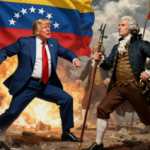
As the New Year took hold, the United States carried out a strike against Venezuela that resulted in Nicolás Maduro and his wife being captured and detained by American forces. They have been indicted in the Southern District of New York on charges including Narco‑Terrorism Conspiracy, Cocaine Importation Conspiracy, Possession of Machineguns and Destructive Devices, and Conspiracy to Possess Machineguns and Destructive Devices against the United States. According to President Donald Trump, they will soon face the full weight of American justice on American soil in American courts.
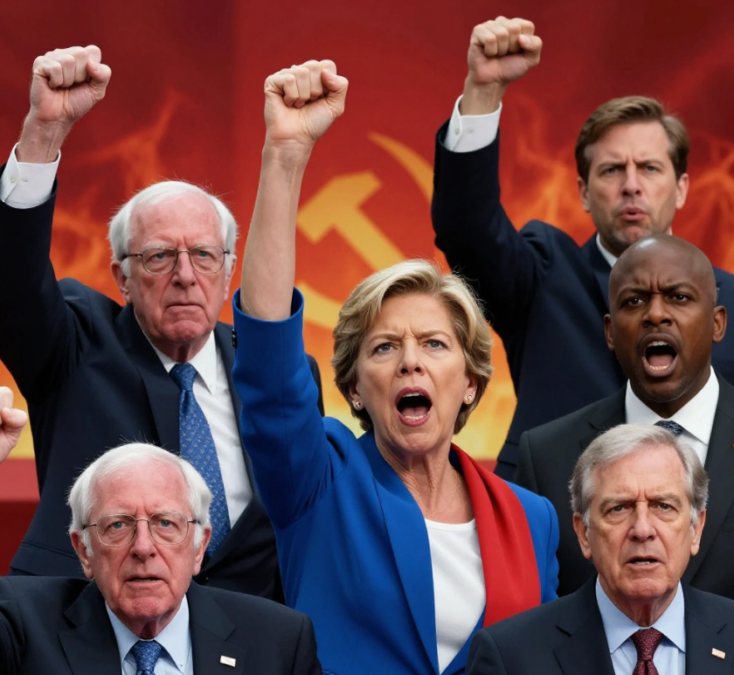
Venezuelans flooded the streets in celebration, popping bottles and singing about freedom, liberty, and a second chance. Democrats, however, still consumed by Trump Derangement Syndrome, could not bring themselves to celebrate the fall of a dictator or the end of the collapse of what was once one of the world’s great economies. Instead, they clutched their pearls and launched into a full‑blown meltdown, accusing President Trump of warmongering and claiming he violated the Constitution with his historic action.
Representative Dan Goldman (D-NY) screamed that, “Trump’s unilateral operation last night was an illegal act of war without Congress’s authorization.”
Representative Jim McGovern (D-MA) accused, “Without authorization from Congress, and with the vast majority of Americans opposed to military action, Trump just launched an unjustified, illegal strike on Venezuela.”
“President Trump’s unilateral military action to attack another country and seize Maduro, no matter how terrible a dictator he is, is unconstitutional and threatens to drag the U.S. into further conflicts in the region,” argued Senator Elizabeth Warren (D-MA).
Senator Ruben Gallego (D-AZ) also accused President Trump of illegal war activities, saying, “This war is illegal, it’s embarrassing that we went from the world cop to the world bully in less than one year.”
Except, there is nothing in the Constitution that demands the President of the United States obtains congressional approval before launching any military operation.
The common argument claiming that Congress must approve any military operation is typically pulled from Article I, Section 8: “The Congress shall have Power…To declare War.”
Waging war and declaring war are two different authorities. By establishing the President of the United States as “Commander in Chief,” the President was given the authority to wage war when he feels it is necessary. In the Articles of Confederation, the two war powers (wage war and declare war) were established as separate powers, but both were given to the Congress of the Confederation because the President did not possess executive power. He was simply the President of the Congress, serving in a legislative manner, and carrying out ceremonial duties that were mostly symbolic as head of state. But, the Founding Fathers realized that there were many flaws in that system, and that an energetic President was necessary.
It was a balancing act. They feared having a king or ruler who constantly made war, or was willing to use a standing army against the people, but they also realized that giving the President no power to operate unilaterally in certain situations was dangerous as well. The President must be able to operate without asking for permission from the legislature, yet the legislature needed to have authorities to rein in a President should he act in a manner contrary to the interests of the country.
The lesson was largely learned during the Revolutionary War. While the militias were answering to the states and the Continental Congress (and later the Confederation Congress), too many problems arose. If a particular troop movement was needed, some states refused to allow their militias to participate in an attempt to keep the men closer to the home front, and Congress would take too much time deliberating over whether or not certain troop movements were necessary or advisable. By the time decisions were made, the opportunity for surprise, or a particular strategy passed. America lost 8 of the first 11 major battles of the Revolutionary War as a result. Until George Washington was made Commander in Chief over America’s armed forces during the war, and given full authority without needing to consult with the states or Congress, the campaign for independence was doomed to be lost.
The lesson? Fear of a king was a legitimate fear, but going too far in the opposite direction was also dangerous. The Commander in Chief of the military during the war and the duties of the President of the United States needed to be similar in many ways. The President must be able to handle foreign affairs, trade, and war without being micromanaged by Congress or the court system – but, if he became tyrannical the Congress must be able to rein him in.
Congress was given the authority to declare war so that the President wasn’t sending America into wars on a continual basis, but the President was established as the Commander in Chief so that he may conduct war operations without having to get legislative approval for every move he makes. If the President becomes too warlike, then the Congress has the options to either defund the effort, or impeach a runaway President. Also, funding for the standing army must be approved every two years as per Article I, Section 8. The power of the purse strings were given to the House of Representatives in Article I, Section 7. All bills regarding revenue must originate in the House of Representatives, which was (and still is) a direct voice of the people (since representatives are directly democratically voted into office) and the Senate was assigned the task to also approve such measures as the voice of the States. In other words, the people’s representation could not interfere with the President’s operations unless the representation from the States was also on board with it, and then if the President vetoed such bills, then it would require two-thirds approval from each House of Congress to override the veto. So, the President has the authority to do what he believes is necessary, but a check is in place for Congress to interfere if necessary but it is not easy since it ultimately requires two-thirds of each House of the legislature to pass measures without the President’s approval. Or as I like to say, the founders put in place mechanisms to check the President, but they made sure mutiny was not something that could be easily accomplished.
In addition to the constitutional reality that President Trump as Commander in Chief may conduct military operations without asking permission from Congress, historical precedent is also on his side. Presidents, including Democratic Party presidents, have launched military attacks often in history. President Barack Obama went so far as killing an American citizen in Yemen under his “kill list” policy. In 1801-1805 and 1815 Presidents Thomas Jefferson and James Madison fought the Barbary Wars – both without a declaration by Congress, though Congress did provide funding for the naval operations. In 1950, President Harry Truman sent U.S. forces to repel North Korea’s invasion of South Korea without talking to Congress first. As did John F, Kennedy in 1961 with the Bay of Pigs. Lyndon B. Johns and Richard Nixon both conducted bombings in Cambodia and Laos without congressional approval. Even after Congress cut funding, bombings continued for a time. Gerald Ford’s Mayaguez Incident in 1975, where the President ordered United States Marines to rescue the crew of the SS Mayaguez from Cambodian forces, was not told to Congress until after the operation began. Jimmy Carter in 1980 attempted to rescue the American hostages in Iran with no congressional authorization. Ronald Reagan ordered the invasion of Grenada in 1983 after a Marxist coup. Congress was not consulted beforehand, and the U.N. General Assembly condemned it as a violation of international law – and Reagan reminded the world we operate under the U.S. Constitution first. International law does not supersede the Constitution. In 1986, Reagan also carried out Libya airstrikes, ordering the bombing of Tripoli and Benghazi in response to terrorist attacks. George H.W. Bush in 1989 ordered the invasion of Panama to remove Manuel Noriega, and Bill Clinton in 1995 and 1999 conducted airstrikes over Bosnia and Kosovo without congressional authorization. In the case of Kosovo, the NATO bombing campaign lasted 78 days. George W. Bush didn’t ask for Congress’ blessing when he hit Pakistan, Yemen, and Somalia following 9/11 from 2002-2008, either. Nor did Barack Obama beg for congressional approval to hit Libya in 2011, or Syria and Iraq from 2014-2016.
Why did these past presidents launch military operations without congressional approval? Because they knew that constitutionally, and based on historical precedent, they could. I am not saying that all of those campaigns were good, bad, or in between. I am simply providing that a long list of Presidents have acted as Commander in Chief without dropping to their knees before Congress for approval because they knew, and we’ve always known, that as Commander in Chief the President may (and must) be able to conduct war operations when necessary, and a declaration of war, or congressional approval, is not necessary from a constitutional point of view.
So why do we have Democratic members of Congress screaming about it now? Because the entire Democratic Party platform is “hate Trump,” and “hate what Trump does.” As Scott Baio said when he endorsed candidate Trump, “If he cured cancer, they’d be on him for putting oncologists out of business.” I seem to remember a Huffington Post article making the same accusation against Republicans regarding President Barack Obama.
In the end, President Trump’s actions in Venezuela were constitutional, and long needed. The criminal operations of the Maduro regime and basically everything that has come out of Venezuela since they abandoned the free-market and embraced socialism in 1999 has been detrimental to the world, America, and has led to the deaths of millions of Americans overall. It’s gotten so bad on the Democratic Party side, that I am not surprised they haven’t started chanting, “Death to America.”
— Political Pistachio Conservative News and Commentary