

By Douglas V. Gibbs
I spent yesterday afternoon, or at least a small portion of it, battling on the phone with a friend of mine over President Trump’s decision to hit Iran. “We needed to stop Iran’s ability to obtain nuclear weapons,” I argued. “That was supposed to be what Midnight Hammer was to take care of,” he retaliated. “Besides,” he continued, “BRICS nation ships are getting through the Strait of Hormuz.”
I don’t know if that argument is true, but it touched upon what the whole thing is about. In addition to stopping Iran’s search for nuclear weaponry, it was also designed to hit China’s blossoming global network.
Iran’s influence around the world as a leading state sponsor of terror reaches outside the Middle East. Members of the Islamic Revolutionary Guard Corps are all over the world, including the Western Hemisphere. Their presence reached into Venezuela, and upon our own shores. Iran’s adherence to an ideology that calls for mass chaos and their willingness to attack their enemies without even an afterthought made it necessary to destroy all of their offensive capabilities, and the ability to recreate the ability to be a threat. There work since Midnight Hammer proved that we needed more than a few strikes in June to take care of the problem. We thought we’d set them back years, but it turned out only to be months.
However, the whole Iran affair runs much deeper than that. Iran has been among China’s chief energy suppliers, and through Iran’s willingness to work with China it has allowed the CCP to flex its own influence in the Middle East. China’s primary oil suppliers in recent history have been Venezuela and Iran. China has built much of its economy on high-end, energy-intensive exports but they don’t domestically have the energy necessary to fuel their technology machine. Now, with Venezuela’s ships no longer bringing oil, Iran under attack and disruptions to oil tankers getting through the Strait of Hormuz, it’s causing a serious energy supply crunch for the CCP. We must be reminded that before the attack against Iran, China accounted for 80 to 90 percent of Iran’s oil sales.
President Trump believes the war with Iran will be “wrapped up soon,” but that doesn’t mean the flow of oil to China will resume. The war stopped Tehran from developing nuclear weapons and averted a nuclear holocaust by a regime that believes the road to a worldwide caliphate travels through mass worldwide chaos, but also it stopped China’s advancement on a different World War III battlefield that is being waged on other less-violent fronts.
China has also been flexing military presence around Taiwan, something it paused for a moment during the Iran strike, but has resumed since Taiwan’s agreement with the United States over an arms package. Starving Beijing of needed resources, like oil, may push the Chinese back a little, and give Taiwan a little breathing room. BRICS, however, to address my friend’s concerns, remains as a major obstacle.
The BRICS question is where economic alliances and military strategies intersect. Trump’s attack on Iran seems to also be designed to disrupt China’s growing influence through BRICS. Iran joined BRICS, but the membership has been undermined by the current conflict. The attack forces China to either defend a BRICS member, or risk appearing unreliable to other partners (and potential partners). The strategy creates a dilemma for China on the credibility front, while also making BRICS more ineffective as a collective security arrangement. China, and BRICS, are struggling with figuring out how to articulate a common response. Their bluff has been called, and the reality that they have no collective defense pact has been exposed. BRICS simply cannot coordinate any meaningful security guarantees to its members, which weakens its cohesion, and compromises Beijing’s attempt to build greater economic and diplomatic structures through BRICS. The Iran conflict has exposed the limitations of China’s BRICS strategy.
Brazil, China and Russia condemned the military attack on Iran, but other BRICS members like India maintained a more neutral position. This division demonstrates that BRICS fails to even realize what its own position is, and hinders its ability to clearly define its role on the international stage.
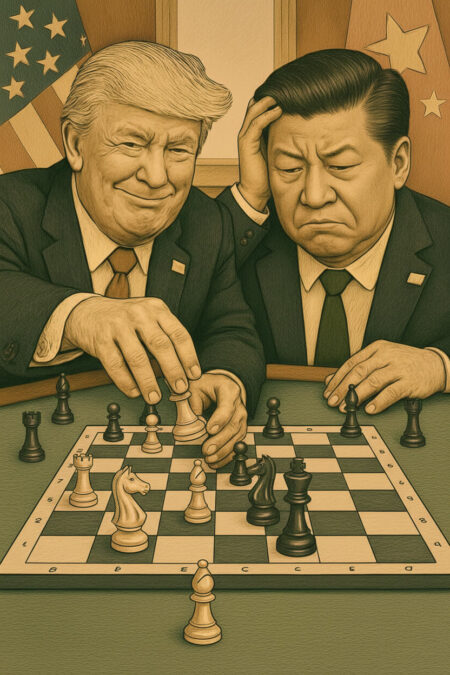
For Trump, the weakness of BRICS as a security alliance represents an opportunity. By demonstrating that membership in China-led organizations provides no real protection against U.S. military action, he undermines Beijing’s credibility and discourages other nations from deepening their ties with China. This aligns with his broader strategy of challenging China’s rise through direct confrontation rather than economic competition alone.
By targeting Iran, Trump strikes at a key node in China’s network of partnerships while also potentially disrupting China’s energy imports, as Iran supplies approximately 13% of China’s seaborne oil imports.
Ultimately, President Trump’s approach appears calculated to exploit the structural weaknesses of both Iran’s defenses and BRICS’ collective security capabilities. By initiating conflict now, he stops Iran’s march to create nuclear weapons, tests China’s commitment to its allies, and forces the U.S. foreign policy establishment to focus on the Middle East rather than Asia – a strategic distraction that ultimately serves neither American nor Chinese interests well, but reflects Trump’s willingness to use confrontational, militarized solutions when diplomatic channels collapse.
— Political Pistachio Conservative News and Commentary