

By Douglas V. Gibbs
Politics runs through everything we experience in life. Maybe not necessarily the same politics as we see in Washington D.C., but politics in general. There are always those seeking power, seeking to preserve their power, the wealthy and powerful seeking to secure their position, and those who manipulate the whole thing to get the outcome they demand. Meanwhile, the minority voice pushes back and sometimes in an attempt to quell their frustrations the system may give in a little and create a temporary fix while doing what they can to keep the deep down guts of the system intact. It’s true in Washington, it’s true at the state level, it’s true in local politics, and it’s true in college football.
Three weeks ago I wrote about how already flaws were beginning to emerge in the new college football playoff scheme. Alabama, after losing to Georgia in the conference championship, was still getting in, and other teams who were obviously not up to the challenge looked like they were getting in as well. It made the conference championship game look like it was a moot point when it came to the SEC. And, the match-ups with the schools from the minor conferences, while they should have a chance to prove their worth on the field, created match-ups everyone knew would end the way they did… with the G5 teams getting beaten up pretty badly. The system they created for this year made for a bad first round when it came to Tulane and James Madison being in the mix. I suggested at the time that perhaps the way to do it would be to just let the teams in the playoffs be the conference champs, regardless of ranking, and then have a couple at large teams. But, that too would be very flawed. It would, in fact, only exacerbate the problem.
Then, I got to thinking. The playoff controversy is not being caused by the playoff format. The problem is the regular season ecosystem that prevents Group of Five (G5) teams from proving themselves during seasonal play.
The system is built backwards.
As it stands right now, the power conferences control the money, they control the scheduling, and they control the narrative. They have no incentive to give a rising G5 team a fair shot. So when a James Madison or Tulane goes 12-1, or God forbid has an undefeated season, the critics say, “Well, they didn’t play anyone.” Or, “They don’t draw ratings.” Or, “They’ll get blown out.” And, more often than not, they are correct. But, those same critics support a system that prevents the G5 teams from playing anyone of a higher caliber during the regular season in the first place.
It’s a grand contradiction packaged and delivered by the power and big money of college football.
In other words, the problem isn’t the playoff format. The regular season is the real problem.
First of all, power conference teams have rigged the system so that they can avoid dangerous G5 opponents. A top-25 SEC or Big Ten team gains nothing by scheduling a strong G5 opponent. If they win: “Well, they should have.” If they lose: “The season is ruined.” So, they schedule FCS cupcakes, bottom-tier G5 teams, and they make sure it’s a “home-only contract,” meaning that the G5 or FCS team opponent will only be scheduled to play the Power Conference team at the Power team’s stadium with no return game at the smaller school’s stadium. By doing this the Power Schools still get the revenue of filling their stadiums, they have guaranteed TV control over the game, they keep their competitive advantage, and it eliminates the risk of losing on the road to a smaller program. A road loss to a G5 team is a resume killer, and a home win over a G5 team is resume padding. The system they’ve created protects the Power Conference teams’ playoff resumes and their revenue.
The problem is, G5 teams can’t build a resume without access. Teams like James Madison, Tulane, Liberty, Fresno State or Boise State all face the same wall: They can dominate their conference, and they can even win 10-12 games, but they can’t get two or three meaningful Power Five (P5) games to prove legitimacy. If they had those games, the playoff committee wouldn’t be guessing, or playing favorites – they’d be making their decisions about who gets into the playoffs based on solid on-the-field evidence.
The problem goes deeper than just the domination and control by the Power Conferences. The advertisers and networks want “brand value.” They want those big match-ups between the Big 10 or SEC giants. There is not as much money to be made with games like JMU vs. Oregon State, Tulane vs. Kansas State or Iowa State vs. North Texas. Not necessarily because the game would be that bad of a game, but because the brands would not draw ratings. So, the system is built to protect the brands.
Bringing me back to my original idea…
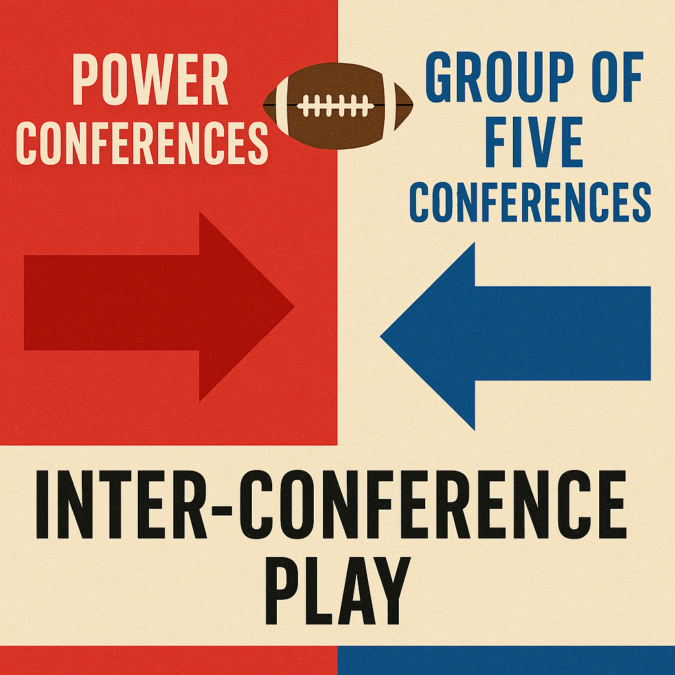
The solution is not a new playoff system, or more tweaking to the playoff format that still leaves teams out of the final twelve who believe they deserved a chance to prove their merit on the field. The solution lies in the regular season. There should be mandated cross-conference scheduling.
If every G5 conference champion contender was able to play two to three Power Conference opponents per year, the conversation at the end of the year would be entirely different. I want G5 teams to be able to prove themselves on the field of battle, so why not give them that chance during the season so that if they fail you don’t have to include them in the playoffs after the regular season has ended. But, if they pull those games off during the regular season, now it seems reasonable to give them the chance during the post-season. A tougher schedule would give the G5 teams a real resume, give the committee real data, give fans better September football, reduce the “they don’t deserve to be here” argument during the post-season, and force the big conferences to put their money where their mouth is.
And to be honest, in the end it would make college football healthier, and recruiting more competitive across the board.
If in 2025 Tulane had beaten a team like Ole Miss or Kansas State, and played a competitive game versus LSU; or if James Madison had beaten a team like Virginia Tech, played Penn State close, and upset a mid-tier SEC team, the questions about playoff spots would be resolved before the playoffs were upon us. The allowance of these G5 conference champs into the playoffs would have been more digestible. And if they had lost all of those games, there would be no reason to cry when they were denied access to the playoffs. They had their chance to prove themselves, and they didn’t pull it off. As it stands now, G5 teams are judged on conference games, perhaps one P5 opponent, and the feelings that some members of the committee might have in letting them get their chance because of how they got ranked. That’s not a fair system, and at the moment it let’s teams squeak in that may not be able to compete as hoped during the playoffs.
To make it fair, a rising G5 program needs road tests, home tests, National exposure, and real resume games. What they get is one-off road games, no return visits, no chance to host a big opponent, and no chance to build a playoff resume at home. The regular season is structurally designed to prevent G5 teams from proving themselves. Then, the power conferences sit there in their ivory towers and proclaim that the G5 teams don’t deserve a chance because they don’t play anyone. But the reality is, they won’t play them unless it’s at the Power 5 home field, on the terms of the Power Conferences, with their officials, their crowd, and their TV deal.
The root cause of the playoff controversy is not that the playoff is broken. The regular season is protecting the powerful and isolating any challengers. If college football wants fairness, they need to shake up the system at its foundation. They need to mandate cross-conference scheduling, require during the regular season that P5 teams play at least one top-tier G5 opponent, and that some of those games be played at the G5 opponent’s home stadium. Give every G5 contender two to three games versus Power teams, with at least one being a home game. This will give G5 teams a real path to legitimacy, and partly shatter the image that the most powerful and wealthiest teams and conferences are too afraid to allow any challengers any chance to get their heads above the waterline. Then, once the regular season follows what I have recommended, the playoff becomes self-correcting.
— Political Pistachio Conservative News and Commentary