

By Douglas V. Gibbs
If you watch the “man on the street” interviews circulating online, you might conclude that many Americans can’t name the three branches of government. Legislative. Executive. Judicial. It’s unfortunate when the average citizen doesn’t know this, but when an elected official doesn’t know it, the problem becomes far more serious.
These three branches exist at every level of government:
Federal Government
• Legislative: Congress (House and Senate)
• Executive: President, departments, and agencies (including the Department of Justice)
• Judicial: Federal court system
State Government
• Legislative: State legislature
• Executive: Governor, state agencies, attorney general
• Judicial: State courts
County Government
• Legislative: County governing body (Board of Supervisors, Commissioners, etc.)
• Executive: Sheriff and associated offices (Coroner, Auditor, Treasurer, Assessor, Clerk)
• Judicial: County courts
Municipal Government
• Legislative: City council
• Executive: Mayor, city manager, police chief
• Judicial: Municipal courts
The Legislative Branch creates, modifies and repeals law. The Executive Branch enforces it. The Judicial Branch applies it in the cases before it. This is middle‑school civics. Yet, many Americans can’t explain it, and, disturbingly, some officeholders can’t either.
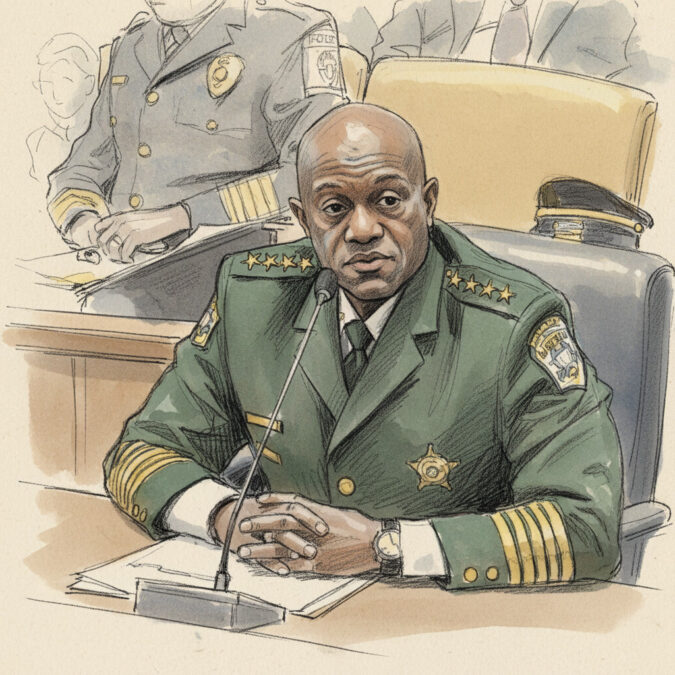
Case in point: Mecklenburg County, North Carolina Sheriff Garry McFadden. During a legislative oversight hearing into the murder of Iryna Zarutska, a Ukrainian immigrant killed last summer on the L train, State Representative Allen Chesser asked McFadden a foundational question: “What branch of government do you operate under?”
McFadden’s answers were astonishing.
First: “Mecklenburg County.”
Asked again: “The Constitution of the United States.”
Pressed further, he repeated “Mecklenburg County.”
Chesser then asked if McFadden even knew how many branches of government exist. McFadden admitted he did not.
When Chesser finally laid out the three branches and asked which one a sheriff belongs to, McFadden said, “judicial.”
He was wrong. As Chesser explained, sheriffs are part of the executive branch, whose job is to execute/enforce the law.
Chesser asked the question for a reason: McFadden has repeatedly stated his opposition to cooperating with ICE. Chesser wanted to know how McFadden reconciled that stance with his executive‑branch duty to enforce the law.
ICE is an executive‑branch agency. It enforces federal immigration law under the President.
Sheriffs, as county executives, are expected to cooperate with lawful enforcement actions from other levels of government.
But McFadden has decided he will not.
If a sheriff can refuse to assist ICE because he disagrees with immigration law, what stops him from refusing to enforce any other law he dislikes? Should he ignore stop‑sign violations? Should he watch bank robbers flee because bank robbery is a federal crime?
A sheriff who does not understand his own constitutional role, and refuses to carry out the duties of that role, is unfit for the office he holds.
The murder of Iryna Zarutska was not an isolated tragedy. The suspect, Decarlos Brown Jr., had been arrested more than a dozen times and had repeatedly passed through the custody of the Mecklenburg County Sheriff’s Office and the North Carolina prison system. Legislators argue that McFadden’s soft‑on‑crime policies allowed Brown to remain free long enough to kill.
Compounding this, McFadden has refused to cooperate with ICE detainers, a direct violation of federal law. When a sheriff knowingly releases dangerous individuals who are subject to lawful federal detainment, he is not merely expressing an opinion; he is obstructing the enforcement of the law.
A law enforcement officer who intentionally allows a crime to occur, or continue, because he personally disagrees with the law can face serious civil and criminal consequences. Federal statutes such as 42 U.S.C. § 1983 and 18 U.S.C. §§ 241 and 242 provide remedies and penalties for officials who deprive individuals of their rights under color of law.
When sheriffs refuse to assist ICE in apprehending criminal aliens, or when they stand by while protesters attack federal officers, they are enabling criminal activity through deliberate inaction.
The issue is no longer whether Sheriff McFadden understands his job. His testimony makes it clear he does not. The real question is whether an elected law enforcement officer who knowingly refuses to enforce the law should remain in office, or face consequences for the unlawful actions and inactions that have already cost innocent lives.
— Political Pistachio Conservative News and Commentary