

By Douglas V. Gibbs
The question is simple: Does the International Emergency Economic Powers Act (IEEPA), a 1977 statute, authorize a President to unilaterally impose tariffs on foreign goods during a declared national emergency. Historically and constitutionally, the IEEPA does not matter, and whether or not there is an emergency doesn’t matter.
As President, Donald J. Trump’s duty is to execute the laws of the United States and the other duties of the presidency. As Commander in Chief, national security and diplomacy are among his duties.
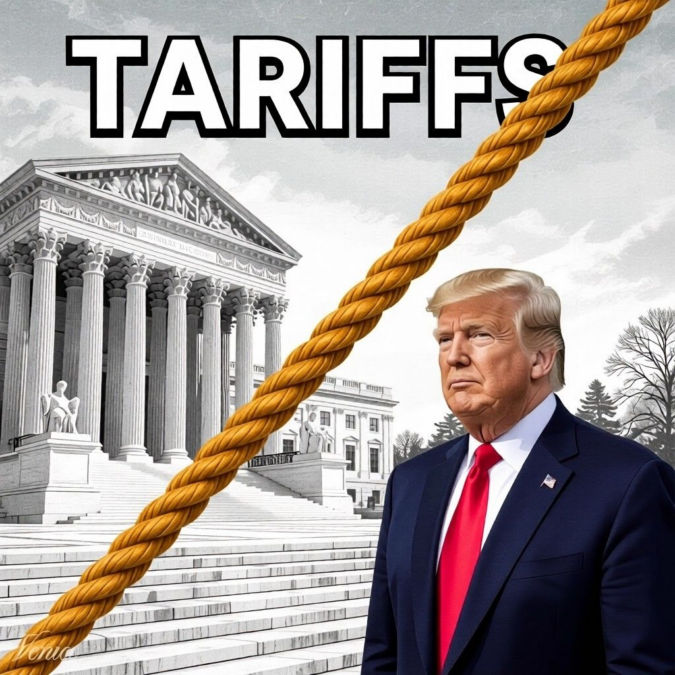
Tariffs, argues his opponents, is a tax, and according to the Constitution the taxing power belongs to Congress so it must be legislated. The opposition of President Trump in the case before the Supreme Court, Learning Resources, Inc. v. Trump (consolidated with Trump v. V.O.S. Selections), argue that Congress never delegated tariff authority through the IEEPA. Doing so would give presidents unlimited power regarding tariffs and the shaping of trade policies.
The Trump administration argues that the IEEPA’s language is broad enough to include tariff actions. National security and economic security are intertwined, according to Trump’s team. They also argue, Congress has historically repeatedly allowed presidents wide latitude in trade emergencies.
As a constitutionalist, I do not like the idea of “emergency powers,” per se. Opponents of the idea that the Constitution only grants limited authorities to government love to use the concept of emergency powers, arguing that emergencies temporarily suspend the Constitution, and to be honest, that’s just not true. Justice Amy Comey Barrett asked during oral argument, can labeling something an emergency fit the IEEPA’s verbs of “regulate,” “prohibit,” and “block?”
President Trump’s opponents argue tariffs are technically taxes, and Article I, Section 8 of the Constitution is clear that Congress must clearly authorize them, first. They argue, the Constitution does not allow executive taxation without legislative approval. A Separation of Powers provides that tariffs require clear congressional authorization. Shall Congress, then, also micromanage the President’s duties regarding foreign affairs? If he believes he needs to reshape global trade policy, and it must be done quickly, must Congress constitutionally be involved in the process?
If the Supreme Court rules against the Trump administration regarding tariffs, the U.S. owes importers $168 billion in refunds. Global markets are watching, and tariffs influence supply chains, pricing, and international relations, and while Congress could write a new law clarifying limits, would that process occur fast enough to head off calamity?
One of the arguments given by the Trump Administration during oral arguments is that, “Congress has historically repeatedly allowed president wide latitude in trade emergencies.” While I am not so sure about the “emergencies” part of that argument, the historical record reveals that long before the IEEPA, even back to the Founding Fathers, presidents repeatedly adjusted tariffs, suspended tariffs, or negotiated tariff-based agreements without prior congressional approval. Congress often ratified these arrangements after the fact, or delegated broad authority in advance, but the initial action frequently came from the executive.
All five of the Founding Father Presidents (Washington, Adams, Jefferson, Madison, and Monroe) adjusted tariffs or negotiated tariff-based agreements without Congress approving the specific tariff changes ahead of time. Later presidents did the same, revealing that the President taking the reins regarding tariffs was especially common during the 19th century. It was common for Congress to delegate broad reciprocal trade authority to the executive and presidents used diplomacy to alter tariff schedules before Congress acted. During this period Presidents raised or lowered tariffs, suspended tariffs, imposed retaliatory tariffs, and negotiated reciprocal tariff agreements, all without Congress approving each tariff change ahead of time. This was the norm, not the exception.
During the twentieth century, Presidents adjusting tariffs through diplomacy before Congress acted continued to be a normal duty of the executive. Theodore Roosevelt negotiated tariff reciprocity agreements with Cuba and several Latin American countries, often ratified by Congress after the terms were negotiated. Woodrow Wilson used executive agreements to adjust tariff treatments during World War I blockades and embargoes, never seeking congressional approval. Before the 1934 Reciprocal Trade Agreements Act (RTAA), presidents already had broad delegated authority to adjust tariffs in response to foreign actions – an authority both Herbert Hoover and Franklin Delano Roosevelt exercised a number of times. After the RTAA, presidents negotiated hundreds of tariff-reducing agreements without Congress pre-approving each one.
If one studies the Constitution, and the context of the debates, writings, and actions surrounding its establishment, we realize that the Founding Fathers recognized that while Congress sets the tariff schedules, the President conducts foreign negotiations and treaties or executive agreements that may modify tariff treatment. This dual structure means historically that presidents often acted first, or unilaterally, and Congress in response ratified the treaty later, passed implementing legislation later, or took no action allowing the executive action to stand and self-execute.
Tariffs have historically served as a central tool of foreign policy. Congress has repeatedly delegated tariff authority to the President throughout American History, which means this country has a long tradition of executive-driven tariff action, especially through negotiation. That practice accelerated since the RTAA in 1934, but it has been a continuation of a much older practice.
Presidents, including the Founders, have a long, well-established history of adjusting tariffs through diplomacy and negotiation without congressional pre-approval. This tradition predates the IEEPA by more than two centuries and reflects the constitutional design: Congress sets the framework, but the President executes foreign policy and negotiates the terms. The Trump administration should not only win the case before the United States Supreme Court, but they ought to win regardless of whether or not the IEEPA applies.
— Political Pistachio Conservative News and Commentary