
By Douglas V. Gibbs
The Supreme Court’s recent decision striking down President Trump’s use of the International Emergency Economic Powers Act (IEEPA) to impose his Liberation Day tariffs has triggered a wave of confusion, celebration, and among Trump’s opponents premature victory laps. The ruling is far narrower than the headlines suggest. Tariffs are not going away. In fact, the Court may have unintentionally strengthened the legal foundation for Trump’s broader trade strategy.
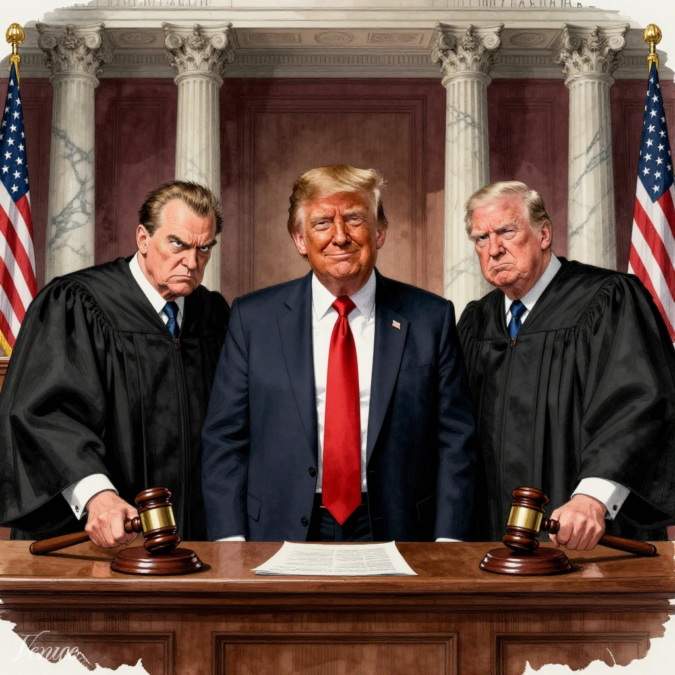
In a 6–3 decision led by Chief Justice John Roberts, the Court held that the Constitution assigns tariff authority to Congress, and that the IEEPA, which was designed for national emergencies, was never intended to give presidents unilateral power to levy taxes on imports. As the majority wrote, “Had Congress intended to convey the distinct and extraordinary power to impose tariffs, it would have done so expressly.”
The ruling emphasized that in nearly 50 years of the statute’s existence, no president has ever used the IEEPA to impose tariffs (despite the fact that there is a long list of tariffs imposed without prior permission from Congress throughout U.S. History), and that Trump’s sweeping measures represented a “transformative expansion” of executive authority. The Court applied the major questions doctrine, concluding that Congress does not delegate such sweeping economic power through vague language.
But the Court’s decision applies only to the IEEPA. It does not invalidate Trump’s tariffs themselves, nor does it prevent him from imposing new ones under other laws Congress has already enacted. Roberts’ opinion rested partly on the idea that the IEEPA is a wartime statute, and “we are not at war with every nation in the world.”
Trump retains multiple statutory avenues for imposing tariffs. These include:
- The Trade Expansion Act of 1962 (Section 232), which allows tariffs on imports that threaten national security.
- The Trade Act of 1974, which gives presidents broad authority to respond to unfair foreign trade practices.
- The Tariff Act of 1930 (Smoot-Hawley), still on the books, allowing product‑specific tariffs when imports are subsidized.
- The Fordney‑McCumber Act of 1922, largely superseded but historically relevant to presidential tariff authority.
Justice Kavanaugh’s dissent underscored this point directly: “The decision might not substantially constrain a President’s ability to order tariffs going forward… numerous other federal statutes authorize the President to impose tariffs and might justify most (if not all) of the tariffs at issue.”
Justice Clarence Thomas went further, arguing that the IEEPA itself did authorize Trump’s actions and that the majority misapplied both statutory text and constitutional history. His dissent emphasized that Congress has long delegated tariff‑related powers to the executive, especially in foreign affairs.
One major question remains unresolved: the billions of dollars in tariff revenue collected under the IEEPA framework. The Court offered no guidance on refunds, leaving the issue to the U.S. Court of International Trade. Hundreds of refund lawsuits are already pending.
Justice Kavanaugh warned the aftermath “is likely to be a mess,” with importers potentially seeking retroactive relief.
Trump called the ruling a “disgrace,” but immediately announced a backup plan. Within hours, he invoked the Trade Act of 1974 to impose a new 10 percent global tariff, signaling that the White House had anticipated this outcome.
Treasury Secretary Scott Bessent reinforced the message:
- “The Court did not rule against President Trump’s tariffs.”
- “Six justices simply ruled that IEEPA authorities cannot be used to raise even $1 of revenue.”
- “We will be leveraging Section 232 and Section 301 tariff authorities… validated through thousands of legal challenges.”
In other words, the ruling changes the legal pathway, not the policy outcome.
Even CNN’s legal analysts acknowledged that Trump can still impose sweeping tariffs under other statutes. George Washington University Law School professor and legal scholar Jonathan Turley echoed that reality, stating the administration can still impose tariffs through other statutes. “There’s plenty of runway for the Trump White House in this area of economic policy.”
Senator Bernie Moreno (R‑OH) is urging Congress to codify Trump’s tariffs through a reconciliation bill, which requires only 51 Senate votes and cannot be filibustered. But the path is uncertain. Several Republican senators oppose tariffs, and the House majority is narrow.
Still, reconciliation remains a viable option to reverse the Court’s ruling legislatively.
The stock market rose slightly after the decision, with the Dow, S&P 500, and Nasdaq all ticking upward.
The ruling may influence future uses of emergency powers, create short‑term market unpredictability, and open the door to refund litigation. But Trump and his economic team insist that trade agreements will remain stable and that tariffs will continue uninterrupted.
Trump has long called “tariff” the most beautiful word in the dictionary, echoing President William McKinley, who championed protective tariffs as a pillar of American prosperity.
As I have written before, Trump’s tariffs have been remarkably effective and constitutional. The U.S. trade deficit has fallen to nearly half of what it was when the Liberation Day tariffs were announced in March. Manufacturing is returning to American soil as companies relocate production to avoid tariff penalties. That means more jobs, higher GDP, and lower long‑term costs of doing business.
With the midterms approaching, affordability is central to voters. People vote with their wallets. Democrats know this, and their opposition to Trump’s tariff strategy reflects a political calculation as much as an economic one.
The Supreme Court did not kill tariffs. It merely closed one door while leaving several others wide open. Trump has already walked through them.
The administration is moving “full‑steam ahead,” armed with statutes Congress itself enacted.
The only thing the Court’s ruling accomplished was accelerating the pace.
Tariffs are not going anywhere. If anything, the fight has only just begun, and the ruling has made President Trump more determined to do what he needs to do to continue to Make America Great Again.
— Political Pistachio Conservative News and Commentary