

By Douglas V. Gibbs
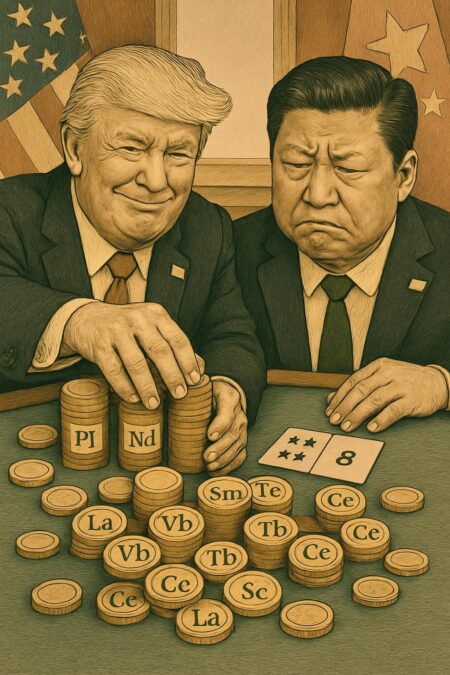
President Donald Trump has unveiled Project Vault. The plan is a $12 billion national stockpile of rare earths and critical minerals designed to reduce America’s dependence on China and stabilize prices for U.S. manufacturers. The initiative blends $1.67 billion in private capital with a $10 billion loan from the U.S. Export‑Import Bank, creating the first minerals reserve in American history built specifically for private‑sector use.
The move comes as China continues to tighten export controls on minerals essential to automotive, aerospace, energy, and defense industries. Between 2020 and 2023, roughly 70% of U.S. rare earth imports came from China. That number climbed to 80% last year. President Trump recognizes the importance of making sure the United States is not dependent upon others, especially nations who consider themselves our enemies. The U.S. once led the world in rare earth production, but environmental regulations, high costs, and the complexities of processing materials containing uranium and thorium pushed domestic production overseas.
The new reserve will function similarly to the Strategic Petroleum Reserve, but instead of oil, it will hold minerals like gallium, cobalt, and other rare earth elements used in everything from smartphones and electric vehicles to jet engines, semiconductors, wind turbines, and military systems.
More than a dozen major companies have already signed on. Three major commodities trading houses will handle procurement.
Manufacturers participating in the program will pay up‑front fees and commit to buying specific quantities of minerals at a predetermined price. In return, they must also agree to repurchase the same amount at the same price in the future; a mechanism designed to stabilize markets and prevent panic‑driven price spikes.
From a constitutional perspective, Project Vault touches on a principle the Founders understood intuitively: a free nation must control the material foundations of its own defense and industry. The Constitution grants the federal government the authority to provide for the common defense and regulate commerce with foreign nations. Those powers presuppose the ability to secure essential resources.
But the deeper constitutional logic is this: Sovereignty is impossible without economic independence.
A nation that relies on geopolitical rivals for critical minerals is a nation that has surrendered a portion of its self‑governing capacity. It becomes vulnerable not through invasion, but through supply chains. It becomes dependent not by conquest, but by commerce.
The Founders warned repeatedly about foreign entanglements that could compromise American autonomy. While they could not have foreseen rare earth elements or semiconductor supply chains, they understood the underlying principle: a republic must never place its survival in the hands of a foreign power – especially one that considers itself our enemy, like China does.
Project Vault is an attempt to restore that balance.
What makes this initiative constitutionally notable is that it does not impose mandates on private companies, nor does it attempt to nationalize industry. Instead, it creates a voluntary framework that strengthens domestic capacity while respecting the private sector’s role in production and innovation.
It is a rare example of federal action that reinforces, rather than erodes, the constitutional order:
• It protects national security without expanding federal regulatory power.
• It strengthens domestic industry without dictating industrial policy.
• It encourages private investment rather than replacing it.
• It addresses a genuine foreign‑policy vulnerability without infringing on state authority or individual liberty.
In other words, it is a federal response to a federal problem, which is exactly how the Constitution intends national power to function.
Trump’s broader strategy has been clear: revive domestic mining, expand processing capacity, and secure supply chains through alliances with nations like Australia, Japan, and Malaysia. The president has been continually pushing for additional rare earth agreements during various meetings and summits.
The geopolitical stakes are enormous. China’s dominance in rare earths is not merely an economic advantage; it is a strategic lever. When Beijing tightened export controls last year, it exposed just how dependent the United States had become.
Project Vault is designed to ensure that never happens again.
Economic security should not merely be a talking point. It is a constitutional necessity. A country that cannot supply its own critical minerals cannot guarantee its own defense, its own industry, or its own future.
Project Vault represents a decisive step toward restoring the material independence that a sovereign republic requires. It is not merely an economic initiative; it is a constitutional one. It reaffirms the principle that America must be able to stand on its own, produce on its own, and defend itself on its own.
In an era of global uncertainty, that principle is not just prudent.
It is foundational.
More than a dozen companies have already signed on to the project. China’s iron grip on critical minerals puts the U.S. in a ‘unfathomable’ national security bind. The president has ramped up his efforts to encourage at-home minerals production and processing to counter China’s actions.
The U.S. actually used to lead the world in rare earths production, but since it involves the separation and removal of uranium and thorium, it can cause radioactive waste, and there were strong concerns around environmental impacts and cost.
Under Trump, the U.S. government has invested directly in domestic minerals companies to boost production, and signed rare earth deals with other countries like Australia, Japan, and Malaysia.
— Political Pistachio Conservative News and Commentary