
By Douglas V. Gibbs
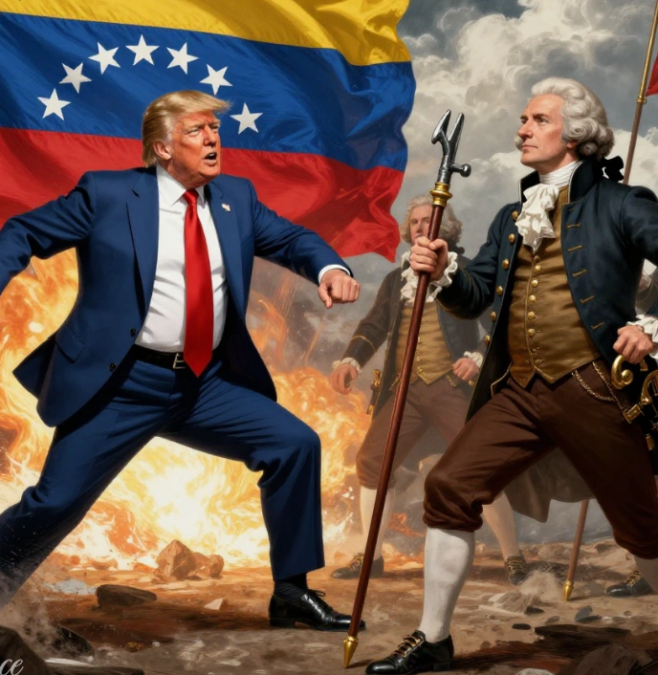
American History offers a number of moments when prolonged provocation, lawlessness, and international contempt forced a President of the United States to choose between endless negotiation, endless harm to America, or decisive action. Two centuries ago President Thomas Jefferson’s bold decision to confront the Barbary pirates after years of failed diplomacy and maritime predation has been echoed by President Donald Trump’s strike and capture of Venezuela’s Nicolás Maduro.
When Thomas Jefferson entered office in 1801, he recognized that the United States had endured decades of harassment from the Barbary States. During the two previous administrations Muslim pirate regimes along the North African coast demanded tribute, seized American ships, and enslaved U.S. sailors. President Washington’s and Adams’ administrations attempted to buy peace through payments and negotiation, but the problem only grew. The young republic faced a stark choice: continue paying for temporary calm or assert its sovereignty through force.
Jefferson chose the latter, rejecting the cycle of tribute and humiliation and dispatching the U.S. Navy and Marines to the Mediterranean, initiating the First Barbary War. His decision marked one of the earliest and clearest demonstrations that the United States would not tolerate lawless actors who preyed upon American citizens or defied international norms. Jefferson’s action was not merely military; it was constitutional, strategic, and symbolic. It signaled that American patience had limits and that the republic would defend its interests when diplomacy failed.
As I read the news this morning about the move against Venezuela that resulted in the capture of Venezuelan President Nicolás Maduro I recognized the historical parallel. For years, Maduro’s regime had been accused by international observers of corruption, human‑rights abuses, narcotrafficking, and the destabilization of an entire region. Diplomatic pressure, sanctions, and multilateral negotiations had repeatedly failed to curb the crisis or protect civilians. In this view, Trump’s action represented a modern application of the Jeffersonian principle: when a hostile actor repeatedly violates international norms, threatens regional stability, endangers the safety of Americans, and disregards every diplomatic avenue, the Commander in Chief of the United States may choose decisive action to restore order and uphold the rule of law. Just as Jefferson refused to allow piracy to become a permanent cost of doing business on the high seas, Trump refused to allow Maduro’s regime to remain an entrenched source of chaos and suffering.
On Fox News’ Fox and Friends Weekend show this morning, President Donald Trump called in and indicated that the operation to hit Venezuela, strike Maduro’s fortress, and capture the criminal president of Venezuela was supposed to happen four days ago, but weather pushed it to this morning. President Trump called Venezuela’s negative effect on America, largely due to the drug trade and human trafficking coming out of that country, war. “It’s a war. We’re losing 300,000 people a year,” said President Trump. They were run by a dictatorship, and “tremendous numbers of people were being killed through drugs and what they did to our country is sending prisoners and mental people – people from mental institutions, and, uh, drug lords and everything. They sent them by the hundreds of thousands of people into our country and that is just unforgivable. That’s why, you know, he wanted to negotiate at the end and I didn’t want to negotiate and I said ‘Nope.’ We gotta do it. You know, he was trying to negotiate at the end, you probably saw that – and – uh, trying hard to make a deal. And I said, and you know, this could have been a very foolish thing if it didn’t work out, but I said ‘nope, we can’t do it.’ What he did with drugs is bad, what he did with a lot of other things is bad, but what he did was sending hundreds of thousands of Tren de Aragua and drug dealers and they emptied out their jails into our country, they emptied out, if you think about it, they emptied out all of their mental institutions into our country. What he did there, and every other thing, is unforgiveable.”
What is important to note, is President Trump echoed Jefferson’s initial patience. Jefferson negotiated until negotiation became a trap. Trump was facing a similar impasse. Jefferson’s naval campaign broke a cycle of extortion, and Trump’s strike broke a cycle of impunity. Jefferson’s decision helped establish the United States as a country unwilling to be bullied. Trump’s approach has been a parallel assertion of American strength and resolve in the modern era.
Both presidents confronted long-standing crises that outlived diplomacy. Jefferson’s confrontation with the Barbary pirates helped define the early republic’s posture toward international lawlessness. Trump’s action toward Maduro fits within that same tradition: a moment when the United States, after exhausting peaceful options, acted decisively to protect regional stability and uphold principles larger than any single administration.
The likely eventual successors to the ousted authoritarian Venezuelan dictator Nicolás Maduro are likely 2025 Nobel Peace Prize winner and opposition leaders María Corina Machado and Edmundo González. The United States recognized González as the legitimate leader of Venezuela after he soundly defeated Maduro by a more than two-to-one margin in the 2024 election. González replaced Machado after she was banned from running for the presidency by the Maduro-run high court. Maduro ignored the results.
— Political Pistachio Conservative News and Commentary