

By Douglas V. Gibbs
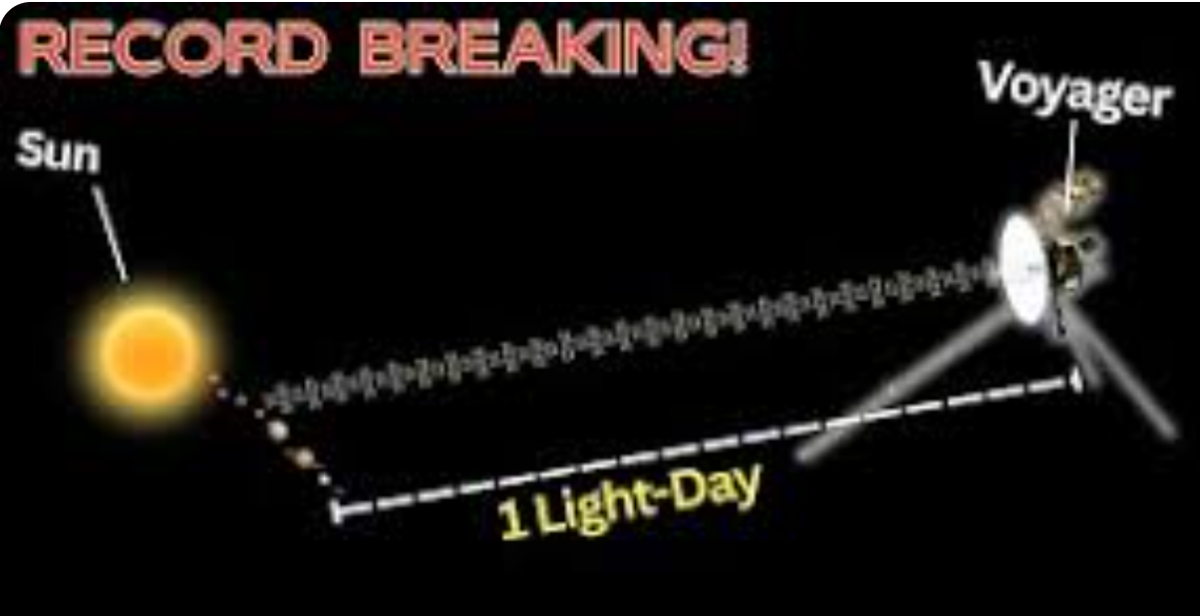
In the cold, silent dark beyond the reach of our Sun, a little spacecraft from the 1970s is doing something no human-made object has ever done. NASA’s Voyager 1, built in the age of rotary phones, disco and classic science fiction novels has now reached a distance once reserved for dreamers… one full light‑day from Earth. And somehow, unbelievably, it’s still working.
Voyager 1 launched in 1977 as a quick scout of the outer planets. Engineers expected a few years of service; just long enough to snap some photos, gather some data, and pave the way for more advanced missions. Nobody imagined it would survive the brutal vacuum of space for nearly half a century.
Yet here it is, almost 50 years later, still moving, still measuring, still teaching us.
Today, Voyager 1 is 15.9 billion miles (25.6 billion km) from Earth, farther than any human creation has ever traveled. It has left the Sun’s protective bubble entirely. Behind it lies the solar system; ahead of it lies nothing but raw, untouched interstellar space.
Distance makes communication more challenging. Radio waves can travel no faster than the speed of light, so communicating with Voyager 1 has become an exercise in patience and precision. The current delay from Earth is 23 hours and 32 minutes to reach the spacecraft. By November 2026: That delay will stretch to a full 24 hours.
That means every command sent to Voyager 1 takes nearly two days to confirm: one day to get there, one day for the “message received” to come back. In an age of instant everything, Voyager forces us to slow down and marvel.
But, despite its age and limited technology, Voyager 1 is still discovering. Voyager 1 is not drifting aimlessly. It is humanity’s only active scout in the space between the stars, and it’s sending home data we’ve never had before.
Here’s what it’s measuring out there:
1. The Galaxy’s “Weather”: Inside the solar system, the Sun shields us from much of the galaxy’s harsh environment. Voyager 1 is now outside that shield, sampling interstellar plasma – a cold, dense, charged gas unlike anything near Earth.
2. Pure Cosmic Rays: These high‑energy particles come from distant exploding stars. Without the Sun’s protection, Voyager can measure them in their raw, unfiltered form.
3. The Milky Way’s Magnetic Skeleton: Using a magnetometer, Voyager 1 “feels” the galaxy’s magnetic fields, helping scientists map the invisible structure that shapes our cosmic neighborhood.
4. The True Shape of the Sun’s Bubble: By looking back toward the solar system, Voyager is helping us understand the real boundaries of the Sun’s influence; something we could never see from the inside.
The Golden Record is also a part of the traveling craft, serving in a sense as humanity’s handshake to the cosmos. Bolted to its side, the Golden Record, a 12‑inch gold‑plated copper disc contains:
- Greetings in dozens of languages
- Music from around the world
- Natural sounds of Earth
- A curated snapshot of human life
It is, in a sense, our cosmic message in a bottle drifting into eternity, waiting for someone, somewhere, to find it.
The spacecraft when it comes to its operations and communication with Earth was never meant to last decades, yet it continues to function thanks to remarkable engineering and careful power management. Voyager 1 runs on plutonium-based generators that now produce only about 4 watts of electricity, which is less than an LED night‑light. To keep the mission alive, engineers have shut down every nonessential system, preserving just enough power to maintain contact.
It’s a fragile connection, but it’s still there.
Voyager 1 will continue traveling indefinitely, but its ability to talk to us is limited by power. Most experts believe that by the early 2030s, it won’t have enough energy left to run even a single instrument or send a radio signal home.
When that day comes, Voyager 1 will fall silent.
But it will not stop.
It will keep moving through the galaxy… a quiet ambassador, carrying humanity’s story across the stars long after we can no longer hear its voice.
— Political Pistachio Conservative News and Commentary