
By Douglas V. Gibbs
If the Democrats had been in charge, the United States would have lost the Revolutionary War.
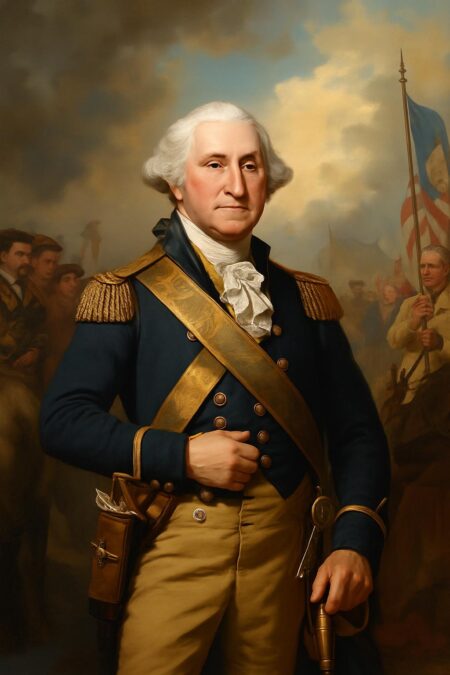
The early years of the Revolutionary War offer one of the clearest historical case studies in the dangers of fragmented military authority. General George Washington, appointed Commander in Chief in 1775, entered the conflict with a mandate that was impressive in title but sharply limited in practice. The political culture of the time, deeply suspicious of centralized power, produced a system in which Congress and the individual states routinely interfered with military operations. The result was a Continental Army hamstrung by political micromanagement, administrative chaos, and structural weaknesses that nearly cost the revolution its survival.
The Continental Congress did not initially conceive of the Continental Army as a unified national force. Instead, it viewed the army as a temporary coalition of state militias, each jealously guarding its autonomy. This mindset produced several crippling constraints on Washington’s ability to wage war effectively:
- Short-term enlistments, typically one year, ensured that just as soldiers became seasoned, their terms expired. Washington was forced into a perpetual cycle of rebuilding his army, losing cohesion, experience, and institutional memory. His repeated pleas for longer enlistments were dismissed for fear of creating a “standing army.”
- Political appointments of officers undermined merit-based leadership. Congress insisted on filling general officer positions according to state quotas and political considerations that disregarded merit. Washington often found himself saddled with unreliable or incompetent commanders while being unable to promote proven leaders from within his ranks.
- The requisition system for supplies left the army chronically underfed, underclothed, and undersupplied. Congress could only request provisions from the states, which frequently ignored or delayed those requests. Washington had no authority to compel compliance, even as his men starved at Valley Forge and Morristown.
- Congress’s inability to tax forced reliance on printed money and loans, fueling inflation and leaving soldiers unpaid. Mutinies became a real threat, and Washington lacked the financial tools to stabilize his force.
- Direct interference in strategic decisions further eroded Washington’s authority. Congressional committees, especially the Board of War, routinely second‑guessed his deployments and attempted to dictate battlefield priorities.
These structural flaws came to a head in the pivotal campaign of 1777.
The most damaging instance of congressional interference occurred during the British campaign that ultimately captured Philadelphia. The Board of War, dominated by Washington’s political critics, developed its own strategic plan that contradicted Washington’s professional judgment.
Washington understood that the Continental Army itself was the indispensable asset of the revolution. His strategy emphasized:
- Maintaining mobility
- Preserving the army’s strength
- Forcing the British to fight on ground of his choosing
- Avoiding fixed defenses that risked encirclement or destruction
He repeatedly warned that defending Philadelphia at all costs would tether the army to static positions and invite disaster.
Congress, under immense pressure to protect the capital and tainted by their own ideological political leanings and the influence of outside powerful voices, insisted on a geographically fixed defense. The Board of War demanded that Washington position his forces to block every conceivable British route to Philadelphia. This political directive forced Washington into defensive postures he believed were strategically unsound.
The consequences were immediate and severe:
- At Brandywine, Washington was compelled to defend a line chosen for political reasons rather than tactical advantage. The British flanked him, routed his army, and opened the road to Philadelphia.
- At Germantown, Washington launched a complex counterattack in a desperate attempt to retake the city. The plan failed, and the defeat compounded the political humiliation of losing the capital.
Both battles were fought on terms dictated not by military necessity but by congressional insistence on defending a symbolic location.
The string of early defeats, eight losses in the first eleven major engagements, combined with the near‑collapse of the army in late 1776 and early 1777, forced Congress to confront the consequences of its interference. Washington’s bold victories at Trenton and Princeton, achieved when he acted without congressional micromanagement, demonstrated the effectiveness of decisive, unified command.
Gradually, Congress began to change course:
- Longer enlistments were approved, allowing the creation of a more professional standing force.
- The Board of War was reorganized, and in 1781 Congress created the office of Secretary at War to centralize administrative authority.
- Congress increasingly deferred to Washington on officer appointments, operational strategy, and battlefield decisions.
- Washington’s leadership at Valley Forge, especially the training reforms implemented by Baron von Steuben, solidified congressional trust in his judgment.
This evolution, from a politically hampered command structure to one granting Washington greater autonomy, was essential to the eventual American victory. It enabled the Continental Army to mature into a disciplined fighting force capable of executing complex, long-term strategies, culminating in the decisive Yorktown campaign of 1781.
The Revolutionary War demonstrates that while civilian oversight of the military is essential, excessive political interference in operational command can be catastrophic. Washington’s experience shows that a commander must have sufficient authority to execute strategy, maintain discipline, and preserve the fighting force – especially during moments of national crisis.
The Founders learned this lesson through hardship. Their eventual trust in Washington’s judgment helped secure American independence, and led to the language in the United States Constitution naming the President of the United States the Commander in Chief over America’s military forces. The balance they sought, civilian control without operational micromanagement, remains a foundational principle of American war powers to this day.
Yet, history’s most urgent lessons are often the first to be forgotten by those who refuse to learn. Today, we see a revival of the same congressional arrogance and strategic ignorance that nearly doomed the revolution in 1777. Spurred by ideological opposition to the President and fueled by a media-driven panic, a coalition in Congress is demanding a new War Powers Act to shackle the modern Commander in Chief. Their grievance? They were not consulted in advance about the necessary and successful military operations targeting the narco-terrorist regime of Nicolás Maduro in Venezuela or the decisive joint strike with Israel against Iranian aggression.
This is not principled oversight; it is a dangerous attempt to re-impose the failed model of legislative command. The proponents of this new restriction would have the United States military operate under the same paralyzing conditions that hamstrung Washington at Brandywine. They demand that critical, time-sensitive strikes be subjected to the same political horse-trading and state quota considerations that once promoted incompetent generals and starved Continental soldiers. They seek to replace the decisive judgment of a single Commander in Chief with the chaotic, committee-driven “strategy” that lost Philadelphia.
The modern world does not wait for a congressional committee to debate. A missile launch from Tehran or a terrorist plot hatched in Caracas demands a response measured in minutes, not months. To tie the President’s hands in such moments is not to uphold the Constitution; it is to invite disaster. It is to willingly trade American security for political theater, to sacrifice strategic surprise on the altar of legislative grievance.
The lesson of the Revolutionary War was not that civilian control is optional, but that operational micromanagement is suicidal. The Founders gave the President the mantle of Commander in Chief precisely to prevent a repeat of 1777’s catastrophic folly. Congress’s current push to restrict that authority is a declaration that they have learned nothing from the sacrifice at Valley Forge or the victory at Yorktown. It is an attempt to win political points by ensuring that when the next crisis arrives, America will be led not by a decisive commander, but by a bickering committee…a recipe for defeat that George Washington would find tragically, and dangerously, familiar.
— Political Pistachio Conservative News and Commentary