
By Douglas V. Gibbs
Once the United States achieved independence, one of the consequences was that American shipping lost British protection. Presidents George Washington and John Adams paid about $1.25 million in tribute money (protection tax from Muslim harassment) to the Barbary States, nearly a fifth of the U.S. annual budget, by the end of the eighteenth century. Both presidents preferred appeasement and payment of the tribute in the hope of protecting American shipping from piracy rather than military confrontation, but their attempts to avoid war simply led to broken treaties and additional monies paid as ransom for American captives – often sailors of the American ships captured who were then enslaved by the Muslims. While President Washington signed the Naval Act of 1794 authorizing a navy to counter threats directly, and signed treaties, the attacks continued. President Adams’ attempt to appease the Islamic maritime predators concluded with a 1799 treaty with Tripoli where he provided $18,000 in additional payments and denied in writing America’s Christian foundation in the hopes of satisfying the anti-Christian “Musselmen.”
By the time President Thomas Jefferson achieved the presidency, the failures of the previous presidents had led to a very expensive situation that had done nothing but delay conflict. President Thomas Jefferson determined that a weak position against Muslim military forces taking advantage of America, and crippling America’s foreign trade efforts, posed a threat to American interests and the lives of Americans on the high seas. Unwilling to give in to the Islamic states of North Africa and the Middle East, he sent the United States Navy and the United States Marine Corps to the Mediterranean Sea to resolve the issue.
President Thomas Jefferson believed that the best way to handle it was to hit the Barbary States with a hard “shock and awe” style campaign. His decision was a deliberate and radical departure from the policy of appeasement practiced by his predecessors. Jefferson loathed the policies of the previous administrations believing that appeasement and paying a tribute only emboldened the enemy and was fundamentally incompatible with American sovereignty and honor.
Jefferson believed that bowing to extortion made a nation weak. He famously stated, “The taste of being forever humbled before an enemy is not a pleasant one.” He argued that the millions paid in tribute over the years could have funded a permanent navy capable of ending the threat for good. He believed a republic, unlike the monarchies of Europe, could not and should not engage in such debasing practices. It was a matter of national character. Jefferson’s vision was that true, lasting peace was not purchased but secured through credible military strength. He was willing to incur the short-term costs of war to establish a long-term principle: the United States would not be bullied.
When Jefferson took office in 1801, the Pasha of Tripoli, Yussif Karamanli, sensing a change in administration, demanded a larger tribute. When Jefferson refused, the Pasha declared war by chopping down the flagpole at the U.S. consulate. Jefferson was ready.
His response had all the hallmarks of a shock and awe campaign, designed to overwhelm the enemy with a sudden, decisive, and unexpected application of force.
Instead of sending diplomats with money, Jefferson dispatched a naval squadron; the very thing his predecessors had avoided. He sent Commodore Richard Dale with three frigates (the President, Philadelphia, and Essex) and a schooner (Enterprise) across the Atlantic. This was a monumental logistical undertaking for the young U.S. Navy and a stunning message.
The American ships immediately established a blockade of the Barbary coast. In August 1801, the USS Enterprise, a much smaller vessel, engaged and soundly defeated the Tripolitan corsair Tripoli in a one-sided battle. This was a powerful psychological blow, demonstrating that American naval technology and skill were superior.
The war continued for four years, longer than Jefferson had hoped, but he realized it was necessary in order to destroy the offensive abilities of the enemy. The U.S. Navy relentlessly bombarded the fortified cities of Tripoli, Algiers, and Tunis. They captured enemy vessels and supported local allies against the Pasha.
Then came the ultimate “Shock and Awe” moment – the Derna Operation. This is the clearest example of shock and awe among Jefferson’s military operations. In 1805, Jefferson authorized a land operation. A force of about 500 U.S. Marines and mercenaries (led by William Eaton and Marine First Lieutenant Presley O’Bannon) marched 500 miles across the desert from Egypt to surprise the port of Derna.
On April 27, 1805, in conjunction with naval gunfire from the USS Argus, Nautilus, and Hornet, this force launched a coordinated assault and captured the city of Derna. It was the first time the American flag was raised in victory on foreign soil. The sheer audacity of a cross-desert march and a successful amphibious-assault-style attack was a profound shock to the Barbary leaders.
Jefferson’s strategy was a deliberate use of overwhelming and unexpected force to achieve a psychological and strategic break from the past. It was designed to shock the Barbary States out of their assumption that the U.S. was a weak, easy target and to awe them with American resolve and capability.
The First Barbary War did not end the threat entirely, but it fundamentally altered the dynamic. The United States proved it would fight for its principles and its commerce. It established a precedent of using the navy to protect national interests abroad that would define American foreign policy for the next two centuries. Jefferson’s decision was a rejection of the old-world diplomacy of appeasement and the birth of a new American doctrine of projecting power to defend its sovereignty.
While Jefferson’s war had demonstrated American resolve, it did not completely end the Barbary threat. The situation reignited during James Madison’s presidency when the Dey of Algiers, exploiting the United States’ preoccupation with the War of 1812, seized American ships and resumed the practice of holding crews for ransom. Unlike his predecessors, Madison now commanded a more seasoned and powerful U.S. Navy, hardened by its victories against the Royal Navy. Unwilling to return to the discredited policy of tribute, Madison dispatched a formidable two-squadron naval force under the command of Commodores Stephen Decatur and William Bainbridge to decisively end the Algerian aggression.
The resulting Second Barbary War of 1815 was a swift and overwhelming campaign, another textbook example of “shock and awe.” Decatur’s squadron arrived off Algiers and, in a stunning display of naval power, captured the flagship of the Algerian fleet, the Mashouda, and forced another Algerian warship, the Estedio, to surrender. This immediate and crushing military success left the Dey of Algiers with no choice but to capitulate. On June 30, 1815, he signed a treaty that not only released all American prisoners without payment but also permanently renounced the practice of tribute or any future payments from the United States. The campaign was so effective that Decatur’s squadron then sailed to Tunis and Tripoli, where they quickly secured similar treaties, compelling them to abandon their demands for tribute and release any European prisoners they held.
Madison’s decisive action effectively ended the two-century-old practice of state-sponsored piracy by the Barbary States. The war was short, lasting only a few months, and achieved all of its objectives with minimal American casualties. It cemented a new American foreign policy doctrine: that the nation would defend its commerce and its citizens with force rather than appeasement. By demonstrating that the U.S. Navy could project overwhelming power at will, Madison finished the job Jefferson had started, ensuring American ships could sail the Mediterranean in peace and establishing the United States as a rising power that would not be extorted.
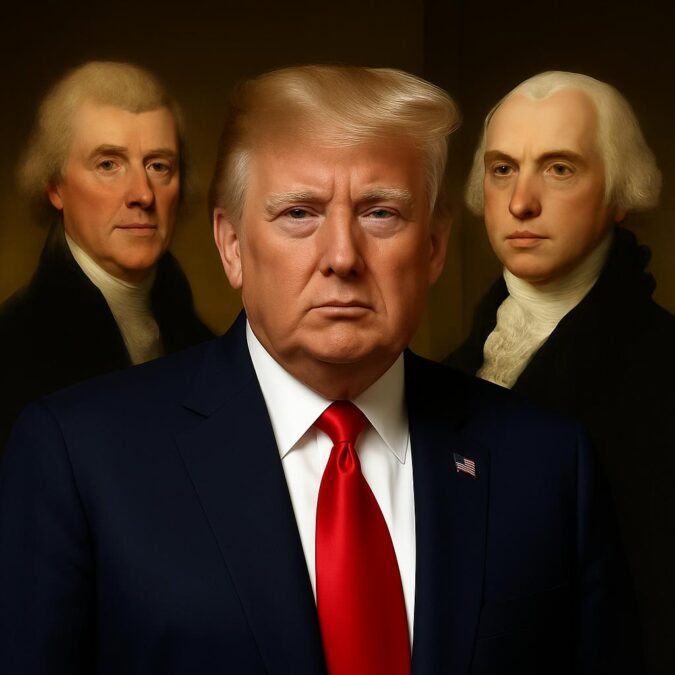
Operations Midnight Hammer and Epic Fury are President Trump’s modern Barbary War, with the American President using the same kind of “shock and awe” that Presidents Jefferson and Madison used a little over two hundred years ago. Past presidents have appeased, and given money, to Islamic powers like Iran in the past, and Donald Trump said, “No more.” Now, as the 2026 version of what two of our Founding Father presidents accomplished approaches its most violent stages, and is approaching its completion, certain realities have emerged. The once believed Iranian supreme leader is dead, the Islamic Revolutionary Guard Corps (IRGC) has been weakened almost to the point of impotency, Middle Eastern neighbors are turning against Iran as the country lashes out, and as the American and Israeli bombs drop on Iran the country’s citizens are dancing in the streets with glee. Meanwhile, China is flummoxed, Russia has been exposed as a secret puppeteer behind Iran’s madness, and Trump’s numbers are rising faster than Iranian leaders are falling – and in fact Trump’s favorability numbers according to polls are higher than any previous president ever. The demoralized remnants of the regime which includes Khameinei’s son are trying to keep everything afloat, but their previous government structure and internal communications are all in disarray.
Iran’s decision to launch missiles against its neighbors has been disastrous. Iran hoped it would unify the region against Israel and the United States, but instead a coalition is forming against Iran. The Abraham Accords, under stress since the Hamas attack on Israel on October 7, 2023, have not only held, but have solidified in ways Iran never expected. Meanwhile, Iran’s terrorist proxies have been remarkably inactive, with only Hezbollah firing some rockets of which have been met with a powerful Israeli response.
President Trump is handling the Middle East in a manner considered impossible by the experts, and is accomplishing something not achieved since the Barbary Wars.
The big difference between the Barbary Wars and Trump’s crusade is the “regime change” idea that once Iran’s regime is removed, America must rebuild it. In Iraq and Afghanistan, the “Pottery Barn Rule” (you break it, you buy it) dictate failed miserably. In Venezuela, Trump didn’t change the regime – he just convinced the new leaders to play nice or they will receive the same kind of end as Maduro. Iran, it looks like, may be treated the same – with one change. Trump plans to make sure that no matter who’s in charge in Iran after this is all over, they won’t have a military to do anything with any foul plans they may be mustering in their minds.
Along the way, the Space Force, which the Democrats once ridiculed, has played a crucial role in Operation Epic Fury. They deployed heat-seeking infrared beams that detect missiles upon launch, giving American forces time to neutralize them before they become a danger. Space Force has played a vital role in guiding and protecting air and naval operations, tracking enemy missile locations and determining for the U.S. Military when and where to strike using infrared sensors on satellites.
Other new technologies have also assisted in saving America tons of money. The U.S. Navy has allegedly been using a new High-Energy Laser with Integrated Optical Dazzler and Surveillance (HELIOS) system that can concentrate an intense, tightly focused beam of energy to eliminate flying drones without spending millions on missiles to eliminate them. While the U.S. and Israeli militaries are neither confirming nor denying the use of the lasers, the precision strikes made possible by new technologies reveal that the lasers are likely in use. The use of these technologies have changed warfare for the better, for sure, allowing the U.S. to avoid deploying ground troops and resulting in only seven casualties at this point.
President Trump, so far, has run Operation Epic Fury like he runs construction projects: under budget and ahead of schedule. The President recently told CBS News that this operation is nearly a wrap. If Iran doesn’t unconditionally surrender, and the IRGC continues to threaten shipping in the Hormuz Strait, however, President Trump has warned the assaults will intensify.
President Trump said, “If Iran does anything to [block the strait], they’ll get hit at a much, much harder level…” adding the United States is not targeting Iran’s energy-production infrastructure to avoid economically crippling the nation when the conflict is over. “We’re not looking to do that if we don’t have to. We are waiting to see what happens before we hit them.”
Trump posted on Truth Social: “If Iran does anything that stops the flow of Oil within the Strait of Hormuz, they will be hit by the United States of America TWENTY TIMES HARDER than they have been hit thus far.”
Among the world’s most critical maritime shipping chokepoints, the 100-mile-long Hormuz Strait is where 20 percent of the world’s oil is exported from the Persian Gulf.
Since the United States and Israel launched their Feb. 28 attack on Iran, traffic through the strait (which at its narrowest points traces Iran’s coast) has come to a near standstill with up to 250 ships, including around 150 oil tankers, stacked in the Arabian Sea.
While gasoline prices in the United States, after dropping steadily over the last year, has jumped significantly during the war, President Trump says the war will end “very soon,” and with that end of the conflict the oil prices will drop, as well.
Either they are ignorant of history, hate Trump beyond their ability to reason, or both – naturally, the Democrats are against President Trump’s actions against Iran. The Iranian regime, after all, has backed an estimated 1,000 major terror attacks, and their fingerprints are on the deaths of over 600 American service members in Iraq between 2003 and 2011. Iran supplied weapons, including explosively formed penetrators, to Iraq. Since that war, from 2019 to present, Iranian-backed militias have launched more than 180 rocket, missile and drone attacks on U.S. troops in Iraq, Syria, and Jordan. In Afghanistan, Iranian armed Taliban attackers also killed and wounded American troops. In short, Iran has been bankrolling worldwide Islamic terror on an industrial scale, killing thousands of American lives along the way.
Of course there was risk involved in attacking Iran, but with the specter of a nuclear-armed Iran on the horizon, and the breakdown of diplomacy with the regime as they basically declared they would cause chaos no matter the cost, the move was necessary. During the conflict, while Europe stays out of it, with their lefties crying almost as loudly as the Democrats, the only true ally in the effort has been Israel – which of course has been drawing distorted criticism from a left-leaning population smoldering with the early embers of anti-Semitism, and a crowd of not-so-left-leaning folks that have also fallen for anti-Israel propaganda largely spread by Islamic and progressive sources. To be honest, regardless of how important this effort means to the protection of Israel, since coming to power in 1979 the number of Americans killed by the Islamic Revolutionary government of Iran is a far greater number than that of Israelis. And because of Israel’s assistance, the boots on the ground that are involved in Operation Epic Fury are those of Israel, not the United States. And, of course Israel is on board, and maybe even running much of the logistics and heavy labor of the operation. They’ve been surrounded by Islamic neighbors who have constantly called for the genocide of the Jews since their rebirth in 1948 as the Nation of Israel. And don’t forget that Iran’s leadership has vowed, if they were to develop nuclear weapons, to destroy Israel with just a single bomb. Israel is involved with us, and they are our ally in bringing down Iran, and it makes sense because taking down the Iranian regime is not only good for the more than 90 million people in Iran, but also for the over 10 million who live in Israel.
— Political Pistachio Conservative News and Commentary