
By Douglas V. Gibbs
In 1812 the term “Gerrymander” originated when Massachusetts Governor Elbridge Gerry approved a redistricting plan to favor his political allies by manipulating district boundaries. Newspapers, critical of the practice, quipped that the new boundaries of one district resembled that of a salamander. A political cartoon depicted the contorted district as a “Gerry-mander” (with a hard “g” – it’s pronounced Gary-Mander), combining the governor’s name with the amphibian shape. Gerrymandering had actually been around since the founding of the country, albeit as an unnamed practice, with evidence reaching back into the first decades of the United States’ system under the Constitution of the United States in Virginia, North Carolina and South Carolina.
In 1788 the Anti-Federalists in Virginia drew congressional maps forcing federalist (federalist based on support of Federalism, not a member of the Federalist Party) James Madison to run against Anti-Federalist James Monroe in the same district hoping to keep Madison out of Congress. Madison won, anyway. A few decades later, Monroe became a staunch ally of Madison.
Gerrymandering intensified after the Apportionment Act of 1842 which mandated single-member districts, making gerrymandering a key tool in electoral politics. Since the very start, gerrymandering has been a key tool that has especially flourished during periods of extreme partisanship to establish both a partisan advantage, and in some cases racial discrimination.
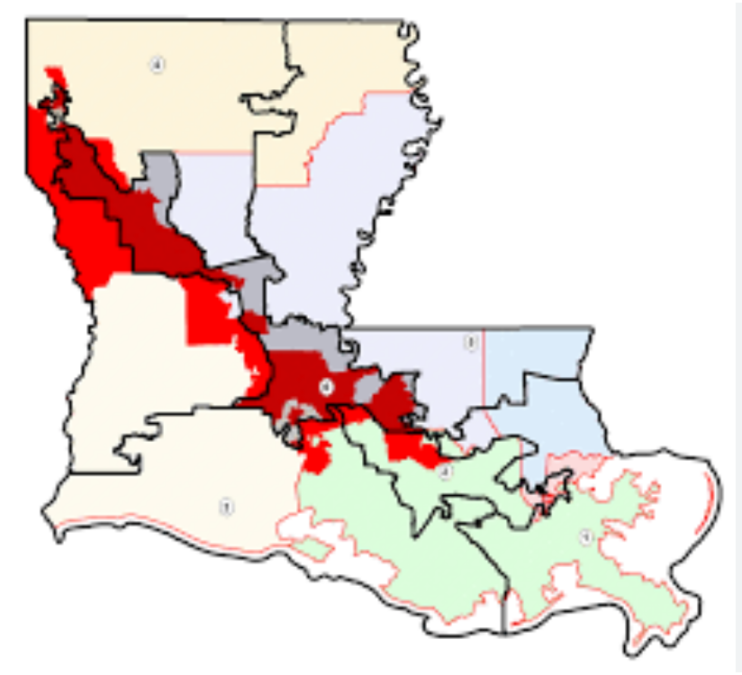
Louisiana v. Callais has been ruled on by the United States Supreme Court, with the case centering on Louisiana’s map and whether state lawmakers were forced to improperly draw districts based on race. Despite being in an age of reverse discrimination thanks to a relatively long history of Affirmative Action, and more recently DEI (Diversity, Equity, and Inclusion), none of which are constitutionally or lawfully supported, the Supreme Court in a 6-3 decision ruled that Louisiana was not required by law to create an additional majority-minority district.
Justice Samuel Alito in the majority opinion wrote, “because the Voting Rights Act did not require Louisiana to create an additional majority-minority district, no compelling interest justified the State’s use of race in creating SB8, and that map is an unconstitutional racial gerrymander.”
Section 2 of the Voting Rights Act has been used historically by partisans to claim districts dilute minority voting strength, which allows Democrats to use a racial twisting of districts in their favor. The Supreme Court ruling regarding Louisiana v. Callais reins in the gerrymandering practice where leftist legal teams pressure states to use race in redistricting which violates the equal protection clause of the Fourteenth Amendment.
Justice Alito explained that the Louisiana v. Callais decision is a warning to lower courts who have stretched Section 2 in a manner that has been compelling race-based decision-making. “Section 2 of the Voting Rights Act of 1965 was designed to enforce the Constitution – not collide with it. Unfortunately, lower courts have sometimes applied this Court’s §2 precedents in a way that forces States to engage in the very race-based discrimination that the Constitution forbids.”
Texas, California, Virginia, and Florida – along with a nice long list of other states – have been lobbing cannonballs at each other with their own redistricting schemes and Louisiana v. Callais could very well have a rippling effect on each of those battles.
According to Black Voters Matter, as a result of the ruling Republicans could end up with a significant advantage over new maps, perhaps swinging 19 districts in the direction of the GOP.
At about the same time, the Virginia State Supreme Court heard arguments regarding Scott v. McDougle, regarding the Democrats’ attempt to gerrymander Virginia in such a way that it would guarantee that 10 out of 11 congressional seats go to Democrats in the upcoming midterm election. While Virginia narrowly approved the redistricting referendum on April 21, County Circuit Judge Jack Hurley Jr. ruled back in January that the constitutional amendment that ended up on the ballot violated the state constitution. On April 24, Virginia’s Attorney General Jay Jones, Democrat, filed a motion for an emergency stay of Hurley’s order. The Virginia Supreme Court denied their emergency stay – which means at the moment the Democrats’ gerrymandering scheme is currently dead in the water.
In Oregon, Judicial Watch’s lawsuit against the state, filed in 2024, charged that state officials have refused to remove ineligible voters from voter rolls, and in 35 of Oregon’s 36 counties the number of voters registered exceeds the number of voters who legally exist in those counties. Since 1998 Oregon has been a mail-in-ballot-only state, and the state’s registration method uses a motor-voter law which automatically registers a voter upon receiving a driver’s license – opening up the opportunity for ineligible voters to be added to the voter rolls without any regulatory supervision or oversight. Meanwhile, widespread voter roll maintenance failures have been occurring across the state. Judicial Watch has now won their case, resulting in Oregon being required to remove possibly up to 800,000 ineligible names on the state list of voter registrations, a number confirmed by Oregon Secretary of State Tobias Read. About 160,000 already meet federal and state criteria for removal. The remaining 640,000 inactive records will be process through future list maintenance efforts.
Tom Fitton, president of Judicial Watch, explained, “Dirty voter rolls can mean dirty elections.” Federal law demands that states take reasonable steps to remove ineligible voters, those who have died, those who have moved, and those who have become otherwise inactive.
Colorado recently removed 372,000 ineligible voter names due to a Judicial Watch lawsuit and settlement. Kentucky has removed 735,000 ineligible voters from their rolls, New York City 918,000, and Los Angeles 1.2 million in recent voter roll maintenance operations.
According to North Carolina election officials, roughly 34,000 deceased individuals have been identified on the state’s voter rolls, yet another failure the Trump administration has been pointing fingers at over the last year. These irregularities are the reason the Trump administration is pressuring states to fix their voter rolls. The discovery comes as an added benefit of North Carolina’s effort to verify the citizenship status of registered voters.
As the U.S. Congress still fights over the passage of the SAVE America Act, which would require voter identification and proof of citizenship to register to vote, and while the voter rolls around the country are being cleaned up, polls show the current fight for the 2026 midterms to be an even split. If the poll is accurate, and it is also true (as I’ve believed for a very long time) that the Democrats manipulate elections with non-citizen voting, dead-people voting, and a variety of other corrupt election tactics, the purging of ineligible voters from the rolls, the courts disallowing their partisan gerrymandering tactics, and the passage of the SAVE America Act (which I believe will eventually get passed), the Republicans should be able to gain seats in both Houses of Congress through the midterm elections of 2026 – if GOP voters and voters disgruntled with the Democratic Party come out in droves – and I expect that they will.
Already, 71 percent of voters plan to participate in the midterms, and 67 percent of voters are already considering the 2028 presidential election.
— Political Pistachio Conservative News and Commentary