
By Douglas V. Gibbs
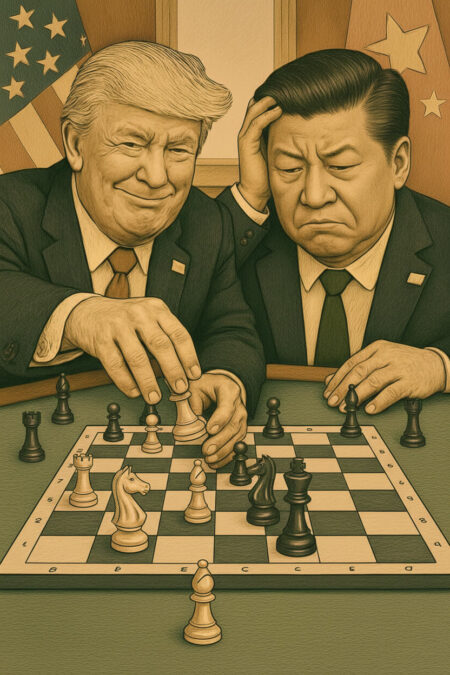
President Donald Trump’s recent diplomatic journey to Beijing represents a masterclass in his usual way of operating: a pragmatic, “no-nonsense” approach to politics and diplomacy that prioritizes national interests, practical outcomes, and power dynamics over ideology, morality, or ethical principles. Trump’s realpolitik approach would make even Bismarck nod in approval. The Founding Fathers, through their language in the Constitution, revealed that they envisioned a president who would conduct foreign affairs with American interests paramount. And that, my friends, is precisely what Trump accomplished during his high-stakes meeting with Xi Jinping.
The Trump administration entered these talks with a clear-eyed understanding of economic leverage, a move that the Founding Fathers would have appreciated given their mercantilist era. Trump secured significant commitments from China regarding purchases of American agricultural products, Boeing aircraft, and energy resources. These aren’t mere symbolic gestures. They represent tangible benefits to American workers and industries, particularly in the agricultural heartland that forms much of Trump’s political base.
The proposed U.S.-China “Board of Trade” to manage commerce in non-sensitive goods demonstrates Trump’s practical approach to international relations. As with is Board of Peace, he seeks to create institutional frameworks that can outlast any single administration while protecting American interests. This mirrors the constitutional principle of creating lasting structures that will outlive his presidency, rather than relying solely on executive whims.
The rare earth minerals agreement deserves particular attention. When China previously blocked exports of these critical elements, Trump initially stood firm before eventually securing a more favorable arrangement. This strategic flexibility, a nod to his businessman background that has taught him to know when to hold firm and when to negotiate, demonstrates the kind of pragmatic leadership that has characterized America’s most effective foreign policy moments.
President Trump appropriately pressed Xi on China’s economic and strategic support for Iran, including oil revenue, dual-use components, and potential weapons transfers. This direct approach reflects an understanding that the president’s primary responsibility is to protect American interests from hostile regimes enabled by foreign powers – a very Jeffersonian stance.
The discussion about China potentially increasing its U.S. oil purchases to reduce dependence on the Strait of Hormuz represents precisely the kind of creative diplomacy that can defuse geopolitical tensions without military confrontation. By addressing the economic motivations behind China’s relationship with Iran, Trump is working to dismantle the support structures that enable Iranian aggression.
On Taiwan, Trump maintained the delicate balance that has characterized U.S. policy for decades while still authorizing an $11 billion arms package, the largest weapons sale ever to the island. This demonstrates Trump’s understanding that effective foreign policy requires both strength and strategic ambiguity.
Xi’s warning that “mishandling Taiwan will put U.S.-China relationship in ‘great jeopardy'” was met with the appropriate American resolve: acknowledging China’s concerns while making clear that U.S. commitments to Taiwan will not be abandoned.
What makes this trip particularly significant is how Trump blended his signature business acumen with presidential gravitas. By bringing top executives from Apple, Boeing, Tesla, BlackRock and Goldman Sachs, he demonstrated that American economic strength and diplomatic power are two sides of the same coin. This public-private partnership approach was a brilliant move that harnesses all elements of national power to advance American interests.
The contrast with the previous administration’s approach could not be starker. Where weakness invited aggression, Trump’s strength has commanded respect. Where empty promises yielded no results, Trump’s transactional approach has produced concrete benefits for American workers and industries.
Trump’s Beijing trip demonstrates precisely the kind of leadership the Founding Fathers would expect from an energetic President. Trump has utilized his role as President to advance American interests through strength, diplomacy, and pragmatic negotiation. By securing trade deals, addressing threats from Iran, and maintaining principled positions on Taiwan, Trump has once again shown that constitutional governance and effective foreign policy are not opposing concepts but complementary ones.
As we evaluate this trip’s success, we should ask if Trump advanced American interests. By that measure, the only measure that truly matters, the Beijing summit represents a significant achievement for President Trump and for the United States.
— Political Pistachio Conservative News and Commentary
CNBC. “Trade wars to extended truce: Analysts expect ‘stabilization’ in U.S.-China ties as Trump-Xi meet.” May 14, 2026. https://www.cnbc.com/2026/05/14/trump-xi-summit-us-china-trade-taiwan-iran-nvidia.html
CNBC. “Xi warns Trump: Mishandling Taiwan will put U.S.-China relationship in ‘great jeopardy’.” May 14, 2026. https://www.cnbc.com/2026/05/14/trump-xi-beijing-summit-trade-taiwan-ai-iran-rare-earths-tariffs.html
EL PAÍS. “The summit between Xi Jinping and Donald Trump, in five key points: From Taiwan to AI and rare earths.” May 13, 2026. https://english.elpais.com/international/2026-05-13/the-summit-between-xi-jinping-and-donald-trump-in-five-key-points-from-taiwan-to-ai-and-rare-earths.html
Fox News. “Trump heads to Beijing for high-stakes Xi talks as Taiwan tensions, trade disputes test US strength.” May 13, 2026. https://www.foxnews.com/politics/trump-heads-beijing-high-stakes-xi-talks-taiwan-tensions-trade-disputes-test-u-s-strength
Reuters. “Trump and China’s Xi set for talks spanning Iran, nuclear, trade and AI.” May 10, 2026. https://www.reuters.com/world/china/rare-earths-deal-between-us-china-is-still-effect-us-official-says-2026-05-10/
CNN. “May 13, 2026 – Trump arrives in China for summit with Xi Jinping.” May 13, 2026. https://www.cnn.com/2026/05/13/politics/live-news/trump-china-visit-arrival-ceremony-hnk
The New York Times. “After Xi’s Warning on Taiwan, He and Trump Strike Positive Tone.” May 14, 2026. https://www.nytimes.com/live/2026/05/13/world/trump-xi-summit-china
The Guardian. “Trump-Xi China summit: five key issues on the agenda.” May 13, 2026. https://www.theguardian.com/world/2026/may/13/donald-trump-china-sumit-5-key-issues-xi-jinping
World Economic Forum. “US-China relations: What to expect from the Trump-Xi summit.” May 2026. https://www.weforum.org/stories/2026/05/what-to-expect-trump-xi-summit-china-us/
CNBC. “What’s at stake for trade, Taiwan and Iran in Trump’s high-risk summit with China’s Xi.” May 12, 2026. https://www.cnbc.com/2026/05/12/trump-xi-china-trade-iran-taiwan.html
Al Jazeera. “Trump and Xi to meet in Beijing: The key issues shaping the China summit.” May 13, 2026. https://www.aljazeera.com/economy/2026/5/13/trump-and-xi-to-meet-in-beijing-the-key-issues-shaping-the-china-summit