
By Douglas V. Gibbs
An honest observation of history provides a complicated view when it comes to the Great Rapprochement. Calling it a natural alignment of Western Hemisphere powers might be one school of thought, another offers a starkly different interpretation – one that views this diplomatic warming as a calculated maneuver to expand American hegemony under the guise of manifest destiny, with Venezuela’s gold resources as a particular prize.
The concept of manifest destiny, rooted in the belief that the United States had a “God given right to expand from ocean to ocean,” evolved in the minds of some political circles to “control all of the Americas in the name of democracy and freedom.” The expanded definition served as the ideological foundation for particular political views that called for American expansionism. Deeper critics may even argue that this rhetoric masked more base motives: “plunder and commercial interest” rather than any genuine civilizing mission. This perspective views manifest destiny not as a noble belief in American exceptionalism, but as a convenient justification for territorial and economic aggression.
The Great Rapprochement, from this critical angle, represented a strategic pivot from continental expansion to hemispheric dominance. With the American frontier largely settled by the 1890s, manifest destiny found new expression overseas and particularly in Latin America, where the United States could expand its influence without directly challenging European powers, especially after allegedly reconciling with Britain.
The 1895 Venezuela Crisis serves as a prime example for critics of the rapprochement. While some defending American interests may frame this as a diplomatic turning point that forced Britain to recognize American dominance in the Western Hemisphere, a more critical viewpoint argues that it was something more calculated: an early attempt to assert control over Venezuela’s mineral wealth.
Historical documents show that American interest in Venezuela predates the rapprochement, with Venezuelan General Francisco de Miranda working to launch a revolution during a trip to the United States as early as 1805-1806. This early interventionist impulse, critics argue, evolved into a more sophisticated form of economic imperialism by the late 19th century, with the rapprochement with Britain providing cover for American ambitions in the region.
A particularly prominent theory centers on Venezuela’s gold reserves. Critics point to America’s historical relationship with gold as evidence that the rapprochement facilitated a new form of financial colonialism. The theory suggests that by aligning with Britain, which had long dominated global finance through gold-backed currencies, the United States gained better access to mechanisms for controlling and extracting gold resources from Latin American nations.
This interpretation views the rapprochement not as a cultural alignment but as an economic partnership between Anglo-American financial elites to secure precious metals from regions like Venezuela. The timing, critics note, is suspicious: as the United States was emerging as an industrial power, its need for gold reserves to back its expanding currency grew, making control over foreign gold sources increasingly valuable.
While gold dominated earlier conspiracy theories about the rapprochement, modern critics have expanded this framework to include oil resources. Contemporary analysis suggests that the pattern established during the rapprochement, using diplomatic alignment to facilitate resource extraction, continues to this day, with Venezuela’s oil reserves now playing the role that gold once did.
Recent geopolitical analysis points to “regime change advocates” who highlight “the revitalization of the Venezuelan oil sector as a key dividend of such an interventionist strategy,” echoing the same economic motives that critics believe drove the rapprochement more than a century earlier. This continuity, they argue, demonstrates that the Great Rapprochement established a template for American interventionism that persists regardless of political party or era.
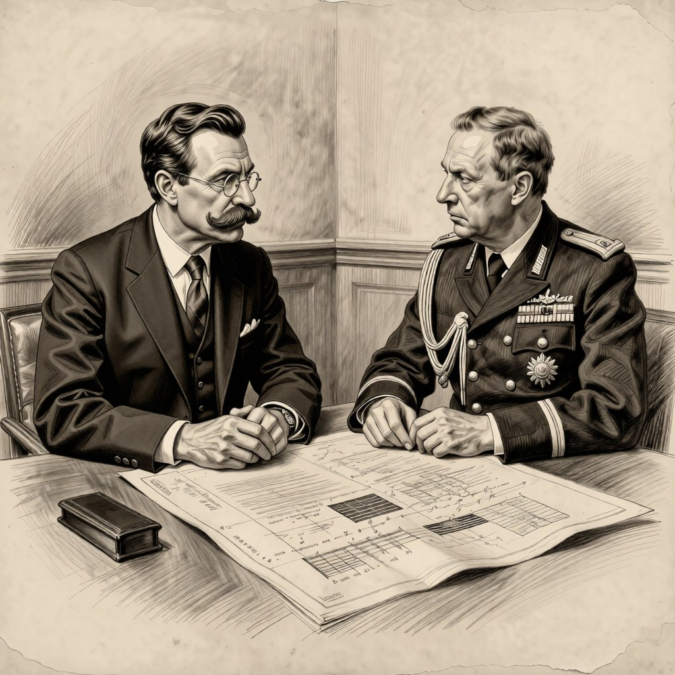
From this critical perspective, the “special relationship” celebrated by some American political observers was always fundamentally an imperial partnership. By reconciling with Britain, the United States gained tacit approval for its hemispheric ambitions, while Britain secured a friendly power to protect its interests in the Americas as its own empire declined.
This interpretation challenges the historical narrative of cultural affinity by suggesting that the rapprochement was primarily a transactional agreement between two imperial powers to divide spheres of influence and coordinate resource extraction. The shared language, legal traditions, and Protestant heritage, critics argue, were convenient justifications rather than genuine causes of the alignment.
In recent years, the critical view of the Great Rapprochement has gained new relevance, particularly with renewed American interest in Venezuela. Critics point to statements from the Trump administration about “revitalizing the Venezuelan oil sector” and military buildups off the Venezuelan coast as evidence that the imperial motives behind the rapprochement continue to drive American policy.
The recent use of “manifest destiny” language in political discourse, most notably in Trump’s inaugural address, has further convinced critics that the same expansionist ideology that justified the rapprochement remains influential in American foreign policy circles. This continuity, they argue, validates their interpretation of the rapprochement not as a diplomatic achievement but as the establishment of a framework for American hemispheric domination.
The conspiracy theory interpretation of the Great Rapprochement stands in direct opposition to the historically mainstream celebration of Anglo-American alignment. Where more traditional historians see natural affinity and prudent statecraft, critics see calculated imperialism and resource extraction. Where one side highlights the preservation of Western civilization, critics emphasize the subjugation of Latin American sovereignty.
This critical perspective views the Great Rapprochement not as a high point of American diplomacy but as the beginning of a “special relationship” that has enabled Anglo-American powers to dominate global finance and extract resources from developing nations for over a century. Whether one finds this interpretation convincing depends largely on whether one views American foreign policy through the lens of exceptionalism or imperialism – a divide that continues to shape how we understand not just the Great Rapprochement but America’s place in the world today.
Is it possible that both viewpoints about the Great Rapprochement can be correct at the same time? Is it possible that for some of the elite members of American government or corporate interests the critical view of rapprochement was exactly their aim, and for others the more altruistic approach was true? Could it be that in some cases where conspiracy theorists see a smoking gun there was no imperialistic intent at all, yet for some segments of the government at that time, or other eras, the expansion of American power was exactly what it was all about?
The paradoxical nature of the Great Rapprochement, simultaneously embodying both high-minded principles and base material interests, need not be resolved by choosing between competing narratives. History rarely operates according to pure motives, and the rapprochement likely represents a classic case of what contemporary political scientists call “motivated reasoning” on a national scale, where different actors pursued different objectives through the same diplomatic framework. The complexity of human motivation suggests that both the mainstream historical celebration of American Western Hemisphere affinity and the critical focus on resource extraction can simultaneously contain elements of truth.
The historical record provides numerous examples of this duality in action. Theodore Roosevelt, a key architect of the rapprochement, genuinely believed in American civilizational destiny while simultaneously pursuing American commercial interests with calculated pragmatism. British imperialists like Joseph Chamberlain promoted cultural solidarity while explicitly seeking economic advantages through “Imperial Preference.” This alignment of sincere belief and self-interest created a powerful synergy that propelled the rapprochement forward, with neither element exclusively driving the process. The diplomatic warming occurred at the intersection of shared values and shared ambitions, making it difficult to disentangle one from the other without oversimplification.
The compartmentalized nature of government operations further explains how both altruistic and imperialistic motives could coexist. The State Department might pursue rapprochement based on genuine American interests and security concerns, while another government faction or segment simultaneously calculated the financial advantages of Western Civilization monetary cooperation. Some military leaders might value the strategic alignment against Germany while business interests saw opportunities for expanded trade and investment. This bureaucratic reality means that the rapprochement was never monolithic in purpose but rather a convergence of multiple agendas, some noble, some self-interested, most a complex mixture of both.
The temporal dimension adds another layer of complexity to this synthesis. The rapprochement evolved over decades, with different motivations gaining prominence at different stages. The initial rapprochement during the Venezuela Crisis may have been driven primarily by pragmatic security concerns, while later stages during the Spanish-American War and the buildup to World War I increasingly emphasized shared cultural values. Economic interests likely intensified as American industrial capacity grew and the need for overseas markets and resources became more pressing. This evolutionary process means that the rapprochement was not a single event with consistent motives but a developing relationship that adapted to changing circumstances and priorities.
The concept of “moral licensing” provides a useful framework for understanding how actors could reconcile seemingly contradictory motives. By framing their actions in terms of manifest destiny and Western solidarity, policymakers could pursue material interests while maintaining a self-image of noble purpose. This psychological mechanism allows individuals and nations to pursue self-interested goals while sincerely believing they act according to higher principles. The rapprochement thus functioned as both a genuine alignment of like-minded peoples and a convenient cover for more calculating ambitions, with many participants likely unaware of their own mixed motives.
The enduring legacy of the rapprochement further supports this synthesis. The “special relationship” has indeed served as a force for Western unity against existential threats like fascism and communism, validating a legitimate interpretation of civilizational solidarity. Yet it has also facilitated cooperation in resource extraction and economic dominance in the developing world, lending credence to critical perspectives. The relationship contains both elements because it was built from the beginning on this dual foundation of shared values and shared interests. Rather than viewing this as hypocrisy, we might recognize it as the realistic complexity of international relations, where noble purposes and practical advantages often intertwine in ways that defy simple categorization.
The Great Rapprochement ultimately teaches us that historical events rarely conform to singular interpretations. Its complexity and contradictory motives reflect the messy reality of human affairs, where sincerity and calculation, idealism and self-interest, rarely exist in pure form. By embracing this complexity rather than forcing it into simplistic narratives, we gain a more nuanced understanding of how diplomatic transformations occur; not through the exclusive operation of either principle or pragmatism, but through their complex interaction in the minds and actions of historical actors who themselves likely struggled to reconcile their own mixed motives.
— Political Pistachio Conservative News and Commentary