

By Douglas V. Gibbs
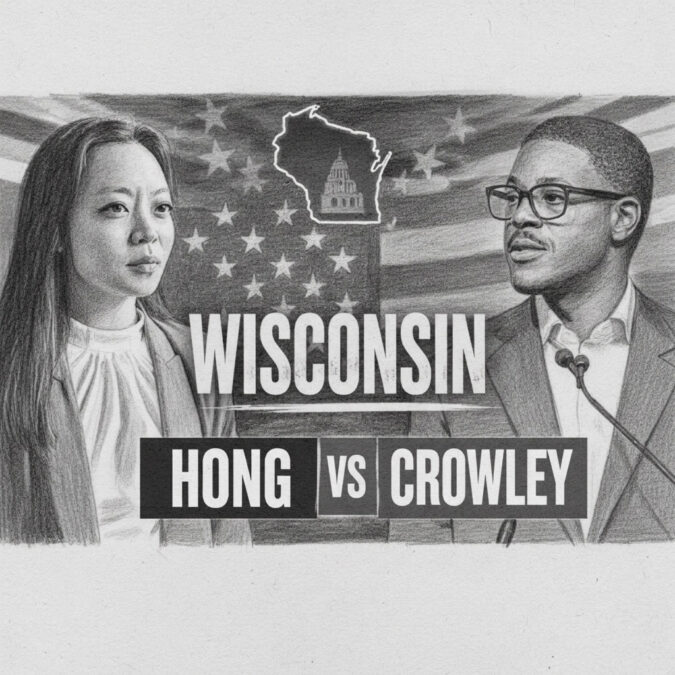
Something doesn’t sit right about Wisconsin’s Democratic gubernatorial primary. According to final polls released just four days before the election, Francesca Hong held what should have been an insurmountable 22-point lead over her opponents. The polling organization even noted that their results aligned with Marquette Law School’s poll – the “gold standard” of Wisconsin polling. Yet when the votes were counted, Hong lost to David Crowley, a candidate who had actually dropped out of the race before re-entering, by a razor-thin margin of about 4,000 votes.
The official narrative suggests that Democratic voters simply changed their minds in the final days. But I’m not buying it. Let’s consider an alternative explanation that deserves serious consideration: those polls weren’t just wrong – they were potentially manipulated.
Think about the mechanics of voter psychology. When polls show a candidate with a massive lead, it creates a powerful disincentive for supporters of other candidates to bother showing up. Why waste your time voting when the outcome seems predetermined? This is especially true in primary elections, where turnout is already typically low.
The 22-point lead reported for Hong wasn’t just a polling miss – it was a polling catastrophe. State Navigate themselves seemed concerned, noting the “12-point polling miss in the Democratic primary for US Senate in neighboring Michigan” and questioning whether a similar miss might occur in Wisconsin. But they proceeded with their numbers anyway, potentially influencing thousands of voters to stay home.
What if that was the point? What if the polls were deliberately designed to create a false sense of inevitability around Hong’s candidacy? The effect would be twofold: discouraging Crowley’s supporters while simultaneously creating momentum for Hong. It’s a classic psychological operation dressed up as scientific polling.
Beyond the questionable polling methodology lies an even more troubling aspect of this election: how close a self-identified socialist with radical positions came to winning the Democratic nomination. Hong’s platform included proposals that would fundamentally reshape Wisconsin’s economy and social structure – policies that would have been considered unthinkable just a few years ago.
That Hong lost by only 4,000 votes despite her radical agenda should alarm every Wisconsin resident, regardless of political affiliation. It demonstrates how far left the Democratic Party has drifted that such a candidate could nearly secure the nomination. This isn’t about principled progressivism; it’s about an ideological shift that threatens the very foundations of our economic system.
The fact that Crowley, who had withdrawn from the race, could still defeat Hong speaks volumes about the reservations even Democratic voters have about her platform. But what’s concerning is that those reservations weren’t strong enough to create a decisive rejection of her ideology.
We need to ask some hard questions about what happened in Wisconsin:
- Who funded these polls that showed Hong with such a commanding lead?
- What methodologies were used, and why were they so dramatically wrong?
- Were there any connections between the polling organizations and Hong’s campaign?
- Why did State Navigate acknowledge concerns about potential polling misses yet release numbers that were even more inaccurate than Michigan’s?
The American people deserve transparent, accurate polling, and this kind of potential manipulation designed to influence electoral outcomes is nothing new. We’ve seen polls weaponized against the GOP for decades. When polls consistently miss the mark by such dramatic margins, it’s potentially something more sinister.
The Wisconsin primary should serve as a wake-up call. We’ve become too complacent about the integrity of our electoral processes, including the polling that shapes voter perceptions. We’ve also become dangerously accepting of ideologies that were once considered on the radical fringe.
Whether through manipulated polling or ideological drift, the Wisconsin primary demonstrates the fragility of our processes. When a candidate with socialist policies comes within 4,000 votes of winning a major party nomination in a state like Wisconsin, which is considered a swing-state, it’s time to reassess our political trajectory.
This isn’t just about one primary in one state. It’s about the direction of our country. The Wisconsin experience should prompt us to demand greater transparency in polling and more thoughtful consideration of the ideologies we’re willing to embrace as a country as the Democratic Party continues to push further and further to the left. Remember, this is the same Democratic Establishment that made sure Bernie Sanders was removed from the presidential party lead in 2020, undemocratically pushed aside Biden for Kamala in 2024, and has done all they can to eliminate Donald J. Trump. They call the socialist communists radical, as they act in such a radical manner to stop the radicals. But, hey, all of the elections are safe and secure… right?
— Political Pistachio Conservative News and Commentary