

By Douglas V. Gibbs
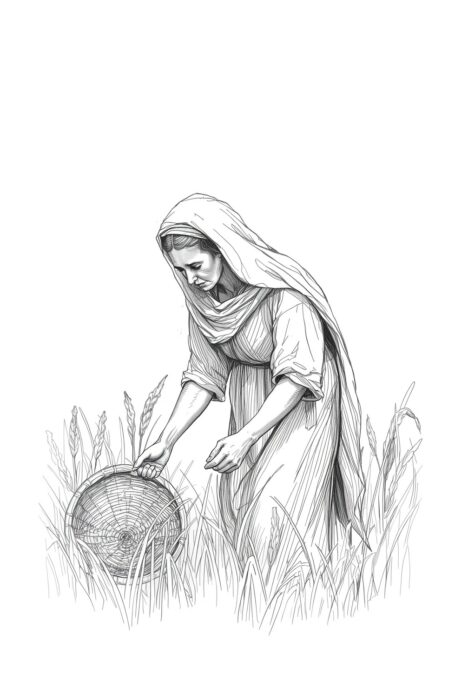
I am currently studying the biblical Book of Ruth with my wife, and in the second chapter there is a lot of discussion regarding the Mosaic Law regarding gleaning. Ruth, because she was poor, gleaned in fields (gathering remaining grain after the harvest and after the workers have moved on).
As I researched the history of gleaning, thanks to the Book of Ruth, I began understanding how it captures a profound biblical principle that contrasts sharply with many modern approaches to charity. The principles around gleaning provide a key distinction in God’s design for caring for the vulnerable that balances compassion with personal responsibility and dignity.
The Mosaic Law established gleaning in several passages:
Leviticus 19:9-10: 9 And when ye reap the harvest of your land, thou shalt not wholly reap the corners of thy field, neither shalt thou gather the gleanings of thy harvest. 10 And thou shalt not glean thy vineyard, neither shalt thou gather every grape of thy vineyard; thou shalt leave them for the poor and stranger: I am the Lord your God.
Leviticus 23:22: 22 And when ye reap the harvest of your land, thou shalt not make clean riddance of the corners of thy field when thou reapest, neither shalt thou gather any gleaning of thy harvest: thou shalt leave them unto the poor, and to the stranger: I am the Lord your God.
Deuteronomy 24:19-22: 19 When thou cuttest down thine harvest in thy field, and hast forgot a sheaf in the field, thou shalt not go again to fetch it: it shall be for the stranger, for the fatherless, and for the widow: that the Lord thy God may bless thee in all the work of thine hands. 20 When thou beatest thine olive tree, thou shalt not go over the boughs again: it shall be for the stranger, for the fatherless, and for the widow. 21 When thou gatherest the grapes of thy vineyard, thou shalt not glean it afterward: it shall be for the stranger, for the fatherless, and for the widow. 22 And thou shalt remember that thou wast a bondman in the land of Egypt: therefore I command thee to do this thing.
The thing I glean (pardon the reuse of the word) from all of this is that God’s Law created an important array of aspects of the system I think we’ve forgotten in modern times.
- Dignity through Work: Gleaning preserved human dignity by requiring effort from those receiving assistance. Ruth didn’t simply receive handouts but worked diligently in Boaz’s field (Ruth 2:7, 17).
- Productivity and Stewardship: The system prevented waste while ensuring the poor were fed. It was an economically wise approach that benefited everyone.
- Limited, Not Comprehensive: Gleaning wasn’t intended to meet all needs but to supplement what the poor could provide for themselves. It was a safety net, not a complete support system.
- Voluntary Participation: The landowner wasn’t required to harvest and distribute food but to leave opportunity for others to work.
The contrast with modern charity systems is stark to say the least. Many contemporary approaches, including private charities and government welfare programs, create dependency rather than empowerment, unintentionally stripping recipients of dignity and work ethic. The biblical model fosters responsibility while still providing for fundamental needs.
This is not to say that God frowns completely on direct giving. In the New Testament Jesus commends those who give to the poor (Matthew 26:11), and early Christians shared resources freely (Acts 2:44-45, 4:32-35). Both approaches have their place. Direct giving is sometimes necessary for urgent needs, and systems like gleaning existed for sustainable provision.
In today’s politics, this serves as among the reasons that I support strategies of welfare reform in the United States that includes work requirements instead of unconditional assistance. Under Newt Gingrich’s leadership in the 1990s, Congressional Republicans championed welfare reform that emphasized personal responsibility and work requirements. The effort culminated in the Personal Responsibility and Work Opportunity Act of 1996, which President Clinton signed, famously declaring it would “end welfare as we know it.” The legislation led to programs that imposed time limits and work requirements on recipients.
During the Great Depression, President Franklin Delano Roosevelt’s philosophy behind the New Deal, at least in the beginning, was that the programs were temporary relief measures designed to restore self-reliance rather than create permanent dependency.
Roosevelt explicitly stated this vision in his 1935 State of the Union address when he said: “The objective of our… social legislation is to correct the injustices of our economic system… but it is also to preserve the essentials of our American system.” He added that “Continued dependence upon relief induces a spiritual and moral disintegration fundamentally destructive to the national fiber. To dole out relief in this way is to administer a narcotic, a subtle destroyer of the human spirit.”
There is an important distinction between Roosevelt’s approach and the gleaning model. The New Deal went far beyond the biblical system of leaving gleanings in the fields. His model suffered from a collective influence that saw government intervention as necessary to correct what he considered to be economic imbalances that left people unable to support themselves due to some kind of error created by the free market system. His intention on the surface was to find employment for those who couldn’t find it, but there was no employment to have at that time due to the Great Depression. He recognized work should be encouraged, but at the moment some people couldn’t support themselves through labor. Ultimately, unfortunately, the New Deal led to programs that created a permanent underclass dependent upon government, of which was doubled-down upon by President Lyndon B. Johnson with his Great Society.
The road to Hell is paved with good intentions.
Today, perhaps, we have a chance to get back to the biblical principles that surround gleaning. Perhaps the application for today would be creating opportunities that allow the poor to work for their provision with dignity, rather than only establishing systems that create dependency. This might include job training programs, honest and fair employment practices, work requirements attached to welfare programs, and community-based initiatives that empower rather than merely enable.
The book of Ruth beautifully illustrates how God’s provision often comes through human responsibility and hard work, combined with the generosity of those who follow His commands to care for the vulnerable.
The Founding Fathers and colonial America understood these principles, and developed systems that reflected principles remarkably similar to the biblical practice of gleaning. While not identical, they shared the core emphasis on work, personal responsibility, and dignity rather than simple handouts.
Colonial America adopted “Poor Laws” modeled after English traditions that established public responsibility for caring for the destitute while requiring work in return. These systems distinguished between the “deserving” and “undeserving” poor, similar to how biblical gleaning targeted those willing to work for their sustenance. Two common approaches were the contract system, where a farmer would care for a poor person in exchange for labor, and auctioning, where a person or family was assigned to the lowest bidder who would then put them to work. Unfortunately, human nature often stuck its ugly head into the whole thing, eventually becoming punitive rather than empowering, with conditions that essentially legalized abusive behavior and near starvation existence. While the early Americans recognized the need for assistance, and they attempted to balance it with opportunities for self-reliance and dignity, even then the darker side of human nature tugged on the system in a negative way.
Jesus said the poor would always be with us. His statements were not intended to express fatalism about poverty, but rather to provide a realistic assessment of human society. It does not mean that we should accept poverty as inevitable, throw our hands up, and do nothing about it. Jesus said in Matthew that caring for the poor was important – as important as caring for ones’ self.
Deuteronomy 15:11 also states that the poor will never cease to be in the land. The verse is also accompanied by commands to address poverty generously. But that doesn’t mean giving away charity to the poor. Recognizing poverty leads to a level of responsibility that we must contemplate on all sides of the issue. We must practice compassionate responsibility while seeking to prevent harmful dependency. After all, there are warnings in the Bible against creating systems that foster idleness or dependency, as seen in Paul’s instruction that: For even when we were with you, this we commanded you, that if any would not work, neither should he eat. 2 Thessalonians 3:10.
This is precisely what makes the gleaning model in the Book of Ruth so brilliant as a framework. It acknowledges the reality of poverty while preserving human dignity through work. The poor weren’t given grain directly but were provided the opportunity to labor for it – much like how Roosevelt’s New Deal work programs originally intended/attempted to preserve “self-respect, initiative and courage” rather than simply dispensing relief.
The challenge for modern society is applying this principle in an economy where most people don’t work in agricultural fields where gleanings can be left. Perhaps the contemporary equivalent would be systems that create pathways to productive work rather than mere assistance. Job training programs that actually lead to employment. Educational opportunities that provide marketable skills. Community-based initiatives that empower rather than simply enable. Welfare programs with work requirements, and education programs that are not simply useless college degrees earned through indoctrination and accompanied by massive student debt.
— Political Pistachio Conservative News and Commentary