
By Douglas V. Gibbs
Someone once told me that the Declaration of Independence articulated the “why” of American independence, and the Constitution would later provide the “how” of American government. The two documents share a profound relationship in the forging of American independence and the desire to secure individual Natural Rights – one being the philosophical foundation, and the other serving as the political catalyst.
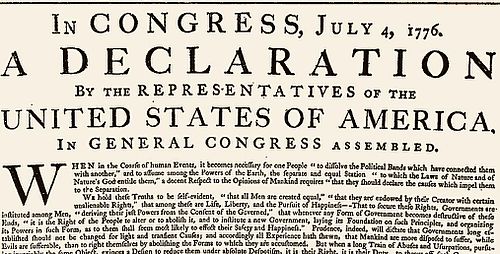
Primarily drafted by Thomas Jefferson, the Declaration of Independence in 1776 established the philosophical framework that would influence the Constitution. The document explained in written form that “truths” are “self-evident,” and among those truths are that “men are created equal, that they are endowed by their Creator with certain unalienable Rights, [and] that among these are Life, Liberty and the pursuit of Happiness.” In other words, humanity possesses Natural Rights derived from the “Laws of Nature and of Nature’s God,” rather than from governments or monarchs. Natural Law, therefore, exists as a higher law that government must respect.
The Declaration of Independence went on to state that “Governments are instituted among Men, deriving their just powers from the consent of the governed,” establishing the principle of popular sovereignty – the political principle that government exists to serve the citizens rather than a system in which subjects serve the government.
The document also proclaimed that if government ceases to serve the people, and instead begins to rule over them, the citizens have the right to “alter or to abolish it.” This last principle specifically challenged the idea of monarchies, and the concept of a divine right of kings. The Declaration provided philosophical justification for creating a new system of government based on the consent of the governed and Natural Rights.
The Declaration’s influence led to the first attempt to translate the document’s principles into governmental form with the Articles of Confederation (1781). The framework for the Articles began in 1777, and sought to emphasize state sovereignty and limited central authority. The document reflected the revolutionary fear of concentrated power, but was an extreme lurch in the opposite direction, creating practical weaknesses in the system. It demonstrated that while too much centralization of government was a threat to liberty, so was too little power in the hands of the general government. So, in 1787, a group of delegates met in Philadelphia to fix the Articles of Confederation.
The Framers of the Constitution sought to create a government that would secure the rights articulated in the Declaration of Independence and the English Declaration of Rights while avoiding the pitfalls of both monarchy and the chaos of the Articles of Confederation.
James Madison, the Father of the Constitution, arrived with a plan already written. The Virginia Plan, however, possessed provisions that the smaller States were not willing to agree to. The New Jersey Plan emerged to accommodate the desires of the smaller States, but the larger States rebelled against the concepts presented by it. What they were seeking was the ultimate balancing act that distributed power in such a way that no faction could rule over any other faction. In Federalist #43, James Madison explained that the aim was to secure the tranquility of the Union against domestic insurrection, while also providing the security of the people against foreign invasion. Create a system capable of securing the Natural Rights of its citizens and protecting the country in a world of empires, while limiting the government’s domestic authorities. Create a government strong enough to govern, while respecting and honoring the principle of government by consent.
The fear of concentrated power expressed in the Declaration of Independence’s charges against King George III led directly to the creation of three distinct branches of government that possess a separation of powers. Federalism not only separated power between the branches, but also between the general government and the States. The federal government, in turn, only possesses powers granted to it by the Constitution – a principle that directly addresses the concerns raised in the Declaration.
Together, the Declaration of Independence and the United States Constitution form the foundation of the American Experiment – a system grounded in liberty, consent of the governed, and a written contract with the States serving as the parties of that contract.
And after a grueling convention during the Summer of 1787, a convention that officially began on May 25, 1787, the work by the delegates reached its conclusion on September 17, 1787. Thirty-nine delegates signed the document after nearly four months of intense debate, deliberation, and compromise. Then, George Washington, as president of the Convention, formally transmitted the proposed Constitution to the Congress assembled under the Articles of Confederation, initiating the process of ratification by the States.
Ratification occurred on June 21, 1788, when New Hampshire became the ninth State to ratify it. The Bill of Rights would later be added in 1791.
— Political Pistachio Conservative News and Commentary