
By Douglas V. Gibbs
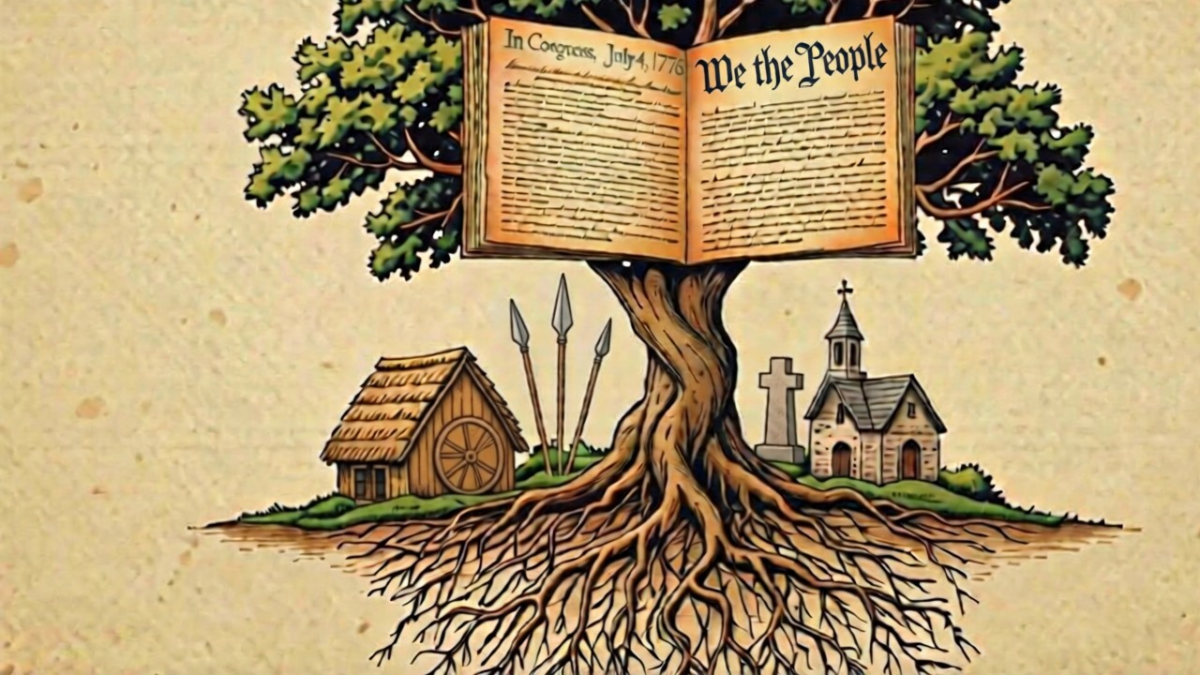
The American founding has two roots. The Saxons brought the first to Britain. Christianity completed it. And the Constitution is the child of both.
There is a popular way of talking about the American founding that traces it almost entirely to the Bible. It is a covenant that connects to Moses, the Ten Commandments, the pulpit, and the Great Awakening. That’s true as far as it goes, and it matters. But it’s only half the story, and the missing half is older than the printing press and deeper than the Reformation.
The other root is the Saxon. The Saxons brought a structure to Britain, a set of institutions and an instinct about law long before they met the Gospel. And when the two finally merged, the structure got its soul and the soul got its structure. Neither one alone produces America. Together, they do.
This is not a competition between the Bible and the Saxons. It’s a compliment. The Saxons supplied the skeleton. Christianity named the source of the rights the skeleton was built to secure.
Let me be precise, because “Saxon” gets thrown around loosely. The Saxons were not ideologues or politicians in the modern sense. What they were was a people with a free man’s order. Theirs was a society built on custom rather than the command of a king, and organized around institutions that carried the instinct for consent of the governed.
They had the witan, the council of wise men whose advice the king was expected to take. They had the folkmoot, the general assembly of the free. They had the hundred moots and shire moots, which were local courts where disputes were settled by the community, which is the ancestor of the jury and of local self-government (localism) itself. They had the fyrd, the levy of armed free men called to defend their own soil, which is the ancestor of the militia. And they had a conception of the king under the law. King Alfred’s own law code bound the crown, and the coronation oath made it explicit. The king did not make the law so much as declare it.
Notice the pattern: local, decentralized, covenanted by oath, and suspicious of consolidated command. Every one of those institutions maps, one to one, onto what the founding generation built: the legislature from the council, the jury and the towns from the moots, the militia from the fyrd, constitutionalism itself from the king under law.
And here is the part that the Bible-only thesis misses: the Saxons already believed their rights were not granted by the king but dispensed from above – a pre-existing order, divine and customary, to which even the ruler was subject. They simply did not yet know the name of the source. That is what the Saxons brought: a structure for liberty, and a conviction that liberty came from God.
Then the Saxons met the Christians, and the ideas got their organizing principle. Alfred the Great’s law code, the oldest sustained English legal text, reveals the truth. He didn’t begin with Saxon custom. He begins with Moses. He opens with the Ten Commandments and the Mosaic law, then layers the Apostolic decrees on top, and only then comes to the customary law of his own people. The very first English lawgiver is telling you, in the architecture of his own code, that the law of England sits beneath the law of God. The rights the Saxons already sensed were divine now had a doctrine, a text, and a name.
That is the merger. The structure was Saxon. The soul was Christian. And once fused, the idea could travel, and it did. It traveled through the common law, through the Magna Carta, and through the long English struggle to hold the crown to the law.
The American founding generation did not invent the “ancient constitution.” They inherited it, and they knew exactly where it came from.
Edward Coke and John Selden, in the seventeenth century, revived the idea that English liberty was older than the Norman conquest, and that pre-Norman England had been a land of free institutions. The Conquest had imposed a foreign feudal yoke. The Levellers carried it into the open. Algernon Sidney’s Discourses Concerning Government grounded it in first principles. And Trenchard and Gordon’s Cato’s Letters, read to pieces in the colonies, taught a whole generation of Americans to see their rights as ancient, English, and God-given.
The Founding Fathers read the history directly. Jefferson wanted Anglo-Saxon taught at William and Mary and pushed it into the curriculum, seeing in the Saxons the wellspring of English liberty. John Adams engaged the Saxon and Germanic models head-on in his Defence of the Constitutions. And Montesquieu, the writer the founders quoted more than any other, traced the English constitution itself back to the Germanic forests, where a free people governed themselves before kings learned to command.
So when Americans said their rights were “ancient,” they were citing a lineage that ran through the moots and the witan and the oaths, was baptized into the Christian understanding of a law above the king, and arrived in the New World intact.
If you want the single clearest proof that these two roots grew into one tree, look at a word. The Latin word foedus means covenant; a binding oath between parties. From it comes foederal. Federalism.
The word itself carries the fusion. The biblical covenant, the Mayflower Compact, the New England town covenants, the Fundamental Orders of Connecticut, Samuel Rutherford’s Lex, Rex with the law above the king and the Saxon tribal oath both landed on the identical principle: self-governing bodies, bound to one another by covenant, resisting consolidated command. Johannes Althusius built an entire political philosophy on it in 1603, grounding the right of local communities in the covenant itself. The American system is the child of that idea.
The Bible-only account gives you the soul but not the skeleton, and a soul without a skeleton can’t stand up in the world. The secular account gives you the skeleton but not the soul, and a skeleton without a soul is a machine. The truth is the merge: the Saxons brought the foundation, Christianity completed and organized it, and the founding generation built on both.
Which is why the assault on the Constitution goes way beyond being some kind of attack in the world of legalism. It was, and is, an assault on a way of being. The Constitution merges all of these things: local, covenanted, God-fearing, and suspicious of distant power. Every consolidation since the 1789 Judicial Act has been an attack on the Saxon layer, dressed up in the language of progress and efficiency. And every defense of the parchment is a defense of that older order, the one the Saxons sensed before they could name it and the Christians named before they could build it.
Two roots. One tree. And the roots are older than the men who wrote the document, and deeper than the men who try to uproot it.
— Political Pistachio Conservative News and Commentary