

By Douglas V. Gibbs
Thirty-seven years ago the Wall came down. The credit belongs to the man who went to Berlin in 1987 and said what nobody in the foreign policy establishment wanted said.
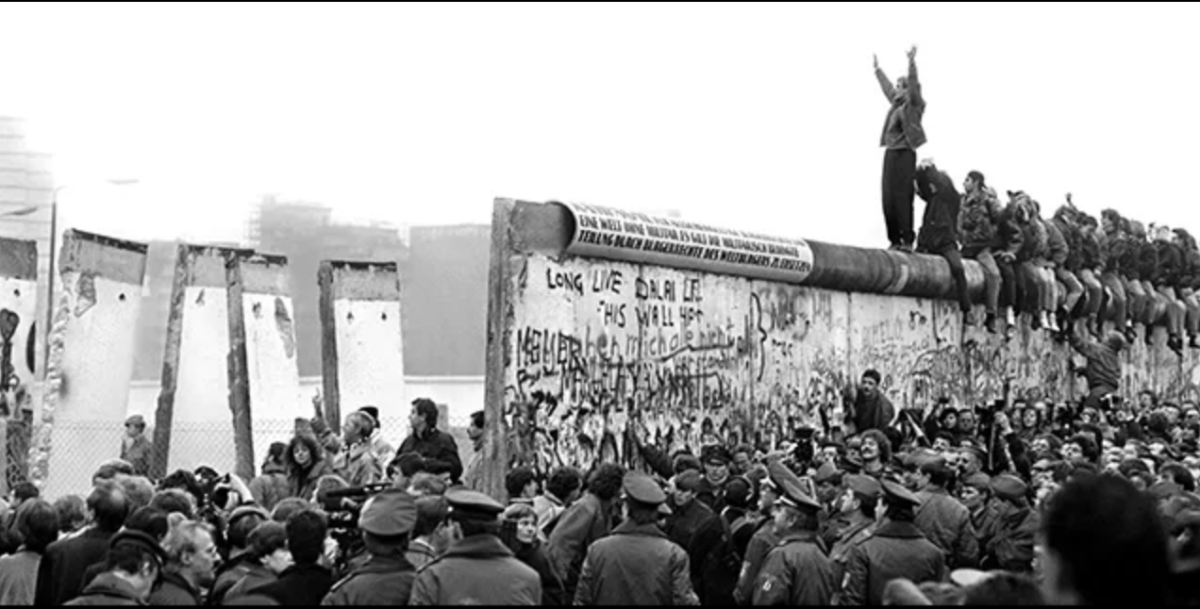
On the evening of November 9, 1989, East Berliners walked through the Bornholmer Straße checkpoint and climbed onto a concrete barrier that had been built to keep them in. Two years and five months earlier, an American president had stood at the Brandenburg Gate, roughly a mile from where those crowds gathered, and told the general secretary of the Soviet Union, in the plainest language available, to take it down.
“General Secretary Gorbachev, if you seek peace, if you seek prosperity for the Soviet Union and Eastern Europe, if you seek liberalization: Come here to this gate. Mr. Gorbachev, open this gate. Mr. Gorbachev, tear down this wall!”
It is the single most consequential sentence an American president spoke in the second half of the twentieth century, and it nearly didn’t survive the bureaucracy. The State Department’s European bureau thought it was presumptuous. The NSC’s senior staff thought it was too blunt, that a line so direct would embarrass the general secretary and complicate the summit calendar. Speechwriter Peter Robinson had drafted it after a trip to West Berlin in which a local woman told him that if the Soviets ever relaxed, “the wall will fall.” The foreign policy professionals wanted it softened, or cut. Reagan read it, liked it, and kept it. In a 1987 briefing, when aides again raised objections, the president’s answer was, essentially, that it was true and he was going to say it.
That whole thing illustrates how the establishment gets it wrong. They were structurally biased toward the polite half-measure.
The revisionist account of 1989 goes like this: the Soviet system rotted from within, Gorbachev loosened the bolts, and the Wall fell on its own schedule. Reagan merely narrated. There is a kernel of truth in it, and a large omission.
Communism was always going to fail. Its economics were fantastical: a price system abolished by decree, incentives replaced with quotas, and a country with a third of the world’s topsoil importing grain. But systems that are doomed take a long time to die, and can be helped to die sooner. What Reagan did was build the machinery of pressure that made the rot terminal rather than chronic.
He did it deliberately, publicly, and over the objections of the same people who thought “tear down this wall” was rude. The 1980 platform his campaign ran on contained a flat prediction: “We will not be satisfied until the Berlin Wall comes down.” In 1981 he lifted the grain embargo’s leverage and hit Soviet hard-currency earnings; his administration weaponized the Farewell dossier, the KGB defector’s catalog of Soviet technology theft, to tighten export controls through COCOM; he pushed the Saudis to flood the oil market, collapsing the price the USSR depended on to buy Western goods; he deployed the Pershing II and ground-launched cruise missiles in Europe over the largest peace demonstrations in a generation, and then walked out of Reykjavik in 1986 rather than surrender the Strategic Defense Initiative, which the Kremlin understood would bankrupt it to match.
And he armed the resistance. The Reagan Doctrine, Poland’s Solidarity, the Afghan mujahideen, the Contras, Angola’s UNITA. It was the first American strategy since containment’s founding to have the word rollback in its operating logic rather than its footnotes. In 1982 he stood in Westminster and said the march of freedom would leave Marxism-Leninism “on the ash heap of history.” In 1983 he called the Soviet Union an evil empire and was told it was undiplomatic. Both phrases turned out to be descriptions.
None of this required a crystal ball. It required a decision about what communism was. It was never a rival economic model with different preferences, but a system with a fatal design flaw.
The American founding rests on a claim about human nature: that men are not angels, that power is predatory unless constrained, and that rights precede government rather than being granted by it. The Constitution’s architecture, including enumerated powers, a separation of powers, federalism, and a Bill of Rights, is not a set of procedural preferences. It is a machine built on the premise that centralization is dangerous and that the burden of proof always lies with the centralizer.
Communism is the pure negation of that premise. It asserts that rights are grants, that the collective precedes the individual, that a vanguard can plan what millions cannot discover, and that the party’s purposes justify the abolition of every intermediary institution (the family, the church, the local association, and the private sector). Where the founders distributed power, Lenin concentrated it. Where the founders assumed the state would get things wrong, the vanguard assumed it could not.
This is why Reagan’s constitutionalism and his foreign policy were of one piece. In his 1964 “A Time for Choosing,” he described the choice as being between self-government and the anthill. His 1987 Berlin speech quoted the Declaration’s logic directly: “the advance of human liberty can only strengthen the cause of world peace.” He was not delivering a policy brief. He was stating an anthropology.
And it is why the speech’s central passage was economic rather than diplomatic. Reagan noted that in the West, output and prosperity had reached levels without precedent, while in the communist world there was “failure, technological backwardness, declining standards of health, even want of the most basic kind – too little food.” Then the line that ought to be printed on the wall of every Democratic caucus room: “the Soviet Union still cannot feed itself.”
We are not guessing about how this turned out. The evidence of collapse is not some ideological talking point; it is the historical record.
The USSR dissolved in 1991 without a shot fired in its own defense. Soviet male life expectancy had been falling before the end. East Germany, the showcase, was bankrupt. Deng Xiaoping bolted markets onto the command economy in 1978 and lifted hundreds of millions out of poverty by doing so; Vietnam did the same with doi moi and now exports more than it can consume. North Korea, the most faithful surviving specimen, starved through the 1990s and still rations food. Cuba repairs 1950s Buicks with hand tools. Venezuela, a country sitting on the largest proven oil reserves on earth, ran out of toilet paper, then ran out of electricity, then ran out of people.
There is no case anywhere, ever, of a command economy outproducing a market one over any meaningful span. There is no case of a centrally planned society that did not eventually require a wall to keep its population from leaving.
Now look at the party that just won the 2026 Midterms Elections.
On November 3, Democratic Socialists of America-backed candidates won a record number of House seats, with the group prevailing in something on the order of two-thirds of the races it endorsed. The figures are small in absolute terms. A bloc of five to seven – not a majority. But, the trajectory is what matters, and so is the branding. In today’s America, the word socialism is no longer a liability a candidate has to explain away. It is a credential.
The policy menu is familiar because it is old: single-payer health care with the private insurance industry abolished, a guaranteed federal job program, sectoral planning and industrial policy by subsidy, price controls on rents and drugs and groceries, and a Green New Deal whose authors cheerfully compare it to the Apollo program and the New Deal at once without noticing that those were different things. Add the newer layer: “equity” administered by regulators, and a preference for governing through agency rulemaking because agencies are unaccountable in ways that Congress is not.
Not one of these ideas is new. Every one of them was tried, at scale, in the twentieth century, and every one of them failed in the way Reagan described on June 12, 1987. The American left has spent thirty-five years since the Wall came down reinventing, in domestic policy, the exact arrangements that the Wall was built to contain.
And the escape hatch is always the same. When a socialist government collapses, the answer is that it wasn’t real socialism. The USSR wasn’t real. Venezuela wasn’t real. Cuba is real but small. Scandinavia is invoked constantly and is, in fact, mostly market economies with high taxes; a distinction that matters enormously and is never made.
There is a second, deeper forgetting. The left has largely abandoned the founders’ anthropology. If you believe natural rights are grants, you can legislate them into existence and reallocate them by decree. If you believe the state is the engine of justice rather than a necessary and dangerous tool, then enumerated powers are an inconvenience and federalism is an obstacle. Originalism becomes not a theory of interpretation but a rival metaphysics. So, the Constitution gets treated as a charter of aspirations to be updated by whoever holds the pen, which is precisely the vanguard logic in a different vocabulary.
Reagan’s closing line at the Brandenburg Gate was not a policy proposal. “Yes, across Europe, this wall will fall. For it cannot withstand faith; it cannot withstand truth. The wall cannot withstand freedom.”
He was right, and it fell, and a great many people who had called him a cowboy took credit for the outcome they had spent eight years disparaging.
Thirty-seven years on, the wall is mostly gone. A few slabs sit in a museum, there is a line of cobblestones through Berlin which is now no more than a tourist’s photo opportunity. But, the argument it settled is not gone. It is being relitigated by people who never had to live inside the answer, in a country whose prosperity was built on the side of the wall that worked.
The wall could not withstand freedom. Neither, in the end, could the party that built it. The only open question is whether we remember why. Today, in Berlin, a diminishing number of people lit candles along a street where a barrier used to be, for a country that was once two.
The forgetting, not the concrete, is the danger now.
— Political Pistachio Conservative News and Commentary