
By Douglas V. Gibbs
Let’s journey back through the mists of time to the very beginning of our great American story. It begins not with a roar, but with a whisper. A whisper of hope that carried across the vast, tempestuous Atlantic Ocean, carried in the hearts of brave souls who dared to dream of a new beginning.
Picture if you will those early colonists, huddled on wooden ships that seemed but fragile toys against the mighty expanse of water. These were not adventurers seeking gold or glory, but families seeking something far more precious: religious liberty. They left behind the familiar shores of England, where their faith made them outcasts, for an unknown land where they might worship as their hearts directed. They dreamed of a place where the soil was plentiful enough to feed their children, where the long arm of the British Empire could not reach into their daily lives and dictate the terms of their existence.
These pioneers arrived on shores that must have seemed both terrifying and magnificent. With little more than the clothes on their backs and the tools they carried, they began the monumental task of taming a wilderness. With blood, sweat, and tears, they cleared forests, built homes, planted crops, and established communities. From those first footholds at Jamestown and Plymouth, colonies sprang up and flourished all along the Atlantic Coast – each with its own character, yet all sharing the common thread of hard-won independence.
As the colonies grew and prospered, something remarkable began to stir in the hearts of the people. A Great Awakening swept through the settlements like a cleansing fire, reminding them that only a virtuous people are capable of true freedom. In meeting houses and open fields, preachers spoke of liberty not just as a political ideal, but as a divine right endowed by the Creator himself. This spiritual renaissance laid the foundation for what was to come, for it taught the colonists that their rights came not from any king or parliament, but from God himself.
But as virtue flourished, so too did tyranny across the sea. The British Empire, once a distant presence, began to tighten its grip. Taxes were imposed without representation; taxes on tea, on paper, on every aspect of colonial life. Red-coated British soldiers marched through colonial streets, their presence a constant reminder that the freedoms the colonists had worked so hard to establish could be taken away at the whim of a monarch an ocean away.
The people had grown too strong, too independent, too American to simply bow their heads. When British ships arrived in Boston Harbor carrying tea taxed by a parliament in which they had no voice, the colonists responded with an act of defiance that would echo through the ages. Disguised as Mohawk warriors, these sons of liberty boarded the ships and, under the cover of darkness, sent 342 chests of British tea swirling into the cold waters of Boston Harbor. This was no mere act of vandalism; it was a declaration that the American spirit would not be silenced.
The tensions escalated until that fateful day when the first shots were fired at Lexington Green. British troops marched to seize colonial weapons stored in Concord, but word of their mission spread like wildfire through the countryside. Farmers, storekeepers, fishermen, ordinary men who moments before had been tending their fields and mending their nets, grabbed their muskets and stood as one against the mightiest empire on earth. They fell back before the advancing British regulars, but not before ensuring that the weapons and ammunition at Concord were safely hidden away. The Revolutionary War had begun.
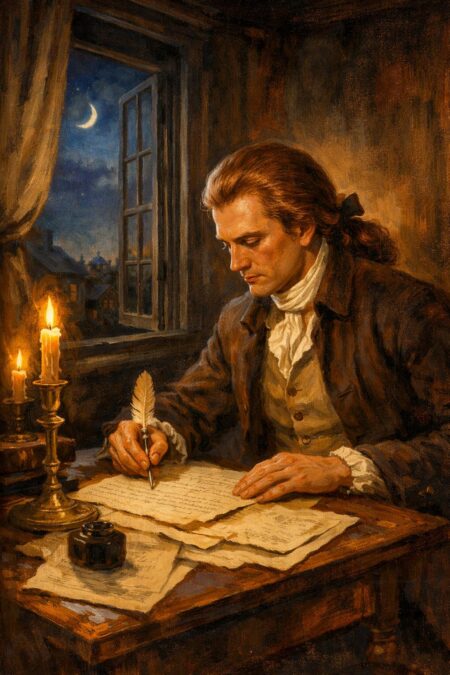
As battles raged from New England to the Carolinas, something extraordinary was happening in Philadelphia. Delegates from across the colonies gathered, knowing that the time had come to make a stand, not just with weapons, but with words. In the sweltering summer heat of 1776, in a room filled with the weight of history, these men debated and deliberated. And in the darkness of night before July 4th, a tall, red-haired Virginian named Thomas Jefferson sat at his desk, quill in hand, crafting the document that would lie at the center of it all.
The Declaration of Independence was more than a political statement; it was a call to arms, a call for freedom, and a call for the grace of Almighty God. With words that would ring through the centuries, Jefferson declared that “all men are created equal, that they are endowed by their Creator with certain unalienable Rights, that among these are Life, Liberty and the pursuit of Happiness.” On July 2nd, the document was signed by John Hancock with a signature so bold that King George III could read it without his spectacles. The formal document was fixed and prepared on July 3rd, so that the final declaration would be ready for the world on July 4, 1776 – 250 years ago.
As the delegates signed their names to this revolutionary document, they did so with full knowledge of the price they might pay. With “a firm reliance on the protection of divine Providence,” they mutually pledged to each other their lives, their fortunes, and their sacred honor. These were not idle words; each man understood that by signing this document, he was signing his own death warrant if the rebellion failed.
And God answered their prayers. Shortly after the Declaration was signed, as General Washington’s army faced certain defeat in New York, a mysterious fog rolled in, thick and impenetrable. Under the cover of this divine blanket, Washington’s forces slipped across the East River, escaping the trap that the British had set for them. Was this mere coincidence, or the hand of Providence guiding the birth of a nation?
Time and again, divine intervention seemed to bless the American cause. When Washington’s army was on the verge of collapse, he led them across the icy Delaware River on Christmas night to surprise the Hessians at Trenton. At Valley Forge, when starvation and cold threatened to destroy the Continental Army, they emerged from that winter crucible stronger and more determined than ever. And finally, at Yorktown, with the French fleet blocking British escape and Washington’s forces closing in from land, the British army surrendered, and America was born.
My friends, this is our story – a tale not just of human courage and determination, but of divine providence guiding the birth of a nation conceived in liberty. It is the story of farmers and shopkeepers who stood against an empire, of statesmen who crafted words that would inspire the world, and of a God who seemed to smile upon their noble cause.
As we celebrate 250 years since that momentous day in Philadelphia, let us remember that America was not founded by accident, but by design – a design that combined the courage of our Founding Fathers with the grace of Almighty God. It is this combination that has carried us through the darkest moments of our history and that will guide us through the challenges ahead.
The tale of America is not finished; it continues with each generation that takes up the mantle of freedom and responsibility. May we, like those who came before us, have the courage to stand for liberty, the wisdom to recognize the hand of Providence in our affairs, and the faith to believe that, with God’s help, the best days of America are yet to come.
God bless America, and may He continue to guide our great nation in the years to come.
— Political Pistachio Conservative News and Commentary