
By Douglas V. Gibbs
It was a sweltering June of 1776. The city was alive with tension and possibility. Philadelphia, the heart of revolutionary America, buzzed with the energy of men wrestling with the most consequential question of their time: Should the American colonies break away from the mightiest empire on Earth?
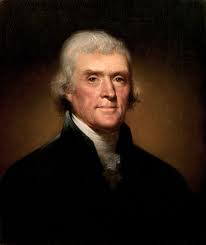
Into this charged atmosphere stepped the Second Continental Congress, a gathering of brave delegates who had already risked everything by merely meeting. Now, they faced an even greater decision. With the weight of history upon their shoulders, they turned to a 33-year-old Virginian; a tall, red-haired man, with a mind as sharp as any lawyer and a pen as mighty as any sword. Thomas Jefferson, they tasked, with crafting the justification for America’s independence from Great Britain.
Picture Jefferson as he retreated from the bustling streets of Philadelphia to a quiet, rented parlor on the second floor of Jacob Graff’s newly built brick house at 7th and Market Streets. This was no grand office, no marble chamber. Just a simple room where history would be made. Armed with a portable writing desk he had designed himself, Jefferson worked in deliberate isolation, knowing that the words he put to paper might determine the fate of millions yet unborn.
For two weeks, this quiet room became a crucible of revolutionary thought. Jefferson poured over ideas from philosophers like John Locke, whose writings on natural rights had ignited minds across the colonies. He drew from colonial pamphlets and the collective grievances that had been building for years. But he did more than compile arguments—he wove together grievances and revolutionary ideals into something extraordinary. Jefferson set out to craft not just a political brief, but an enduring piece of literature that would capture what he called the “American mind.”
In those long hours of concentration, with Philadelphia’s summer heat pressing in, Jefferson reached deep into his understanding of human nature and divine truth. He knew that mere legal arguments would not suffice; what was needed was a document that would speak to the heart as well as the mind, that would articulate not just why America should be free, but why freedom itself mattered to all humanity.
Before presenting his “original Rough draught” to the full Continental Congress, Jefferson shared his words with a five-man committee that included two of the most brilliant minds of the age: John Adams, the passionate advocate from Massachusetts, and Benjamin Franklin, the wise and witty polymath from Pennsylvania. These three giants of revolutionary thought sat together, reviewing Jefferson’s work, making roughly two dozen edits to his text. They refined phrases and ensured the tone was perfectly calibrated to rally the colonies; not just to anger, but to purposeful action built upon the foundation of timeless truth.
When the document finally reached the floor of Congress, the delegates spent two days debating and heavily editing Jefferson’s writing. They slashed roughly a quarter of his original draft, including an impassioned passage he had written condemning King George III for perpetuating the slave trade. Though Jefferson sat frustrated by the heavy red-lining, his words, his thoughts, his carefully crafted arguments being cut away, the core message remained intact, shining through like a beacon in the night: that all people possess unalienable rights, chief among them Life, Liberty and the pursuit of Happiness.
Then came the moment that would echo through eternity. On July 2, 1776, Congress officially voted to sever ties with Great Britain. The decision was made, the course set. But there was still the matter of making it official, of putting into words what their hearts had already decided. Two days later, on July 4, they formally adopted the edited text of Jefferson’s Declaration of Independence.
Think of that moment. Fifty-six men, representatives of thirteen diverse colonies, putting their names to a document that declared them traitors to the Crown and patriots to a new ideal. They knew the risks. They knew the price they might pay. Yet they signed anyway, with courage that still takes our breath away centuries later.
The elegant words Jefferson had penned in that quiet parlor would soon be galloped on horseback across the thirteen colonies, printed in broadsheets and read aloud in town squares. They would rally troops facing impossible odds, spark a revolution that would shake the world, and establish principles that would guide not just America but nations yet unborn.
From that simple room in Philadelphia came a document that would change the course of human history. It began as the work of one man in isolation, but became the voice of a people yearning to be free. It started as a justification for rebellion, but ended as a declaration of human dignity that transcended time and place.
As we reflect on those momentous days in June and July of 1776, let us remember that freedom is not born in battle alone, but in the quiet rooms where thoughtful souls dare to dream of a better world. Let us remember Thomas Jefferson, sitting at his portable desk, crafting words that would outlive empires and inspire generations. And let us remember that the Declaration of Independence was not just the birth certificate of a nation, but a testament to the power of ideas to transform the world.
The tale of that Philadelphia parlor reminds us that greatness often comes from humble beginnings, that the most powerful revolutions can begin with a single person putting pen to paper, and that the words we speak today might just echo through the ages, changing lives we will never meet, in times we can scarcely imagine.
This is our heritage as Americans. Not just the battles won or the territories claimed, but the ideas articulated in that quiet room, ideas that continue to guide us, challenge us, and inspire us to build a more perfect union. May we never forget the power of those words, and may we always strive to live up to their promise.
— Political Pistachio Conservative News and Commentary