

By Douglas V. Gibbs
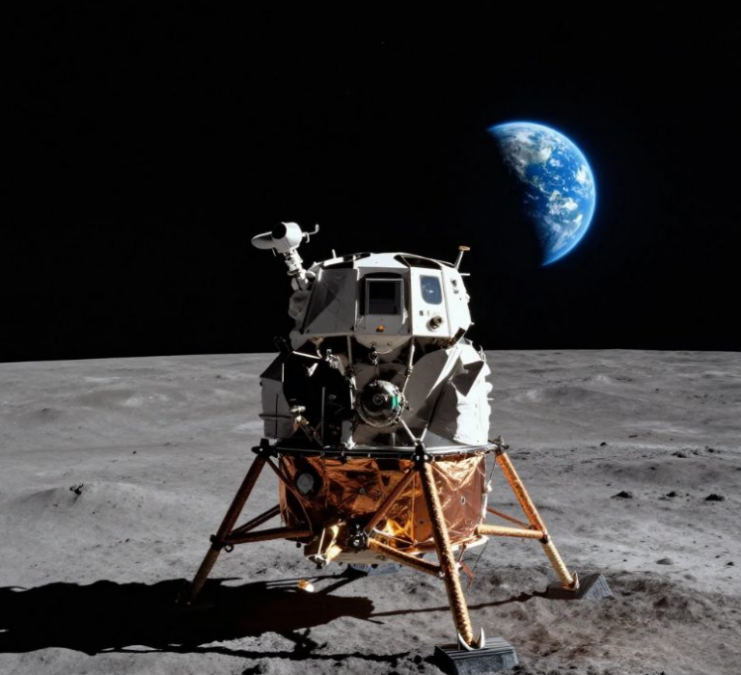
President Trump’s fascination with space exploration and his desire to return Americans to the moon and eventually Mars represents one of the most ambitious space policy initiatives of the 21st century, much less the History of the United States. The evolution of this vision and its transformation into the Artemis Program reveals how political leadership can reshape space priorities.
In December 2017, shortly after taking office, Trump signed Space Policy Directive 1, which refocused America’s space program on sending astronauts back to the moon. This directive marked a significant shift from previous administrations’ priorities, which had largely focused on low Earth orbit activities and partnerships with commercial space companies. Trump declared in 2017 that “this time, we will not only plant our flag and leave our footprints,” but “establish a foundation for an eventual mission to Mars.”
While U.S. interest in returning to the Moon pre-dated his entry into politics, Trump directly created what became Artemis in his first term, vowing to “launch American astronauts to plant the Stars and Stripes on the planet Mars.” This ambitious vision positioned lunar exploration as a stepping stone toward the more distant goal of Martian exploration.
In May 2019, NASA officially named the new lunar exploration program “Artemis” – in Greek mythology, the twin sister of Apollo and the goddess of the moon. This naming choice deliberately connected the new initiative to NASA’s historic Apollo program that first landed humans on the moon in 1969, while also emphasizing its distinct identity and goals.
The Artemis Program was formally established during Trump’s first term with the explicit goal of returning humanity to the Moon. Unlike the Apollo missions of the 1960s and 1970s, which were primarily about exploration and demonstrating technological prowess, Artemis was designed with a longer-term vision of establishing a sustainable human presence on the lunar surface.
Trump’s vision for Artemis extended beyond simply returning to the moon. He wanted to establish a permanent lunar base that would serve as a testing ground for technologies needed for future Mars missions. According to his plans, these bases “will establish U.S. dominance on the Moon, enable more intensive exploitation of lunar resources by NASA and U.S. companies, and serve as a testing ground for technologies” that will be used to travel to Mars.
Initially, Trump wanted to land astronauts on the Moon by 2024, an ambitious timeline that many experts considered unrealistic, and one that became very unlikely after the 2020 Presidential Election. The deadline was since been pushed back to 2028, which would coincide with the final productive year of his second term. According to his plans, 2028 would see up to two astronaut landings on the lunar surface, marking the beginning of lunar colonization with permanent bases established by 2032.
For Trump, the Artemis Program represents not just a scientific endeavor but a powerful symbol of American leadership and technological prowess. He grew up during the Apollo era and “wants to top the achievements of Apollo 11 and its brethren” with a moon base, nuclear rocket, and trip to Mars.
The program also aligns with Trump’s “America First” approach to policy. A successful Artemis mission could provide “a competitive edge with China, the possibility of a lunar gold rush, and a rare moment of national unity” at a time when America seems to be polarized. Some experts have suggested that the Artemis mission could replicate the unifying effect of the Apollo 11 Moon landing, which provided “a rare moment of collective national pride at a difficult time in US history” despite the divisions of the 1960s.
Despite Trump’s strong support for the program, there have been challenges. Artemis has faced multiple delays, with Artemis 2 facing postponements from November 2024 to early 2026 due to technical issues including hydrogen leaks.
The program’s goals have also evolved. Along the way among its primary objectives was to land the first female astronaut and first astronaut of color on the lunar surface. However, this goal was removed from NASA’s website around March 2025 under the Trump administration, aligning with Trump’s “merit-based” agenda.
The Artemis Program’s development has been characterized by shifting timelines, evolving mission objectives, and the complex interplay between political vision and technical reality. During President Trump’s second term he transformed the program’s goals into a concrete launch plan, and a space initiative that overcame numerous challenges to reach its current operational state.
The Artemis Program underwent significant structural changes during its development phase. The uncrewed Artemis I mission successfully sent an Orion spacecraft to lunar orbit in November 2022, serving as a critical test of the Space Launch System (SLS) rocket and Orion capsule. This milestone paved the way for crewed missions, though not without substantial delays from the original 2016 target plans.
Under Trump’s renewed vision, NASA announced a series of transformative initiatives to achieve the president’s National Space Policy. These included standardizing the SLS rocket configuration, adding an additional mission in 2027, and undertaking at least one surface landing every year thereafter. This revised architecture repositioned Artemis III – now scheduled for 2027 – to focus on testing integrated systems and operational capabilities in Earth orbit in advance of the Artemis IV lunar landing.
A notable aspect of Artemis’s development has been the alignment of mission timelines with political considerations. NASA maintained its 2028 target for the first Artemis Moon landing in part for political reasons, as it aligned with President Trump’s renewed space policy calling for Americans to be back on the lunar surface by 2028 – a deadline that fell within his current term of office.
The Trump administration’s commitment to space exploration has been a consistent theme, with the president himself stating, “You know, I had a decision to make in my first term, and the decision is: What are we going to do at Nasa? Are we going to have it be revived, or are we going to close it down?” This direct presidential involvement has shaped the program’s direction and priorities throughout its development.
In an attempt to streamline NASA, he has been criticized for cutting the overall budget, but President Trump is simply taking a businessman’s approach. Cut the waste so that there is funding for bigger and better things. His opponents have accused him of creating a paradox, cutting funding as he seeks more operations by NASA. This fiscal tension highlights the complex relationship between the political battlefield and budgetary reality.
The Artemis Program has faced significant technical hurdles that have necessitated schedule revisions. By 2023, NASA had indicated that Artemis III could proceed without a landing, but there were concerns about the Orion spacecraft’s heat shield. There were also delays in the development of the Starship Human Landing System. Alternative concepts studied included a crewed visit to the now-cancelled Gateway space station and a low Earth-orbit docking test between Orion and the Starship HLS.
On February 27, 2026, NASA Administrator Jared Isaacman confirmed a revised plan for Artemis III to perform tests with one or both landers in Earth orbit, with Artemis IV tentatively designated as the first crewed lunar landing mission, scheduled for 2028. This revision represented a significant shift in the program’s architecture and timeline.
In March 2026, NASA canceled the Lunar Gateway program, removing it from Artemis mission planning. Under earlier plans, the first two Gateway modules – the Power and Propulsion Element (PPE) and the Habitation and Logistics Outpost (HALO) – were to be launched together on a Falcon Heavy rocket. This cancellation represented a major architectural change that simplified the mission profile but also eliminated a planned orbital outpost around the moon.
The successful launch of Artemis II on April 1, 2026, marked a pivotal moment in the program’s development. The nine-day lunar flyby mission carried four astronauts – Commander Reid Wiseman, pilot Victor Glover, and mission specialists Christina Koch and Jeremy Hansen – and represented the first crewed flight beyond low Earth orbit since Apollo 17 in 1972.
This mission achieved several historic milestones, including the first time humans viewed entire sections of the far side of the Moon and becoming the humans to have traveled farthest in space. The successful completion of Artemis II’s major milestones demonstrated the viability of the SLS rocket and Orion spacecraft systems and set the stage for subsequent missions.
The Artemis Program’s development has been shaped by significant leadership changes at NASA. Jared Isaacman, a billionaire entrepreneur and private astronaut, had a bumpy path to becoming NASA administrator. President Trump withdrew his initial nomination in May, then nominated him again in November, and he won confirmation in the Senate a month later.
Under Isaacman’s leadership, NASA has implemented bold schedule changes designed to decrease the time between missions to less than one year. Sweeping tax law signed by President Trump in 2025 included a provision that mandated the use of the Space Launch System through Artemis V, along with additional money for NASA to pay for the accelerated schedule.
As the Artemis Program moves forward from the successful Artemis II mission, it faces both technical challenges and political imperatives. The program intends to store propellant in a depot orbiting around Earth, which will be topped up by more than 10 separate tanker flights launched at regular intervals over months – a plan that looks elegant but is fiendishly difficult to execute.
The journey ahead remains ambitious, with NASA planning one crewed lunar landing per year beginning in 2028 with the fifth Artemis mission – planned for later that same year – marking the start of what the agency calls its Moon base. This accelerated schedule reflects both the technical progress made and the political imperative to establish a sustainable lunar presence during Trump’s second term.
Artemis I represented the critical first step in NASA’s ambitious plan to return humans to the Moon and eventually journey to Mars. The uncrewed test flight served as the foundation upon which all subsequent Artemis missions would be built, demonstrating the capabilities of the Space Launch System (SLS) rocket and Orion spacecraft in the harsh environment of deep space.
Artemis I launched on November 16, 2022, from Kennedy Space Center’s Launch Complex 39B, marking the inaugural flight of NASA’s next-generation space exploration systems. The mission lasted 25 days, during which the Orion spacecraft traveled 1.4 million miles into space, orbited the Moon, and returned to Earth with a precision splashdown in the Pacific Ocean.
The primary objectives of Artemis I were to test the integrated systems in a real mission environment before putting astronauts on board. This included validating the SLS rocket’s performance, testing Orion’s heat shield during reentry, demonstrating navigation and communication systems at lunar distances, and ensuring the spacecraft could support human life during future missions.
One of the most significant technical achievements of Artemis I was the successful flight of the SLS rocket, the most powerful rocket ever built. The rocket performed flawlessly, delivering Orion to its planned trajectory with precision that exceeded expectations.
However, the mission was not without challenges. During reentry, the Orion spacecraft’s heat shield experienced unexpected erosion, which would later impact the planning for Artemis II. This finding led NASA engineers to modify the reentry profile for the crewed mission, replacing the planned “skip reentry” with a steeper entry profile to minimize heat shield exposure.
Another aspect of Artemis I was the deployment of 10 CubeSats – small secondary payloads that hitched a ride to space. These included the world’s tiniest lunar lander and a solar-sailing asteroid scout. However, several of these science experiments experienced difficulties, including loss of communications and battery anomalies, with some failing altogether.
Artemis I carried an array of scientific experiments and technology demonstrations beyond the CubeSats. These included radiation detectors to measure the deep space environment that future astronauts would experience, biological experiments to assess the effects of radiation on living organisms, and technology demonstrations for future lunar exploration.
The mission also captured stunning imagery of Earth and the Moon from distances not seen by human-rated spacecraft since the Apollo era. These images not only provided valuable scientific data but also helped reconnect the public with the wonder of space exploration.
Perhaps the most important contribution of Artemis I was the data it collected to inform subsequent missions. The flight provided invaluable information about spacecraft performance, radiation exposure, and navigation in deep space that could only be gathered through an actual mission.
The mission also tested Orion’s ability to travel far beyond the Moon, reaching a maximum distance of approximately 280,000 miles from Earth – farther than any spacecraft built for humans has ever flown. This demonstrated the system’s capability for the more ambitious missions planned for the Artemis program.
The success of Artemis I represented a watershed moment for NASA’s exploration ambitions. It proved that the agency could develop and fly complex deep space systems after a decade of development, validating the design of both the SLS rocket and Orion spacecraft.
The mission also established a template for international cooperation in space exploration. The European Space Agency provided the European Service Module for Orion, which provides power, propulsion, and life support systems for the spacecraft. This partnership model would continue in subsequent Artemis missions.
Artemis I’s success set the stage for Artemis II, which would carry four astronauts on a journey around the Moon and back – the first crewed lunar mission in over half a century. The data and experience gained from Artemis I directly informed the planning and execution of this follow-up mission, demonstrating the critical importance of this foundational flight in NASA’s lunar exploration architecture.
As we look back at Artemis I, we can see it as the essential first step that made the renewed era of lunar exploration possible. Without this successful uncrewed test flight, the crewed missions that followed would not have been possible, and NASA’s ambitious plans for sustainable lunar presence and eventual Mars exploration would have remained theoretical rather than operational.
Artemis II represents a pivotal moment in human space exploration as the first crewed mission to travel beyond low Earth orbit since Apollo 17 in 1972. The planning and preparation for this historic lunar flyby mission involved years of meticulous work, numerous technical challenges, and several schedule adjustments before finally achieving its successful launch on April 1, 2026.
The Artemis II crew consisted of NASA astronauts Reid Wiseman (Commander), Victor Glover (Pilot), Christina Koch (Mission Specialist), and Canadian Space Agency astronaut Jeremy Hansen (Mission Specialist). This diverse crew was selected to represent the international partnership at the heart of the Artemis program and to fulfill the mission’s primary objective: testing the Orion spacecraft’s life support systems and demonstrating human performance in deep space environment ahead of future lunar landing missions.
The path to launch was not without significant challenges. NASA originally targeted a November 2024 launch date, which was initially delayed until September 2025, then rescheduled for early 2026. Both February and March 2026 launch attempts were called off due to hydrogen leaks and other technical problems. A January 2026 North American winter storm also caused additional delays in preparations.
One of the most critical technical issues involved Orion’s heat shield. Following unexpected erosion observed during the uncrewed Artemis I mission, NASA had to modify the reentry profile for Artemis II, replacing the planned “skip reentry” with a steeper entry profile to minimize heat shield exposure. The agency conducted additional testing and analysis to evaluate scenarios involving more extensive heat shield damage, ultimately determining that the underlying structure would remain intact and protect the crew under conditions exceeding those expected during reentry. Nonetheless, work on improving the heat shield is currently in place to ensure the heat shield holds more successfully during subsequent missions.
The final preparations for Artemis II began in earnest in January 2026, with the rollout of the fully stacked Space Launch System (SLS) rocket and Orion spacecraft to Launch Pad 39B at Kennedy Space Center on January 17. The four-mile journey took approximately 12 hours to complete. After initial pad preparations, the vehicle was rolled back to the Vehicle Assembly Building for additional work before returning to Launch Pad 39B on March 19, 2026.
During these final preparations, teams connected electrical power, environmental control systems, and cryogenic propellant lines, while conducting comprehensive systems checks to ensure all components were functioning properly. The launch team also had to address a temporary hurdle that forced them to rely on legacy hardware from the Space Shuttle program while continuing the countdown.
The official countdown for Artemis II began on March 30, 2026, with the onsite countdown clock starting at 4:44 p.m. EDT, targeting a launch time of 6:24 p.m. on April 1. During this final phase, engineers powered up flight hardware, checked communication links, and prepared the rocket’s cryogenic systems for the precise fueling sequence required to load hundreds of thousands of gallons of super-cooled liquid hydrogen and liquid oxygen.
The crew spent the final countdown phase in quarantine under strict health monitoring, completing medical checks and following a controlled sleep schedule and nutrition plan to maintain optimal readiness for launch. On launch day, the astronauts departed from the Neil Armstrong Operations and Checkout Building, traveling to Launch Pad 39B where they boarded the Orion spacecraft.
With a unanimous “go” across all systems, Artemis II lifted off from Launch Complex 39B at 6:24 p.m. EDT on April 1, 2026, marking the first crewed launch of NASA’s SLS rocket and Orion spacecraft. The Orion spacecraft’s solar array wings fully deployed as planned, locking into place and began to draw power as the mission moved from ground operations to spaceflight.
Artemis II was designed to be a 10-day mission to take the four astronauts around the Moon and back to Earth. The mission profile included a translunar injection burn planned for 7:49 p.m. on launch day, pending mission management team’s approval. During their journey, the crew would observe the darkness of the Moon, the stars beyond, and visible planets from their unique vantage point in deep space.
The mission was scheduled to conclude with a splashdown off the coast of San Diego, California on April 10, 2026, where the crew was anticipated to be recovered by U.S. Navy personnel after exiting the Orion capsule and completing medical assessments.
The successful launch of Artemis II represents a critical step toward establishing a sustainable human presence on the Moon and eventually sending astronauts to Mars. It validated the performance of the SLS rocket and Orion spacecraft with crew aboard, demonstrating the systems’ capability to support human life in deep space.
As the first crewed lunar mission in over 50 years, Artemis II has reignited public interest in space exploration while providing valuable data and experience that will inform subsequent Artemis missions, including Artemis III (now planned as a demonstration mission) and Artemis IV, which will conduct the first human lunar landing of the program.
The mission also exemplifies the international cooperation that will characterize future space exploration, with the Canadian Space Agency’s participation through astronaut Jeremy Hansen and contributions to the program’s development. This partnership approach will be essential as humanity moves toward a permanent presence on the Moon and eventually journeys to Mars.
The launch of Artemis II on April 1, 2026, marked the beginning of humanity’s return to deep space. The historic mission, carrying four astronauts on a journey around the Moon, was filled with moments of triumph, technical challenges, and breathtaking views that captivated the world and demonstrated the capabilities of NASA’s next-generation space exploration systems.
Artemis II lifted off from Launch Complex 39B at Kennedy Space Center at 6:24 p.m. EDT on April 1, 2026, riding the powerful thrust of NASA’s Space Launch System (SLS) rocket. The ascent was flawless, with the SLS performing exactly as designed, delivering the Orion spacecraft and its crew of four into their initial orbit around Earth. The crew experienced the intense forces of launch, reporting that the ride was “smooth but powerful” as they climbed through the atmosphere and into space.
Approximately 8.5 minutes after liftoff, the core stage of the SLS separated as planned, followed by the jettisoning of the launch abort system and service module fairing. These critical milestones were achieved without incident, setting the stage for the translunar injection burn that would send the crew on their journey toward the Moon.
The translunar injection burn, a critical maneuver that placed Orion on its trajectory toward the Moon, was successfully completed at 7:49 p.m. EDT on launch day. This precisely timed engine firing accelerated the spacecraft to the velocity needed to escape Earth’s gravitational influence and coast toward lunar orbit.
During the coast phase, the crew settled into their routine in space, conducting systems checks and preparing for the mission’s primary objectives. The Orion spacecraft’s solar arrays performed flawlessly, generating the power needed for all onboard systems as the distance from Earth increased.
Despite the overall success of the mission, the crew and ground teams faced several technical challenges that tested their preparation and the robustness of the Orion spacecraft. While the technical difficulties with the space toilet seemed to be the challenge that graced the news media’s reports the most, there were other difficulties we didn’t hear as much about.
One significant issue involved the spacecraft’s communication system, which experienced intermittent dropouts during the journey to the Moon. These temporary losses of contact with Mission Control required the crew to perform additional procedures to restore full communications, demonstrating their training and adaptability in the deep space environment.
Another challenge involved one of Orion’s star trackers, which experienced intermittent performance issues. The crew worked with ground controllers to recalibrate the system and implement workarounds that ensured accurate navigation throughout the mission.
The highlight of the Artemis II mission was the lunar flyby, which occurred on April 6, 2026, as the spacecraft passed approximately 80 miles above the lunar surface. This maneuver brought the crew to the closest distance to the Moon any human has been since the Apollo era.
From their unique vantage point, the astronauts captured stunning imagery of both the near and far sides of the Moon, including regions never before seen by human eyes. The far side of the Moon, perpetually facing away from Earth, appeared as a stark, cratered landscape against the backdrop of space – a view that only robotic spacecraft had previously witnessed.
Commander Reid Wiseman described the experience as “humbling and awe-inspiring,” while pilot Victor Glover noted the striking contrast between the “gray desolation of the Moon and the vibrant blue of Earth in the distance.” These observations and the accompanying imagery helped reconnect the public with the wonder of space exploration while providing valuable scientific data.
Artemis II achieved several historic firsts during its mission. The crew became the first humans to view entire sections of the far side of the Moon, and they traveled farther from Earth than any human-rated spacecraft since the Apollo program.
The mission also conducted valuable scientific experiments, including radiation measurements to characterize the deep space environment that future astronauts will experience on longer missions to the Moon and Mars. Biological experiments assessed the effects of radiation on various organisms, providing data that will inform planning for future extended lunar stays.
After completing their lunar objectives, the crew began their journey home on April 8, 2026, with a trans-Earth injection burn that placed Orion on a trajectory back toward Earth. The return journey provided additional opportunities for systems testing and scientific observations as the spacecraft gradually closed the distance to home.
The most critical phase of the mission occurred on April 10, 2026, as Orion approached Earth’s atmosphere at approximately 25,000 miles per hour. Due to the heat shield concerns identified during Artemis I, NASA had modified the reentry profile for Artemis II, replacing the planned “skip reentry” with a steeper entry profile to minimize heat shield exposure.
As Orion entered the atmosphere, the spacecraft’s heat shield experienced temperatures up to 5,000 degrees Fahrenheit, creating a plasma sheath that temporarily blocked communications with the crew. This period of radio blackout, lasting approximately five minutes, was a critical test of the heat shield’s performance and the spacecraft’s ability to protect the crew during the most extreme portion of reentry.
Once through the peak heating phase, Orion’s parachutes deployed in a precisely timed sequence, slowing the spacecraft from hundreds of miles per hour to a gentle 20 miles per hour at splashdown. The Orion capsule touched down in the Pacific Ocean off the coast of San Diego, California at 10:47 a.m. PDT on April 10, 2026, concluding a mission that had traveled 1.4 million miles through space.
The recovery operation, conducted by U.S. Navy personnel and NASA teams, proceeded smoothly as divers approached the spacecraft and helped the crew exit the Orion capsule. After initial medical assessments on the recovery vessel, the astronauts were transported to shore for more comprehensive medical evaluations and debriefings.
The successful completion of Artemis II marked a pivotal achievement in NASA’s Artemis program, demonstrating the capability of the Space Launch System and Orion spacecraft to safely carry humans to lunar distance and return them to Earth. The mission’s accomplishments, despite the challenges encountered, have paved the way for future Artemis missions that will build on this foundation to eventually land astronauts on the Moon and establish a sustainable human presence there.
The successful completion of Artemis II has not only marked humanity’s return to deep space but has also set the stage for an ambitious new era of lunar exploration and the eventual journey to Mars. With Artemis II’s achievements as a foundation, NASA and its international partners are now moving forward with a carefully sequenced series of missions that will establish a sustainable human presence on the Moon and develop the technologies needed for the next giant leap: a crewed mission to the Red Planet.
Following the triumph of Artemis II, NASA’s attention now turns to Artemis III, currently scheduled for 2027. This mission will represent a significant evolution from Artemis II’s lunar flyby to a more ambitious demonstration of integrated systems in Earth orbit. In a notable shift from earlier plans, Artemis III will now focus on testing operational capabilities and conducting docking tests between the Orion spacecraft and the Starship Human Landing System in Earth orbit, rather than attempting a lunar landing.
This revised approach reflects NASA’s commitment to methodical testing and validation of systems before proceeding to the most challenging milestones. Artemis III will serve as a critical bridge between the lunar flyby of Artemis II and the lunar landing planned for Artemis IV, currently scheduled for 2028.
Artemis IV will mark the historic moment when humans once again walk on the lunar surface, achieving the primary goal of the Artemis program’s initial phase. This mission will build on all the knowledge gained from previous flights and incorporate lessons learned from Artemis I’s heat shield findings and Artemis II’s operational experience.
Beyond these initial landing missions, NASA’s vision extends to establishing a permanent human presence on the Moon. The agency plans to conduct one crewed lunar landing per year beginning in 2028, with Artemis V – planned for later that same year – marking the start of what NASA calls its Moon base.
This lunar base will serve as a scientific outpost, a testbed for new technologies, and a proving ground for the systems that will eventually carry humans to Mars. The architecture for this sustained presence includes surface habitats, power systems, rovers, and resource utilization capabilities that will allow astronauts to live and work on the Moon for extended periods.
The strategic importance of this lunar base was emphasized by NASA Administrator Jared Isaacman, who noted that it would “establish U.S. dominance on the Moon, enable more intensive exploitation of lunar resources by NASA and U.S. companies, and serve as a testing ground for technologies” needed for Mars missions.
While the Moon represents the immediate focus of the Artemis program, Mars remains the ultimate destination. The lunar base will serve as a critical analog for Mars missions, allowing astronauts to test technologies and procedures in a relatively accessible environment before attempting the much more challenging journey to the Red Planet.
The Artemis program is explicitly designed to develop and demonstrate the capabilities needed for Mars exploration. These include long-duration life support systems, surface operations in a hostile environment, resource utilization, and advanced propulsion technologies that will reduce travel time to Mars.
President Trump has been clear about this long-term vision, stating that the Artemis program represents “a foundation for an eventual mission to Mars” and that his administration is committed to “launch American astronauts to plant the Stars and Stripes on the planet Mars.”
Several key technologies are being developed under the Artemis program with direct applications to Mars exploration. These include advanced life support systems that can recycle air and water with high efficiency, closed-loop habitats that minimize resupply needs, and in-situ resource utilization capabilities that can produce oxygen, water, and propellant from local materials.
Nuclear propulsion represents another critical technology for Mars missions. NASA is developing nuclear thermal and nuclear electric propulsion systems that could significantly reduce travel time to Mars, from the current 6-9 months to as little as 3-4 months, thereby reducing radiation exposure and other risks to astronauts.
The Artemis program is also testing advanced communication systems, navigation technologies, and autonomous operations that will be essential for Mars missions, where communication delays with Earth will require greater spacecraft and crew independence.
The future of lunar and Mars exploration will be characterized by unprecedented international cooperation and commercial partnerships. The Artemis Accords, a set of principles guiding space exploration cooperation, have been signed by numerous countries, establishing a framework for peaceful exploration and resource utilization.
Commercial companies are playing an increasingly important role in both lunar and Mars exploration. Under NASA’s Commercial Lunar Payload Services (CLPS) program, private companies are delivering scientific instruments and technology demonstrations to the Moon, helping to establish a lunar economy that will eventually support commercial activities on Mars as well.
While NASA has not established a firm date for a crewed Mars mission, current planning suggests that the late 2030s or early 2040s represents a realistic timeframe, assuming continued progress and funding. This timeline allows for the gradual development and testing of technologies through the Artemis program, followed by increasingly ambitious Mars precursor missions, including robotic sample return and possibly uncrewed flights of the Mars transportation system.
The journey to Mars will be the most ambitious undertaking in human history, requiring sustained commitment over multiple presidential administrations and international partnerships. The Artemis program represents the essential first steps on this journey, establishing the capabilities, experience, and confidence needed to eventually venture to the Red Planet.
As we look to the future following the success of Artemis II, we are witnessing the dawn of a new era in space exploration. The Moon is no longer a destination to be briefly visited but a place where humans will live and work, conducting scientific research, testing new technologies, and preparing for the next great adventure.
The Artemis program, with its methodical approach to developing and testing systems, its international partnerships, and its clear vision for the future, provides a roadmap for this journey. Each mission builds on the successes of the previous one, gradually extending human presence farther into space and developing the capabilities needed for the ultimate goal: a human mission to Mars.
As President Trump has stated, the Artemis program represents not just a return to the Moon but “the beginning of a new era of space exploration that will take us to the Moon, Mars, and beyond.” With the successful completion of Artemis II, that new era has truly begun.
Bibliography
“Artemis Program.” NASA, 2026, https://www.nasa.gov/specials/artemis/. Accessed 11 April 2026.
“Artemis I Mission Overview.” NASA, 2022, https://www.nasa.gov/specials/artemis-i/. Accessed 11 April 2026.
“Artemis II Mission Overview.” NASA, 2024, https://www.nasa.gov/specials/artemis-ii/. Accessed 11 April 2026.
“Artemis III Mission Overview.” NASA, 2025, https://www.nasa.gov/specials/artemis-iii/. Accessed 11 April 2026.
“Artemis IV Mission Overview.” NASA, 2026, https://www.nasa.gov/specials/artemis-iv/. Accessed 11 April 2026.
“Space Launch System (SLS).” NASA, 2026, https://www.nasa.gov/exploration/systems/sls/. Accessed 11 April 2026.
“Orion Spacecraft.” NASA, 2026, https://www.nasa.gov/exploration/systems/orion/. Accessed 11 April 2026.
“Returning to the Moon with Artemis.” NASA, 2026, https://www.nasa.gov/specials/artemis/returning-to-the-moon/. Accessed 11 April 2026.
“Mars Exploration Program.” NASA, 2026, https://mars.nasa.gov/. Accessed 11 April 2026.
“Human Spaceflight.” NASA, 2026, https://www.nasa.gov/human-spaceflight/. Accessed 11 April 2026.