
By Douglas V. Gibbs
I remember when my parents’ black and white television showed the amazing scene of the moon landing. I was just a little tyke, but the image remains branded on my brain to this day. As a child I became obsessed with space. I have drawings from my elementary school years of the solar system I fashioned, and space capsules I dreamed my be the next to visit the moon. Then, after six landings, the lunar exploration ended.
The cancellation of Apollo missions 18-20 was driven by budget concerns. And, I am not sure the politicians had the stomach to push like President Kennedy had. The political reality was that the Nixon administration (a Republican president) was facing significant budget pressures from the Vietnam War, domestic spending priorities, and economic challenges. The Apollo program was extraordinarily expensive (about $280 billion in today’s dollars), and with the Cold War race to the Moon already had already been won. Public and political support for the continued massive spending had simply diminished. It not only was outside our budget, but it no longer paid political dividends, either.
NASA’s mission shifted to things like Skylab and the “Mission to Planet Earth.” The scientific community had developed new interests in studying Earth from orbit, which did in fact yield valuable climate and environmental data – especially considering the growing theories about how humanity may, or may not be, influencing changes in the climate’s global temperature.
The Space Shuttle program seemed to be a return to the space exploration thing I found myself interested in, and it turned out it had been conceived during the Nixon administration as a more cost-effective way to maintain space presence, but it had its share of setbacks, as well.
The Columbia disaster investigation revealed technical and organizational issues at NASA, rather than insulation changes driven by environmental concerns that some of the hard-lefties tried to claim. The foam insulation problem was a known issue that wasn’t adequately addressed across multiple administrations. With these kinds of internal issues, and again the budgetary concerns, the Space Shuttle program eventually also came to an end.
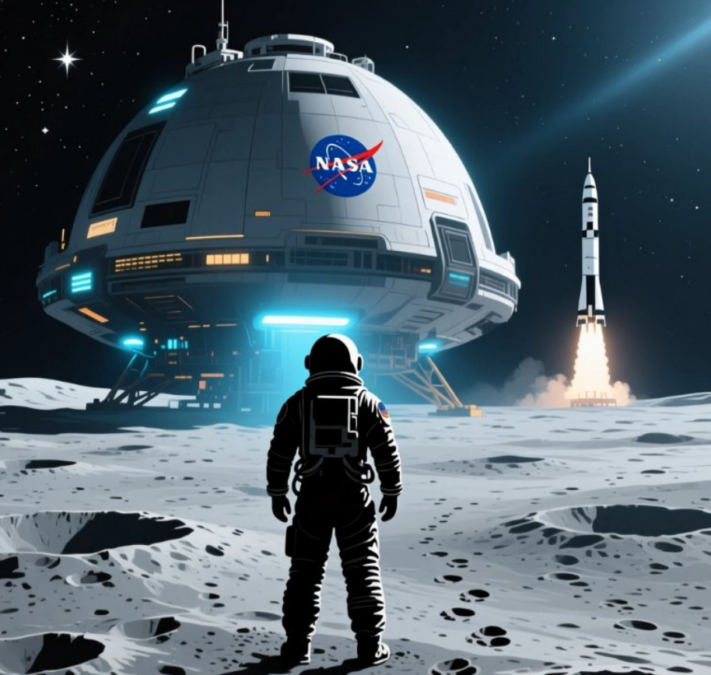
Then, President Trump emerged with the kind of energy that President Kennedy provided. And, a new two-step space race was emerging – first, returning to the Moon, and then achieving a human landing on Mars. The Artemis program represents a new American commitment to return to the Moon, with NASA’s budget receiving support across political spectrums. The rise of commercial space companies like SpaceX has also transformed the economics and capabilities of space exploration in ways that weren’t possible during the Apollo era.
The torch lit by Apollo was never truly extinguished, but merely passed to a new generation of dreamers and builders. As we stand on the precipice of humanity’s return to the Moon and our eventual journey to Mars, we are reminded that the spirit of exploration is not bound by budgets or political cycles, but by the unquenchable thirst for discovery that defines our species. The legacy of those early astronauts who first left their footprints in the lunar dust lives on in every rocket that pierces the heavens and every child who looks up at the night sky with wonder. America’s greatest days in space are not behind us, but ahead, waiting to be written by those bold enough to reach for the stars once more.
— Political Pistachio Conservative News and Commentary