
By Douglas V. Gibbs
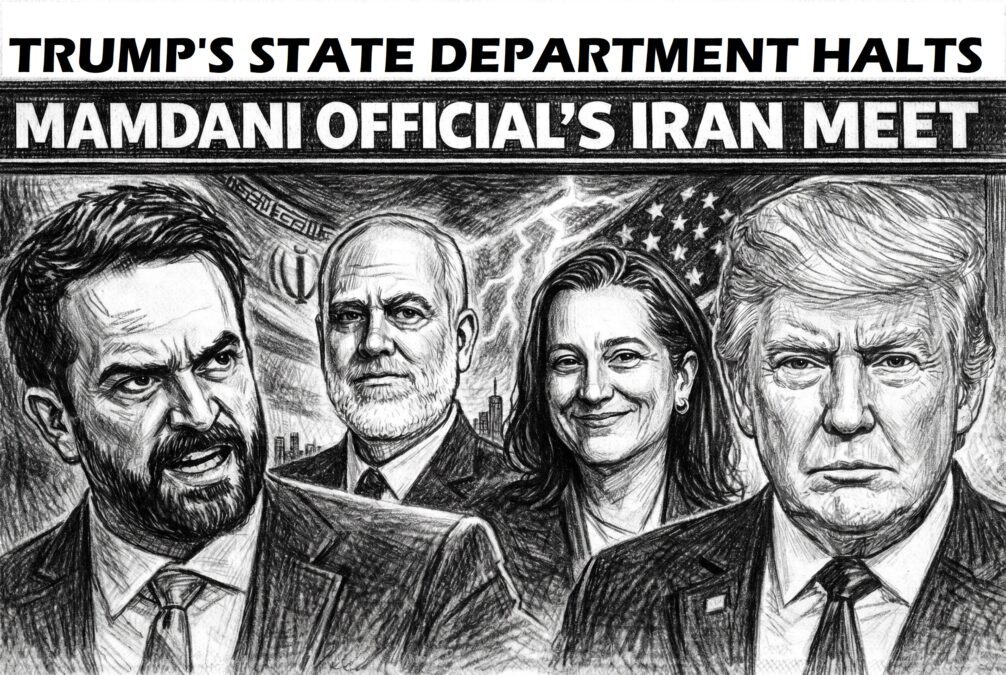
The Constitution clearly lays out that foreign relations belongs only to the federal government. In Article I, Section 10 it reads: “No State shall, without the Consent of Congress… enter into any Agreement or Compact with… a foreign Power.” This is a foundational principle of our federal system. Yet last week, we witnessed New York City Mayor Zohran Mamdani’s administration attempt to do precisely what the Framers forbade, only to be stopped by the State Department.
Commissioner Ana María Archila, who leads Mamdani’s Office for International Affairs, scheduled a meeting with Iran’s ambassador to the United Nations, Amir-Saeid Iravani. The timing could not have been more egregious, coming after the Iranian leadership fired missiles at commercial ships traversing the Strait of Hormuz in direct defiance of an interim peace agreement. Mamdani’s office, however, didn’t simply make a diplomatic misstep; it was a constitutional affront during active military operations.
Let’s be clear about who Iran is: a designated state sponsor of terrorism whose leaders have American blood on their hands and whose regime chants “Death to America” as a national mantra. This is not a country with whom we exchange pleasantries while they target our citizens and allies.
The Logan Act explicitly prohibits unauthorized citizens from negotiating with foreign powers that have disputes with the United States. While prosecutions under this law are rare, its purpose is clear: to prevent exactly what Archila attempted; a freelance foreign policy that undermines the federal government’s exclusive constitutional authority to conduct international relations.
What makes this incident particularly alarming is the ideological alignment between Mayor Mamdani’s Democratic Socialist agenda and Iran’s anti-American posture. Mamdani has condemned President Trump’s “illegal war of aggression” against Iran, positioning himself not as an American mayor but as a global citizen critical of U.S. foreign policy. This ideological sympathy with our adversaries creates a dangerous precedent when combined with official actions like the planned meeting with Iran.
Archila’s background is not in diplomacy but in activism as co-director of New York’s progressive Working Families Party, whose official position is that the war in Iran “can and must be stopped.” Her appointment to lead international affairs was controversial from the start, with insiders noting she was “woefully unqualified for the job.” Yet here she was, prepared to meet with representatives of a regime that actively works against American interests.
The State Department correctly intervened, calling it “unconscionable” that a New York City official would even consider such a meeting. This marks the second known instance in recent weeks where the Trump administration has stepped in over the Mamdani administration’s contacts with foreign leaders, highlighting a pattern of behavior that threatens to undermine national security.
Mayor Mamdani claims he was unaware of the meeting until receiving a press inquiry, calling it “made in error.” This excuse strains credulity. Either he is incompetent, unable to control his own administration, or he is complicit in these dangerous overtures to our enemies. Neither possibility inspires confidence in his leadership of America’s largest city.
The Office for International Affairs was designed to foster trade and exchange best practices, not conduct foreign policy. Yet under Mamdani’s leadership, it appears to have become a vehicle for advancing a specific political agenda that aligns more with our adversaries than with American interests.
This incident reveals a dangerous mindset among some on the radical left who view America not as a force for good in the world but as an imperialist power that must be checked. When this ideology infects local governance, we see officials like Archila attempting to normalize relations with regimes that seek our destruction.
The constitutional principle at stake is not trivial. Our federal system assigns foreign relations exclusively to the federal government precisely to prevent states and cities from pursuing independent foreign policies that might conflict with national interests or create confusion on the international stage. This principle becomes even more critical when dealing with hostile powers like Iran.
What happened in New York last week wasn’t just a diplomatic faux pas; it was a constitutional crisis narrowly averted. It serves as a warning about the dangers of electing officials who prioritize ideology over constitutional principles and national security.
As we face increasing threats from adversaries around the world, we cannot afford to have local officials playing at diplomacy with our enemies. The Constitution provides clear guidance on this matter, and the State Department’s intervention reinforces what should be obvious: America speaks with one voice to the world, and that voice belongs to the federal government, not to ideologically driven municipal officials in New York City.
The American people deserve better than leaders who sympathize with our enemies and attempt to undermine our foreign policy. They deserve leaders who understand and respect the constitutional framework that has kept our Union secure for over two centuries.
— Political Pistachio Conservative News and Commentary