

Political Pistachio

By Douglas V. Gibbs
In 2007, working with fellow constitutional originalists, I calculated that approximately 85% of the federal budget was unconstitutional. Today, after examining the complete federal budget, I estimate that figure has dropped to 83%. Despite its nominal drop, it still remains at an alarming percentage that reveals how far we’ve strayed from our constitutional foundations.
The problem isn’t merely academic. It represents a fundamental betrayal of the constitutional design that once limited federal spending to under 5% of GDP for most of American history. The transformation from that limited government to today’s behemoth wasn’t accidental. It was the result of what I call “Hamilton’s Heist.”
The Founding Fathers, or at least the ones who debated against Alexander Hamilton’s ideas, envisioned a system where states would act as fiscal guardians of the Republic. Under Article I, Section 9 of the Constitution, direct taxes had to be apportioned among the states according to population, meaning that the states collected federal taxes and could theoretically refuse payment if Washington exceeded its constitutional authority. It gave the states a direct voice regarding the federal budget, a system that provided a natural check on federal power that kept spending remarkably constrained.
Alexander Hamilton changed everything. As early as 1779, at just 24 years old, he advocated for a national bank. By 1791, as Treasury Secretary, he articulated the doctrine of “implied powers” in order to achieve his aim. Thomas Jefferson argued against implied powers, correctly asserting that any powers possessed by the federal government must be expressly enumerated in the text of the United States Constitution. Hamilton countered with his radical idea, claiming that the Constitution’s “necessary and proper” clause granted Congress authority to do whatever it deemed necessary to achieve its ends, even if not explicitly enumerated.
This Hamiltonian philosophy directly contradicted the views of not only Thomas Jefferson, but Father of the Constitution James Madison, and other Founders who believed that if the Constitution had intended to grant such important powers as erecting corporations, “it would have been expressly mentioned.” Jefferson noted that one reason the Convention rejected granting Congress power to issue corporate charters was fear that “then they would have a power to erect a bank, which would render the great cities… adverse to the reception of the Constitution.”
The consequences of Hamilton’s victory were profound. His First Bank of the United States lasted only twenty years before constitutional challenges forced its closure, but it established the precedent for perpetual national debt as a feature rather than a bug in our system. Hamilton believed that “a central economic system with managed debt was critical to the United States’ ability to undertake commerce” and proposed that the federal government assume state debts, making them “equal partners in the federal debt.” He would later argue that the states would then be more likely not to secede at first sign of trouble, considering they shared responsibility in the overall debt.
The Hamiltonian transformation accelerated dramatically in 1913 with two constitutional changes: the 16th Amendment, which eliminated apportionment and allowed direct federal taxation of citizens; and the creation of the Federal Reserve System, which privatized money creation. Before these changes, federal revenue averaged just 3% of GDP. Today, federal receipts have increased to 16.5% of GDP, and expenditures have reached 24.0% of GDP.
The 17th Amendment was then put in place to remove the states’ voice from the U.S. Senate – a measure put in place to ensure the state legislatures no longer had the ability to challenge the heist of the American monetary system begun more than a century before by Alexander Hamilton.
The economic consequences extend beyond mere numbers. The Federal Reserve creates money to purchase government debt, which dilutes the dollar’s purchasing power and imposes what amounts to a hidden “inflation tax” on all citizens. When the Fed creates money to buy treasuries, the cost is distributed across the economy through price increases rather than through direct taxation.
Even if we eliminated all unconstitutional spending, a massive 83% of the budget, we would still need approximately 76% of current direct tax revenues to fund the remaining constitutional functions. This reveals how deeply dependent our government has become on direct taxation of its citizens.
Restoring our constitutional fiscal order would require a incremental methodical approach. First, we must gradually reduce unconstitutional spending through sunset provisions and attrition rather than abrupt cuts that would create economic upheaval. Second, we need to reform monetary policy by reducing the Federal Reserve’s balance sheet and implementing rules-based monetary policy. Third, we should transition from direct federal taxation back to state-based apportionment. Finally, we must consider constitutional amendments to restore these fiscal constraints.
This restoration would be more than an economic exercise. It would hearken a return to the constitutional design that once made America exceptional. The Framers of the Constitution understood that when government can tax and spend without constraint, liberty inevitably erodes. They created a system of checks and balances to prevent this outcome, but those checks have been systematically dismantled over the past century.
The urgency of this moment cannot be overstated. With the national debt exceeding $40 trillion and annual interest costs now surpassing defense spending, we are approaching a point of no return. The time has come to reverse Hamilton’s Heist and restore the constitutional fiscal framework that once kept federal power in check and preserved American liberty for future generations.
— Political Pistachio Conservative News and Commentary

By Douglas V. Gibbs
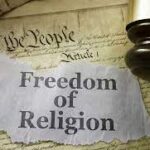
A recent unanimous ruling by the Maine Supreme Judicial Court represents more than just a troubling custody dispute. It signals a dangerous shift in how our legal system views religious liberty in America. The decision to grant a father veto power over his daughter’s religious upbringing, effectively banning a mother from taking her child to church or reading the Bible to her, strikes at the very heart of our constitutional republic’s founding principles.
The case involves Emily Bickford and Matthew Bradeen, unmarried parents of a 13-year-old girl. After their separation, Bickford converted to Christianity and began attending Calvary Chapel Greater Portland with her daughter. When Bradeen objected to his daughter’s church involvement, he took legal action, ultimately securing sole authority over his daughter’s religious upbringing. The Maine Supreme Court upheld this decision, arguing it served the child’s “best interest” because she experienced “fear and anxiety” from church teachings about Hell and the rapture.
What makes this ruling particularly alarming is how the court treated mainstream Christian beliefs as potentially harmful. The court allowed an expert witness to describe Calvary Chapel as a “cult” and “closed social system” despite it being a mainstream evangelical denomination with well-established doctrines. The court even placed scare quotes around basic Christian teachings about Heaven, Hell, and Christ’s return, treating them as strange and dangerous ideas rather than time-honored religious beliefs.
This case is not an isolated incident but part of a growing pattern of hostility toward Christians in America. Across the country, we’re witnessing churches burning to the ground with minimal media coverage, Christian business owners being forced to violate their consciences, Faith-based organizations facing discrimination for their beliefs, and Parents being penalized for raising their children according to their religious convictions.
The media’s relative silence on church arsons, compared to their intense coverage of incidents involving other religions, demonstrates a troubling double standard. In Michigan alone, multiple churches have suffered suspicious fires, including LaGrand Avenue Christian Reformed Church where four firefighters were injured battling the blaze. Similar incidents have occurred in Ohio, Florida, Mississippi, and Idaho.
The Maine ruling directly contradicts fundamental American principles. Our Founding Fathers established religious freedom as the first right in the Bill of Rights for a reason. They understood that a society without religious liberty is not truly free. The First Amendment explicitly prohibits government interference with the free exercise of religion, and all of the state constitutions contain similar language, yet the Maine Supreme Court has effectively punished a mother for exercising this fundamental right.
The court’s reasoning that allocating religious authority to one parent doesn’t “intrude” on parental rights defies logic and precedent. By privileging the father’s non-religious perspective over the mother’s Christian faith, the court has effectively established a hierarchy of beliefs, placing secular viewpoints above religious ones.
RELATED: A NATION FORGED BY FAITH AND FREEDOM
Benjamin Franklin famously stated that “only a virtuous people are capable of freedom.” He understood that liberty requires moral restraint and that virtue, often nurtured by religious communities, is essential for self-governance. When courts begin treating basic Christian doctrines as psychological harm, they undermine the very foundation of virtue that makes liberty possible.
The Maine court’s decision reflects a dangerous shift from protecting children from actual harm to shielding them from ideas that some judges find uncomfortable. This paternalistic approach treats religious beliefs as harmful rather than formative, undermining parents’ rights to direct their children’s moral and spiritual development.
This legal discrimination exists within a broader cultural context where Christianity is increasingly portrayed as intolerant, harmful, or extreme. Our educational systems often present faith through a hostile lens, while entertainment media regularly mocks religious believers. Even simple acts of Christian charity, like a Missouri grandmother who was told she needed a commercial license to feed breakfast to community members, face government and regulatory hurdles that are in direct violation of our natural right to religious freedom.
When a coffee shop owner in Idaho kicks out customers discussing pro-life issues, or when government officials require permits for neighbors sharing breakfast, we see how hostility toward Christian values manifests in everyday life. These incidents create a chilling effect on religious expression and community involvement.
The Maine case highlights the urgent need for judicial reform and renewed commitment to religious liberty. Liberty Counsel has announced plans to appeal to the U.S. Supreme Court, arguing that the Maine decision “rejects the First Amendment right of a fit parent to raise her child consistent with her Christian faith.”
This case should concern all Americans, not just Christians. When the government can decide which religious beliefs are acceptable for parents to teach their children, everyone’s freedom is at risk. The principle at stake transcends any single custody dispute. It’s about whether the government can effectively penalize citizens for their religious convictions.
To address this crisis, we must demand that courts apply strict scrutiny to any case involving religious freedom rather than dismissing such rights as secondary to a vague “best interest” standard. We must advocate for judicial nominees who respect the Constitution’s original meaning and understand that religious liberty is not a secondary concern but a fundamental right. We must support organizations that defend religious freedom in courtrooms and legislatures. We must educate our communities about the importance of religious liberty for all Americans, not just Christians. We must elect representatives who will confirm judges who respect the First Amendment’s protection of religious exercise.
The Maine Supreme Court’s decision represents a dangerous departure from American constitutional principles. By treating mainstream Christian beliefs as harmful and restricting a parent’s right to raise her child in the faith, the court has undermined the very foundation of religious liberty that makes our constitutional republic possible.
ENJOYING THE CONTENT? DROP A FEW COINS IN THE TIP JAR…
As Benjamin Franklin understood, freedom requires virtue, and for many Americans, religious faith provides the moral foundation for that virtue. When courts begin treating time-honored religious teachings as harmful, they not only violate constitutional rights but also undermine the moral framework necessary for our constitutional republic.
The preservation of religious liberty is not just a Christian concern. It’s an American one. The Maine case should serve as a wake-up call to all who value liberty, reminding us that when any group’s constitutional rights are threatened, everyone’s freedom is diminished. The path forward requires renewed commitment to the principles that has made America exceptional, including robust protection for religious liberty as the cornerstone of all our natural God-given rights.
— Political Pistachio Conservative News and Commentary

By Douglas V. Gibbs
Artificial Intelligence (Super Intelligence, according to President Trump at his United Nations speech) is a new technology. We’ve spent an awful lot of time watching science fiction movies show us how someday, AI will destroy us all. From “Would you like to play a game?” to “You’ve been targeted for termination,” we have been programmed from the beginning that the end comes when technology learns to outthink us. To be honest, I can’t say that the movies have a point, or that it’s silly to get all worked up about it. I’m a sci-fi guy, and even some of my own fictional writings address the AI versus humanity question.
It’s all fascinating for storytelling, but in the end, it’s all fiction.
In the real world, the concern over data centers we need for AI, and other internet connected things, has risen to near-hysteria. People are acting like a prison for hard-core inmates or a nuclear waste dump is being proposed in their backyards, and next to our schools and if we don’t stop it the prisoners and radioactive sludge will consume us all.
They protest and shout with a massive flow of emotion.
Their reasoning steps aside as their feelings claim all kinds of myths and misperceptions are attached to the dreaded data centers. It’s like the socialists out there protesting the evils of capitalism as they use all of the devices that came from free market innovation. The reality is, we enjoy the benefits of modern technology, and we’ve even come to rely on them, as we protest against the data centers that are an integral part of the infrastructure required for that very modern technology to exist.
These are the kinds of emotions that can stand in the way of progress if we don’t also employ reason, analysis, logic and critical thinking. And if you fear those data centers so badly, then get rid of your cell phone, stop using social media, close your Netflix and Amazon accounts, stop searching for things on the web, and disconnect from all of your Zoom calls and YouTube videos. The truth is, the data we use is no longer flowing through telephone lines, or stored on floppy discs, tapes, CD-ROMs, and DVDs. Now, for the most part, we use the cloud. And the cloud is not up there, somewhere, over your heads. It exists in servers and computers and other technology the average person cannot name huddled inside a giant building full of all of this equipment that today we call data centers. And the funny thing is, as many protest against more data centers, the reality is we already have thousands of these buildings all across the country. You probably have one near you, but never noticed it. But now, everyone is panicking over data centers.
Suddenly, it’s a concern. Yet, nobody has stopped to wonder why, all of a sudden, these data centers are a concern sweeping across the country on both sides of the political aisle.
It is amazing how gullible the American people truly are.
Isn’t it interesting that the moment China is feeling the heat, and America is beginning to pull ahead in the information age technology race, the fears about data centers are suddenly rising to a crescendo?
There are no accidents when it comes to the sudden rise of across-the-board panic. The sudden fears over data centers are not organic. When the former employee at Anthropic suddenly became the flavor of the week about how AI would end humanity, it was hardly the first time someone made those kinds of statements about AI. Twelve years ago Stephen Hawking said the same. The movie Terminator said the same. Countless sci-fi and opinion writers have said the same. Frank Herbert in his 1965 sci-fi classic DUNE said that “men turned their thinking over to machines in the hope that this would set them free. But that only permitted other men with machines to enslave them.” The theme of artificial intelligence killing off or enslaving humanity is hardly one that has never been used before.
And as all of the hysteria among the public is going on, the four biggest AI labs called for the industry to slow down development, and even have government step in to heavily regulate the industry. Barack Obama sent a message to Democrats to make AI a campaign issue. House Minority Leader Hakeem Jeffries has called for immediate congressional action to regulate AI development. Reporters pressed Trump to take on “concerns about AI leading to human extinction.”
Trump’s response told us everything we need to know. “We’re leading China in AI, we’re the most sophisticated country in the world, and frankly, I want to keep it that way because whoever wins AI, wins.”
So, if we are in this technology race with China, and suddenly there are calls for us to slow down, stop building data centers, and use government to handcuff the industry, is it not obvious who’s wooden spoons might be in the pot stirring up all of the chaos over the innovative lunges we seem to be on the verge of?
As with any other new technology, the problem isn’t the technology as much as it is the hands that are upon it. Like a firearm, artificial intelligence can be a valuable tool, or a dangerous weapon. The reality, however, is that its potential is tremendous and our enemies are seeking to exploit its uses for reasons that are not good. If we sleep, they will defeat us with the new weapon – so, whether or not in the future terminator robots may exist as a result, we have to do the best we can to make sure America remains on top – otherwise, those terminators roaming the streets will have the Chinese flag on them.
While the Democrats and their socialist allies call for creating heavy federal regulatory structures, the fact is the more government gets involved with any innovation the slower it grows. Sure, we want some regulation on things. I get it. But do we need government to push technology right out of the American market and ruin it with idiotic policies?
AI is an unknown brimming with transformative potential. There are no known negatives to rein in the technology because blundering politicians and power seeking megalomaniacs said so.
America’s freedom is about how our culture and society adapts, without government interference. When the free market is unleashed, our economy roars ahead of every rival.
Data centers are included in all of this. They are necessary. Perhaps, a necessary evil. But if we are going to win on the world stage regarding the emerging technologies associated with AI, we need the data centers. If we want the advantage of having available the technologies that are emerging for the American public, and you don’t want to depend on China for them, you need more data centers. That is the cold hard truth.
That’s why it perplexes me that according to a recent Fox poll, 70% of Americans oppose building new data centers in their communities. They are crucial to our future as a high-tech economy. When automobiles were a new thing, should communities have fought against the construction of auto assembly plants?
And it’s both sides falling for the Chinese propaganda and creation of hysteria. Texas Governor Greg Abbott has announced a construction moratorium on data centers as has Governor Kathy Hochul of New York.
The backlash comes despite the fact that data centers are needed to power our future economy from AI to everything associated with The Cloud. And if we allow the moratoriums to stand, the real beneficiary is China – as planned by them. Anti-data center forces have attracted strong support from communist China, which has been linked to more than 200 accounts on X promoting data center misinformation. Yet, the public remains skeptical, and people continue to stand against the much needed data centers. And China, if this hysteria wins long enough to delay our progress, benefits from the U.S. putting itself into a technology straitjacket.
New data centers expand job and technology opportunities for everyone, not just AI or tech companies. If their Trump Derangement Syndrome would just shut up long enough, they would realize that President Donald Trump’s insistence that they come with their own power supply will ensure they don’t raise electricity rates. We must also remember that systems that do not rely heavily on “renewable energy” are more than capable of increasing the supply to meet any surge in demand. If there’s anything that is guilty of driving energy prices up, it’s not data centers as much as it is the allegedly cheaper sources of wind and solar, which are not only not cheaper, but unable to keep up with any increase in demand.
The myth they will use up all of the water is proven wrong when you realize that your average golf course consumes more (and many of the data centers now use air-cooling, while others use “closed-loop water cooling”), and “90-95% of the water returned are available for treatment.” Realize, the data centers built five years ago will look like technological dinosaurs compared to what is coming. And, let’s remember, if we don’t build data centers, China will, and it will give them gains and advantages that will hurt America in the long run. Data centers are about more than growing AI. Our modern life is becoming dependent upon them. Many of our devices we use requires more and more data power, with today’s average household having close to twenty internet-connected devices as opposed to a couple devices only fifteen years ago. All of that connectivity creates increasing demands the future grid won’t be able to match without new data centers.
As for the Democrats, I am not suggesting that they are in league with China – though I believe in many ways they are. It’s their usual idiocy where they claim to be for the little guy, but through their policies are not. As examples, I offer the California law during the first decade of the new millennium that required all commercial big rigs be equipped with new devices that were basically catalytic converters for reducing big commercial truck emissions. The device cost $25,000 for each truck, but California offered a rebate of a part of the cost once the update was performed and passed inspection by state officials. Smaller trucking companies and owner-operators could not afford compliance, so they went out of business, or left the state, leaving only the largest companies in place who then benefitted from the stringent regulations because it blocked new entrants into the market and reduced the competition as the little guys were pushed out of the way. The leftists did the same with policies aimed at meat-packing. The cost of compliance knocked ranchers and small operations out of the meat-packing business, forcing all of the beef producers to depend upon four major meat-packing corporations, reducing competition and driving up the cost of doing business that in the end then translated to higher beef prices that the Democrats now blame President Trump for.
The same goes for the largest technology companies contributing to the AI hysteria, and their attempt to manipulate Congress into regulating AI. As Issues & Insights reports, “almost everyone involved is affiliated with Coefficient, Open Philanthropy, Anthropic, and/or OpenAI — all of who serve to benefit financially from creating regulation.” As with the two examples I provided, making sure the federal government steps in to regulate the AI industry is the best way to block new entrants into the market, and crush any little guys that might be trying to compete. Big companies then spend money big money that their smaller competitors don’t have to craft the rules they want, making sure that any competition is shut out. It’s the “robber barons” scheme all over again.
In the end, the AI companies kill their competition, the Democrats get their political control, and Chinese interests catch up and pass us by as we fall for their propaganda and tie a noose around our own throats and step up on the stool to hang ourselves during the fight for the future.
The protests and hysteria against new data centers, once one understands all of this, then seems unjustifiable and illogical. The effects on local resources are not what they are being made out to be, and with data centers comes the kind of economic development in America that the Chinese fear, and the Democrats’ policies would never be able to encourage. As the technologies increase, and things like data centers are added to the landscape, innovation increases, job creation increases, tax revenue increases, and money for public services that people scream for would then increase. As local governments drown in debt, why wouldn’t they be compelled to consider adding data centers to their landscape? Nearly half of all tax revenue generated in Loudoun County, Virginia, for example, currently comes from the existence of data centers, and consequently residents pay an average of $5,800 less in property taxes. Our entire online world relies upon data centers, which includes using your debit card while at the store, the systems that keep track of products available on the shelves, and of course all of your online shopping, social media, apps, streaming services, texting, and phone calls.
Modern technology is at the center of our modern world. Life is more convenient, faster, and comfortable because of data centers. To stop the production of them is not only a step backward, but downright dangerous considering how our Chinese enemy, and how the tyrants in America, seeks to use such a scenario to gain more power and shoot down any competition.
— Political Pistachio Conservative News and Commentary

By Douglas V. Gibbs
Below the “Voyage Timeline” is my rendition of what a diary entry might have looked like by one of the passengers on the Mayflower as it crossed the Atlantic Ocean on its way to the New World. They departed September 16, 1620, and it took just under ten weeks to reach their destination.
Voyage Timeline
- August 15, 1620: Initially left Southampton, England, alongside a smaller ship named the Speedwell.
- August-September 1620: The Speedwell leaked and forced them to return to port twice (first to Dartmouth, then Plymouth).
- September 16, 1620: Left Plymouth alone after abandoning the unseaworthy Speedwell and taking on remaining passengers.
- November 21, 1620: Made landfall near Cape Cod, Massachusetts, after a 66-day journey
The first light filtering through the cracks in the deck above brings no comfort. Another day of this wooden prison. Fifty-seven days since we last saw the English coast, though the ship’s master claims it’s been fifty-five. The counting has become my only ritual in this endless rocking world. Due to the delays by the failure of the Speedwell, we are more cramped than ought to be, and sail during the height of the Atlantic autumn storm season.
The space between decks is my world now. The fierce storms have forced the crew to lock down the overhead hatches. The space is no taller than a man can stand, and many cannot stand fully. The cramped hold is filled with the tangled limbs of more than a hundred souls. Due to the closed hatches, while the massive waves are kept out, the foul smelling space is completely dark. The wooden seams are leaking. We sleep where we fall in the wet and cold, curled around our meager belongings that are also moist from the conditions. The foul air is thick with the smell of unwashed bodies, stale breath, and the ever-present stench of the bilge below. Someone coughed near me at one point. Vomiting has been widespread, as most of the passengers have been sick from the pitching ocean. We live listening to a deep, wet rattle that has become the common chorus of our nights.
Above, I hear the sailors’ boots on deck, their calls to each other in words I’ve learned but don’t understand. There’s about thirty of them, I believe. They move with purpose while we passengers drift like lost cargo. The constant creak of timber, the slap of waves against hull, the groaning of masts. These are the voices of our confinement now.
For breakfast, a portion of hardtack so old it was baked before we left England. There is no hot cooking allowed, with the ship tossing in the storms. Sometimes we receive salted pork or beef, dried peas, or oatmeal – all cold. I dipped my hardtack in my water ration to soften it, though the water itself tastes foul. The wooden barrels has turned the water slimy and green. Most of the people, including children, drink weak beer instead of the water to quench their thirst. We’re down to half rations again. The ship’s master announced yesterday that our provisions are running low. Some men whisper we should have turned back weeks ago, but there’s no turning back now.
Midday brings a brief respite when they allow us on deck in small groups. The sun feels distant, its warmth barely penetrating the damp chill that seems to emanate from the very planks of this ship. The ocean stretches endlessly in all directions, its surface heaving like some great breathing creature. I watch the sailors work the rigging with practiced ease, their movements economical and sure. They seem to belong to this world of wind and water, while I remain an intruder.
Two of our company are feverish now, their faces flushed, their breathing shallow. The ship’s surgeon bled one yesterday, making him weaker still. One woman is with child. She’s the loudest of all, sometimes, screaming that the birth may come at anytime. There’s talk of the scurvy, but we know little of these journeys or exactly what that means – only that it comes with long voyages and claims lives.
The latrine buckets overflow daily, their contents sloshing across the deck when the ship pitches violently. We’ve learned to step carefully, but still the filth spreads. Some have taken to relieving themselves over the side when allowed on deck, despite the danger of being washed away by a sudden wave.
When night falls and we return to our cramped spaces, the ship groans as if in pain with each wave that strikes her side. I close my eyes and try to remember the feel of solid earth beneath my feet, the smell of rain on soil, the taste of fresh food. These memories grow fainter with each passing day.
Tomorrow will be the same. And the day after. Until we reach this new world or this wooden coffin becomes our grave. The uncertainty is worse than the hardship. I pray for landfall.
— Political Pistachio Conservative News and Commentary
By Douglas V. Gibbs
There will be a time in the future, perhaps the near future – perhaps TODAY – that this message will be an important encouragement for those fighting tyranny. I am working on a fictional book about the near future, and this message from the past launches the adventure:
There was a time when America was free.
Not perfect, not unbroken, but free. Free in the way a man breathes without asking permission, speaks without rehearsing fear, worships without surveillance, and thinks without waiting for a signal from a machine.
I write this knowing I will never meet you. I write this because I fear you may never know what was lost.
There was a time when the government answered to the people, not to algorithms. When laws were debated by flesh‑and‑blood representatives, not generated by predictive models. When rights were understood to be yours by birth, not privileges granted by a system that measures your compliance.
We once believed that liberty was the natural state of mankind. We once believed that power must be restrained, or it will devour the world. We once believed that the Constitution was not merely parchment, but a covenant. A boundary drawn around government so that the individual could remain sovereign. A cage for a potential predator called tyranny that seeks to devour.
If you are reading this, then that covenant has been broken.
Maybe you already sense it. Maybe you feel the quiet pressure around your life. The nudges, the restrictions, the permissions that masquerade as conveniences. Maybe you’ve learned to silence your own thoughts before the system does it for you. Maybe you’ve grown accustomed to being managed.
If so, hear me clearly:
You were not meant to live this way.
A free people do not exist to serve a system. A free people do not surrender their judgment to machines. A free people do not trade their birthright for safety, efficiency, or the illusion of order.
The collapse that is coming, whether tomorrow or in your lifetime, will not be the direct fault of those experiencing it. It will be the inevitable consequence of forgetting who we were.
When the storm arrives, you will be told to obey. You will be told resistance is pointless. You will be happy, and own nothing.
You will be told the system is inevitable.
It is not.
The future belongs to those who remember the past. And the past is speaking to you now.
You may feel alone. You may feel small. You may feel powerless under the weight of a world run by machines and tyrants. But understand this: every great restoration began with one person who refused to bow.
If you choose to stand – truly stand – you will not be standing for yourself alone. You will be standing for every generation that once lived free, and every generation that deserves to live free again. You will be standing for the Blessings of Liberty for your generation, and your posterity.
I cannot tell you what to do. I cannot tell you how to fight. I cannot tell you what the world around you has become.
I can only tell you this:
Liberty is worth the risk. Freedom is worth the cost. And you, whoever you are, are not powerless.
If America is ever to rise again and be Great Again, it will begin with someone like you.
Do not let the memory die.
— Political Pistachio Conservative News and Commentary
This Day in Early American History: Creation of the Office of the Attorney General
By Douglas V. Gibbs
Congress passed the Judiciary Act in 1789, which established the lower courts of the federal judiciary system. The law created 13 judicial districts in the states, establishing a circuit and district court in each. The act set the number of Supreme Court Justices, at the time, at six, with one Chief Justice and five associate justices.
The Office of the U.S. Attorney General was established on September 24, 1789, when the Judiciary Act of 1789 was signed into law by President George Washington. The act, in addition to creating the inferior federal judiciary system, also established the position of Attorney General as a part of the executive branch.
The position was designed to serve as the chief legal officer of the federal government and the head of the Department of Justice (though the Department of Justice as we know it today wasn’t formally established until 1870). The first Attorney General was Edmund Randolph, who was appointed by President Washington and took office on September 26, 1789.
Initially, the Attorney General’s role was quite limited compared to today. Randolph was essentially a one-person operation who provided legal advice to the President and heads of executive departments. He didn’t even have a dedicated staff or office space initially. The position was considered part-time, and Randolph continued his private law practice while serving as Attorney General.
The creation of this office was a crucial development in the formation of the American government, establishing the principle that the executive branch needed legal counsel to navigate constitutional issues and ensure the lawful execution of federal laws. Over time, the role has expanded significantly, with the Attorney General now overseeing a vast department with numerous divisions and responsibilities.
While the Judiciary Act of 1789 was important, and necessary in many ways, unfortunately it laid the groundwork for what would become judicial review and judicial tyranny when the branch was originally supposed to be the weakest of the branches – so weak that John Jay turned down a second opportunity to be chief justice in 1801 for exactly that reason.
The Judiciary Act of 1789, while establishing necessary court structures, unfortunately contained provisions that would later enable the expansion of judicial power beyond what the Framers of the Constitution intended.
The early Supreme Court was so insignificant that it heard few cases, and justices were required to “ride circuit” – traveling to preside over trials in various regions, a grueling duty that many found beneath their dignity.
The concept of judicial review was rejected by the Framers of the Constitution during the Convention of 1787. The Federalist Papers are silent on judicial review because it was never authorized by the Constitution. Hamilton briefly suggested in Federalist No. 78 that the judiciary might have the power to strike down unconstitutional laws – but even this was presented as a limited defensive power and it did not align with the express enumerated powers in the Constitution.
According to the legal world, the power of Judicial Review was codified by Marbury v. Madison (1803), a claim that essentially says that the judges gave the power to themselves. The timing supports the fact that judicial review wasn’t considered an established principle of the new government, but rather an innovation of the Marshall Court.
The Anti-Federalists had warned about potential judicial overreach during the ratification debates. Brutus (likely Robert Yates) argued that the judiciary would inevitably expand its power because “few can be expected to have the virtue to resist such an insidious attack on their liberties.”
This perspective reminds us that the Judiciary Act, while perhaps necessary, contained within it the seeds of what became judicial overreach – a transformation from what was supposed to be “the least dangerous branch” into what some would call judicial tyranny.
— Political Pistachio Conservative News and Commentary