
By Douglas V. Gibbs
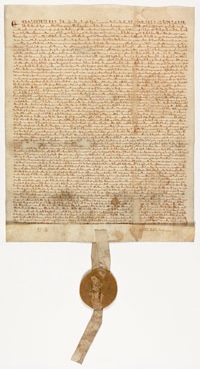
Today is the 811th anniversary of the sealing of the Magna Carta, signed by King John at Runnymede on June 15, 1215. The “Great Charter” returned the British System to its Saxon foundation, proclaiming that everyone, including the monarch, is subject to the law and possesses natural rights including the right to due process. Its influence on individual liberty and America’s journey to its Declaration of Independence and Constitution is critical – a legacy that still influences America to this day.
The American experiment in liberty did not emerge from a vacuum. It stands upon the Magna Carta’s foundation of English constitutional development that began long before our Founding Fathers gathered in Philadelphia. To understand American freedom, we must first understand its English ancestry – particularly the pivotal role of the Magna Carta.
Before the Norman Conquest of 1066, England had developed a system of governance that contained crucial elements of limited government. The Saxon kings ruled with the consent of their nobles through the Witenagemot – an assembly of wise men that served as a check on monarchical power. This tradition established that royal authority was not absolute but existed within established customs and required consultation.
The Saxons understood something fundamental: power must be constrained and distributed in a balanced manner in order to secure liberty. This principle would echo through centuries of English constitutional development and ultimately find its most complete expression in our American system.
On June 15, 1215 rebellious barons forced King John to seal the Magna Carta. This document did not create new liberties so much as it enumerated and formalized existing ones – for they believed that all rights came from the Creator – and among those ideas was that even the king was subject to the law.
Two clauses stand out for their profound influence on American freedom:
Clause 39: “No free man shall be seized or imprisoned…except by the lawful judgment of his equals or by the law of the land.”
Clause 40: “To no one will we deny or delay right or justice.”
These principles – due process of law and the right to a fair trial – would become cornerstones of American constitutionalism. The Magna Carta established the revolutionary concept that government exists under the rule of law, not above it.
The Magna Carta’s influence persisted through centuries of English history, reaching another critical moment in 1688 with the Glorious Revolution. When Parliament invited William and Mary to assume the throne, they required acceptance of the English Declaration of Rights – a document that explicitly drew upon Magna Carta principles.
The Declaration of Rights reasserted limitations on monarchical power and affirmed parliamentary supremacy. It codified concepts like regular parliaments, free elections, and freedom from cruel and unusual punishment – all with clear echoes in the Magna Carta. This document would directly influence our own Bill of Rights.
When American colonists declared their independence in 1776, they were not inventing new principles of liberty but claiming their rights as Englishmen. The Virginia Declaration of Rights (1776) and the Declaration of Independence incorporated Magna Carta principles, particularly regarding due process and the right to trial by jury.
The Fifth and Fourteenth Amendments to our Constitution, recognizing the natural right of due process of law, are direct descendants of Magna Carta clause 39. Our system of checks and balances reflects the same spirit that animated the Magna Carta – the idea that governmental power must be limited to secure individual liberty.
The U.S. Constitution created a more elaborate framework than the Magna Carta, but both share the fundamental premise that governmental authority derives from the consent of the governed and exists within legal constraints. The American system of separation of powers and checks and balances represents the most complete institutionalization of the Magna Carta’s principle that even rulers must be subject to the rule of law.
American freedom is not an accident of history but the culmination of an 800-year journey that began with the Magna Carta. From Saxon customs to the Great Charter, from the Glorious Revolution to our own Constitution, liberty has advanced through the recognition that government must be limited to secure individual rights.
As Americans, we are heirs to this constitutional tradition. When we defend our Constitution, we are not merely defending a document but the culmination of centuries of struggle to establish that government exists to serve the people, not rule over them. The Magna Carta began this journey; our generation must continue it.
— Political Pistachio Conservative News and Commentary