
By Douglas V. Gibbs
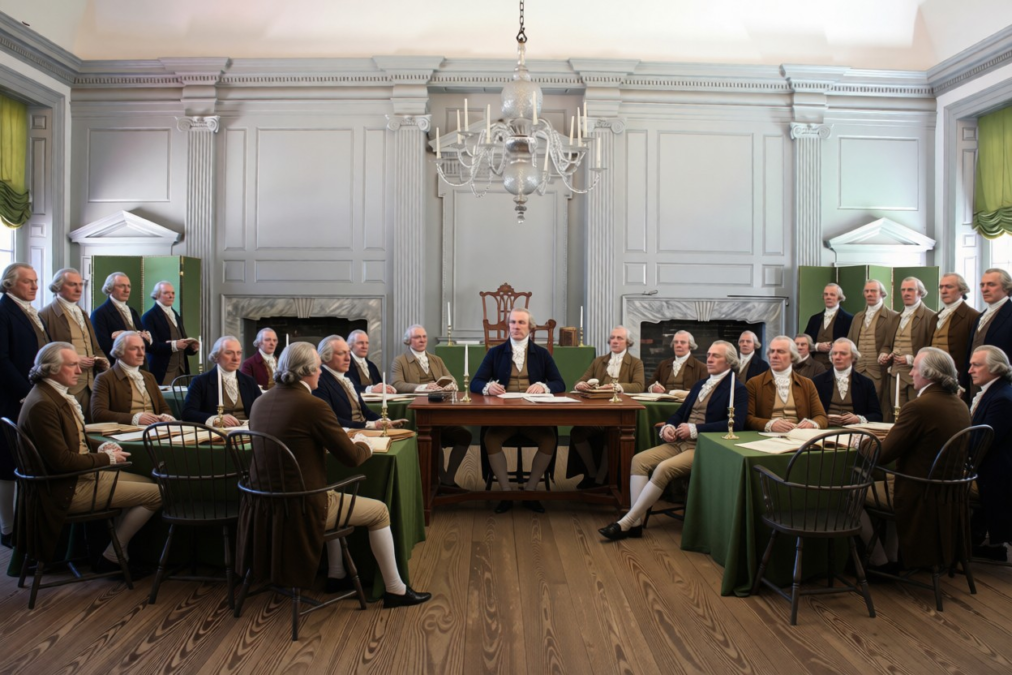
The air in the Pennsylvania State House on September 17, 1787, was thick with the weight of history. Thirty-nine men, delegates from across the fledgling Union of states, gathered in what we now call Independence Hall. Outside, Philadelphia carried on with its daily bustle. Inside, behind closed doors, after four months of grueling debate and compromise, something extraordinary was taking shape; the very foundation of a new republic.
The room was modest in size but grand in purpose. Heavy velvet curtains framed tall windows that filtered the morning light onto polished mahogany tables. Inkwells stood ready, quills at attention, while the scent of old paper and beeswax mingled with the sweat of anticipation. At the head of the room sat George Washington, his presence commanding yet humble, presiding over this Constitutional Convention with the dignity that had carried the revolution.
James Madison, once the architect of the Virginia Plan that had favored the populous states, now sat with a different perspective. The intellectual journey of the past months had transformed him. He had come to understand that true liberty required not just representation by population, but a system of checks and balances that would prevent any single entity, state or federal, or any of the branches of government, from accumulating too much power. His eyes scanned the document before him, seeing not merely words, but a framework that would give the states oversight through the Senate, protect minority interests through the Electoral College, and preserve the power of amendment through ratification by the states themselves.
As the delegates prepared to sign, three men stood apart: Elbridge Gerry of Massachusetts, Edmund Randolph of Virginia, and George Mason of Virginia. Those three men, though present during the entire convention, would not put their names to parchment. Mason, who had refused to sign, spoke with quiet determination: “It wants amendments,” he said, referring to what would become the Bill of Rights. Gerry and Randolph shared similar concerns, about protections for individual liberties and the document’s silence on slavery. Their refusal was not an act of disloyalty, but of principle, a reminder that even in this moment of creation, the work of liberty would remain unfinished.
One by one, the delegates approached the document. The scratching of quills on parchment filled the room as names were affixed to what would become the supreme law of a new Union of States in a world of empires. Each signature represented months of debate, compromise, and vision; a testament to what could be achieved when reasonable men, despite their differences, committed themselves to the creation of a system based on The Laws of Nature and of Nature’s God – the Rule of Law.
As the last signature was placed, Benjamin Franklin, the eldest delegate at 81 years, looked toward Washington’s chair. Its back featured a carved half-sun, and throughout the long months of debate, delegates had addressed the man in the chair, George Washington, during debate.
Now, as the convention concluded, Franklin spoke with characteristic wit and wisdom: “I have often and often in the course of the session, and the vicissitudes of my hopes and fears as to its issue, looked at that sun behind the President without being able to tell whether it was rising or setting. But now at length I have the happiness to know that it is a rising and not a setting sun.”
The delegates smiled, understanding the metaphor. America was indeed rising, and this Constitution, this framework of limited government, separation of powers, and federalism, was its dawn.
As we commemorate Constitution Day today, we would do well to remember that September
morning in Philadelphia. These were not perfect men, nor did they create a perfect document. But they forged something remarkable: a vibrant constitution, a compact among the States, that has served our republic for over two centuries. Adaptable through amendment, yet enduring. The ultimate balancing act, balancing the consent of the governed with mechanisms to ensure that the voice of the minority could also be heard. A system of government that has weathered storms that might have destroyed lesser nations.
Perhaps it is time to elevate September 17 to its proper place as a national holiday. I wonder how many Americans truly realize that today is Constitution Day – a day not just of historical remembrance, but in its celebration each year of rededication to the principles of constitutional government that continues to light America’s rising sun.
— Political Pistachio Conservative News and Commentary