
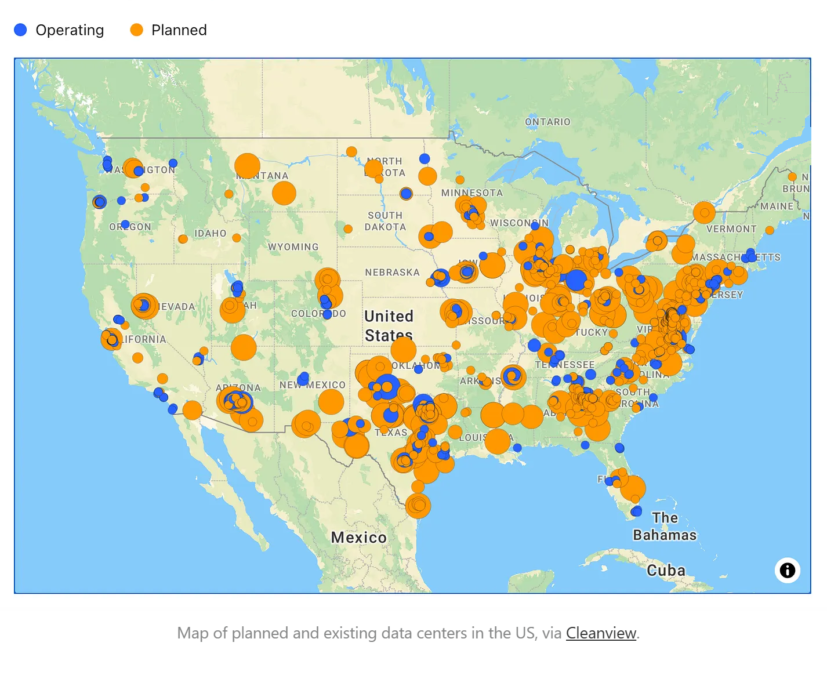
Link for image above: https://cleanview.co/data-centers/us
By Douglas V. Gibbs
One month ago I wrote that the panic sweeping the country over data centers was not organic, that it was a manufactured hysteria with a foreign hand on the spoon, and that the American people were being played for suckers. Since then, everything that has happened has proven the thesis correct, and the people doing the screaming have handed us the evidence themselves.
Let’s do a roll call.
Two weeks ago in Memphis, a City Council meeting over an 18-month moratorium on new data centers collapsed into a shouting match, a megaphone, and a fistfight between two women in the lobby. The chairwoman slammed her gavel and barked “Get that f—ing bullhorn!” into the microphone. Councilwoman Yolanda Cooper-Sutton told a constituent to “pipe down baby, I clap back,” and was later suspended 30 days from her committee assignments for violating the council’s “decorum” rules. Police were called. Nobody was arrested.
Then came the encore. State Rep. Justin Pearson and five others sued the city for banning them from the next meeting, and a federal judge had to issue a temporary restraining order just so citizens could walk into their own City Hall.
After more than a year of pushing, after three readings, after hundreds of people packing the chamber, the moratorium went down in a 6-6 tie on Tuesday. Not a rejection on the merits. A tie. The council could not even agree on whether to pause and think.
“I think we failed the citizens of Memphis tonight,” Council Member Jerri Green told CNN. Council Member JB Smiley Jr., the sponsor, had promised “people before profits.” What he delivered was a split decision and a police report.
What is actually happening in Memphis is that a company called SpaceXAI (Elon Musk) converted an abandoned factory in southwest Memphis into what it calls “the world’s largest supercomputer,” and built a second facility across the state line in Southaven, Mississippi. Residents in the historic Boxtown community got gas turbines, transformer banks, noise, and vibration. Nobody disputes that. But what they got alongside it, and what the panic merchants refuse to mention, is the reason a dying industrial corridor suddenly had a pulse again.
Two days before Memphis punched itself out, the United States Senate held its final vote before leaving town to campaign. The bill was the Ratepayer Protection Act, authored by Sen. Jon Husted of Ohio; the very thing the anti-data-center crowd claims to want: a requirement that states and utilities make data centers pay their own freight for the grid upgrades they demand.
It passed the House 417 to 3, a vote that reminds us that rather than a controversy, there is a consensus on that part of the issue.
Then, when it went to the U.S. Senate, the bill failed 57-43. I needed 60 to reach cloture, and the Democrats wanted to deny Husted, locked in a tight race against Sherrod Brown, a win before Election Day.
“The bill is a fraud, plain and simple,” said Chuck Schumer.
A bill that makes data centers pay their own way is a fraud? A 417-3 consensus is a fraud? If it’s a fraud, then there must be a clear and reasonable alternative, right? Where’s it at?
It is Senator Martin Heinrich’s version, which is the same idea but mandatory. Fine. Then pass it. You had the votes. You had the clock. What you did not have was the political will to let the other party take credit for the obvious.
And the timing tells you everything: the bill now waits until after November. That means the people who claim to be protecting ratepayers deliberately kept the fix off the books until the ballots were printed.
Meanwhile, the moratorium brigade is growing.
While Washington dithered, the states stampeded.
- Texas: Governor Greg Abbott, a pause.
- New York: Governor Kathy Hochul, a pause.
- Michigan: Republican Mike Rogers wants a one-year moratorium; Democrat Abdul El-Sayed wants a statewide one. Both parties, same conclusion.
- Pennsylvania: Governor Josh Shapiro, who was pro-AI until the polling changed, suddenly discovered “the strictest guardrails in the nation.”
- Washington: Representative Alexandria Ocasio-Cortez and Senator Bernie Sanders introduced the Artificial Intelligence Data Center Moratorium Act, a nationwide pause on construction until AI companies prove AI is “safe” and will not raise prices or hurt the environment.
Let’s examine and appreciate the AOC-Sanders bill for a moment. It pauses the entire national buildout until an undefined standard called “safe” is met. That is a nationwide moratorium with no off-ramp, run by people who cannot tell you what the off-ramp looks like. The last time we tried to freeze an industry pending the definition of “safe,” the industry grew up and moved on without us.
If you look at the polls, the deception seems to be working. Here is the scoreboard showing the panic merchants are winning:
- A Fox News poll found 70% of Americans oppose building new data centers in their communities.
- A September CNN/SSRS poll found 75% of Americans say their feelings about AI are closer to fear than hope, and roughly nine in ten are more concerned than excited about data centers specifically.
- Reuters/Ipsos found 64% say rapid data center construction is not a good thing, and 77% worry about their electricity rates.
- The Foundation for American Innovation’s Daniel King explained the phenomenon perfectly: data centers are “so local as an issue” that “both sides have been able to really pick up the spike.”
Both parties are running against the very thing both parties agree we need. Politicians are holding a finger up to the political wind and they are making decisions not based on what is the best thing to do, but based on the mood of the voters who are being led around by the nose by China.
I said a month ago that the sudden, coordinated, coast-to-coast panic did not smell organic. Let me now give you the receipts, and then let me give you the honest caveats, because a good argument survives contact with the facts.
The receipts:
- In late August, X publicly announced that roughly 200 accounts from a suspected Chinese bot farm had been quietly pushing Americans to oppose AI data centers. They called it a “boost” to the revolt.
- OpenAI announced in June that it had banned a cluster of likely Chinese-origin accounts running a “covert influence operation” telling Americans that data centers make life more expensive.
- Graphika identified 119 inauthentic accounts across 10 platforms tied to the Chinese state operation known as Spamouflage, posing as ordinary Americans across the political spectrum.
And the messaging is not random. The bots push the cost angle: “these things will raise your power bill.” It’s precisely the argument that polls best with the American public.
The caveats, because you deserve them:
- Graphika’s Tyler Williams said there remains “very little evidence of significant foreign intervention.” Clemson’s Darren Linvill found that at least 59 of the accounts he examined had zero engagement. One obscure hashtag in his dataset produced just 90 posts. And WIRED ran a piece with the blunt headline: “China Didn’t Make Americans Hate Data Centers.”
Technically, in one way of looking at it, all of that is true. So let me be more precise, because precision is the whole point.
The Chinese did not manufacture the anger. They amplified it, aimed it, and are now profiting from the delay it causes. A real grievance, be it local noise, local emissions, or local rate anxiety, is a raw material. An adversary does not need to create the grievance. It needs to find it, magnify it, fund the loudest voices with volume, and let Americans do the rest to themselves. That is a hundred times cheaper than building anything, and it works.
And here is the tell that should stop you cold. Trump said on Truth Social: “The only reason that communities throughout the U.S.A. should not want Data Centers is if they want to end up being backwards and poor… If we kill the Golden Goose, you will only have yourselves to blame. China could not be happier with this anti Data Center movement.”
He is right, and he is not guessing. If your enemy’s cheapest path to victory is your own self-imposed delay, and you are voluntarily delaying, you are the enemy’s best asset.
Now let me pick a fight with my own side, because that is what honest analysis requires.
GOP strategists are now openly telling Republicans to stop leading with the China argument. Mark Bednar of Monument Advocacy: relying exclusively on the China competition “has been an insufficient talking point to voters.” GOP analyst Rob Stutzman: voters want candidates who oppose expansion or demand “serious checks,” and getting that box unchecked “can be disqualifying.” Amy Koch: “It’s hard to be nuanced with a president who has no nuance.”
They are right about tactics. Voters do not vote on geopolitics. They vote on the power bill.
But they are wrong if they conclude China is a side note. China is the answer to the only question that matters: why now? Every technology faces NIMBYism. America grumbled about fracking, pipelines, and transmission lines. What is different this time is the timing and the intensity. It is a sudden, simultaneous, bipartisan spike in resistance to an industry that until eighteen months ago was a political non-issue. In 2024, not a single broadcast TV ad mentioned data centers. Now it is a national flashpoint with fistfights.
The pocketbook argument wins the conversation. The China argument explains why the pocketbook argument is suddenly on every tongue.
So do both. Lead with the rate bill, close with the flag.
Let me re-arm you for the arguments you will hear at the next council meeting.
- “They’ll raise my power bill.” Then make them pay for their own upgrades, which is exactly what Husted’s bill does, what Trump demanded, and what the White House said in August: “By requiring data centers to pay for their own power, water, and utilities, the President has ensured the American people never foot the bill.” Goldman Sachs projects roughly a 6% national electricity bump over the next year, with the biggest jumps near data centers. That is not a reason to stop building. It is a reason to build the generation and transmission to serve them, which requires more construction, not less.
- “They’ll drain our water.” Your average golf course uses more. Modern facilities increasingly use air cooling or closed-loop water cooling, and 90-95% of the water they do use is returned for treatment. Meanwhile the anti-crowd marches with the same confidence they had about fracking; and look how that turned out.
- “They don’t bring anything.” Nearly half of all tax revenue in Loudoun County, Virginia comes from data centers, and residents there pay an average of $5,800 less in property taxes. Representative Rich McCormick put it best: “If you don’t want a data center, that’s fine, don’t have one. But just realize they’re not going to use your water, they’re going to keep your electricity rate low, they’re going to pay for your teachers, your schools, your roads, most likely your property taxes, you’re gonna have more jobs.”
- “It’s just AI, and AI is scary.” The average American household now runs close to twenty internet-connected devices, up from a couple fifteen years ago. Your debit card, your grocery inventory, your streaming, your texts, your phone calls – all of it runs through these buildings. The cloud is not in the sky. It is in a windowless box off the highway, and you have been using one for years without noticing.
Here is the part that should make you angriest.
The same giant AI labs that built this industry are now lobbying for the federal government to regulate it. As Issues & Insights documented, “almost everyone involved is affiliated with Coefficient, Open Philanthropy, Anthropic, and/or OpenAI – all of who serve to benefit financially from creating regulation.”
Read that again. The people calling for a slowdown are the people who already have their data centers built. Every month of delay is a month the incumbents are running and the newcomers are paying lawyers. And now a super PAC called Leading the Future, bankrolled by OpenAI’s Greg Brockman and Andreessen Horowitz, has raised over $140 million to buy midterm influence on both sides of the aisle.
We have seen this movie, before. It is the California trucking rule that cost $25,000 per rig and drove every owner-operator out of business so the big fleets could corner the market. It is the meat-packing regulations that squeezed out the ranchers until four corporations owned the beef processing game. The little guy gets regulated out. The giant writes the rule.
Data Center Watch found that at least 75 data center projects, worth about $130 billion combined, were blocked or delayed by local opposition in the first three months of 2026 alone. One quarter. One hundred thirty billion dollars. Over 2,000 more are in planning stages.
Now look at China.
China already runs roughly 24 gigawatts of AI data center capacity against our 56. It is on track to nearly double its total data center capacity to 60 gigawatts by 2030. It has a national program called “Eastern Data, Western Computing” moving compute to cheap power. And by 2030 it is projected to sit on roughly 400 gigawatts of spare generating capacity – triple what the entire global data center fleet will need.
As Brookings’ Kyle Chan put it: “China’s trying to take advantage of the fact that it has this muscle memory for building energy infrastructure quickly. Whereas for the US, we haven’t done this kind of grid buildout in a long time.”
That is the whole ballgame. We are the ones who invented this. We are the ones leading it. And we are the ones now fighting each other in city hall lobbies while the other guy pours concrete.
You are being played, and it is a two-part con.
Part one is domestic. Politicians in both parties have discovered that “I hate data centers” polls well, so they are all running against the thing they all admit we need. The Senate proved it by burying a 417-3 consensus bill until after the election.
Part two is foreign. The Chinese found a real grievance, pumped it full of volume, and are now collecting the winnings in the form of American delay.
And the American people – as I said a month ago, and as I will keep saying – are being gullible about it. Because the arguments feel true. “It’s near my house.” “It’ll cost me money.” “It’s big and loud and weird.” All feelings. All legitimate feelings. But the moment feelings override reason, analysis, logic, and critical thinking, someone else gets to decide your future for you. Frank Herbert warned us in 1965: “Men turned their thinking over to machines in the hope that this would set them free. But that only permitted other men with machines to enslave them.”
Do not hand your thinking over to a megaphone.
When the automobile was new, towns fought the assembly plant. When electricity was new, neighborhoods fought the power station. Every generation gets one of these. Ours is the data center. The ones who build it win the next hundred years. The ones who pauses it watch someone else win.
Election Day is November 3. Before you vote, ask the only question that matters: do you want to be the country that builds the future, or the country that denies it?
— Political Pistachio Conservative News and Commentary