
By Douglas V. Gibbs
The following is an excerpt from my upcoming book: 25 Honest American Tales.
There are two ways this story gets told, and both of them are true enough to be useful and false enough to be dangerous.
The first is the version most people have absorbed: greedy American missionaries and sugar barons, backed by the Marines, stole a kingdom from a helpless queen, and the United States has owed Hawaiians an apology ever since. The second is the shrug: empires rise and fall, conquest is the human condition, and Hawaii was simply among the newest pages of an old book. Nothing to see here but the weather of history.
Start with the shrug, because it has more going for it than we like to admit. History is a chain of conquests, end to end. Every one of us is descended from somebody who was conquered and somebody who did the conquering – from the enslaved and from the enslavers – and most of us are descended from both, often in the same century. Hawaii is no exception. The Kingdom of Hawaii was itself forged by conquest: Kamehameha I unified the islands with cannon and muskets bought from the very traders whose descendants would later take his successors’ country. And the Great Māhele of 1848, that grand land reform, quietly dispossessed thousands of commoners who had worked the soil under the old system and simply failed to file. If the test is whether Hawaii was pristine until America showed up, the answer is no.
But the shrug has a problem, and it is this: Hawaii is the best case the progressive anti-American side has. It looks exactly like the story they tell. A sovereign nation, recognized by treaty, with embassies in ninety ports taken by thirteen men and a hundred and sixty-two Marines and sailors. It is the cleanest example of American bad faith you could ask for. Which is why it’s worth pulling apart, because a frame that can’t survive its own best example isn’t a frame. It’s a mood.
So let me say where I sit, because it matters for everything that follows.
I don’t buy the standard progressive indictment that colonialism is original sin, that corporations are the villains by definition, that America is an empire pretending otherwise, and that all of it comes with a bill still owed. But, at the same time, I don’t necessarily buy the patriotic shrug either, the one that says America is right even when it’s wrong, and that anything we did was probably necessary.
Here’s the thing. The Constitution was written by men who had watched republics rot. They built in checks against corruption, against ambition, against the concentration of power, against the slow drift from a republic of laws to an empire of men – and the list goes on. They made the acquisition of new territory deliberately hard, because they had seen what easy conquest does to free government. A treaty takes two-thirds of the Senate to ratify. That is not an accident. That is a guardrail.
And in Hawaii, every one of those guardrails fired, and failed.
The President of the United States investigated the coup and concluded that his own country had committed an act of war against a friendly sovereign nation. Two annexation treaties went to the Senate and failed. More than half the adult Native population signed petitions against annexation in a single week. The Queen surrendered, but she surrendered under protest, to the United States rather than to the men who had seized her government, preserving her claim and appealing over their heads. The machinery worked. It produced the right answers, over and over.
And Hawaii is a state anyway.
Because the annexationists never beat the Constitution. They went around it. When they couldn’t find two-thirds of the Senate for a treaty, they used a joint resolution, which needs half. When the President found them guilty, they found a Senate committee to overrule him. When the people petitioned, they waited for a war.
That’s the honest tale. Not America the villain, and not America the benevolent. A sound machine, operated by men in a hurry, who understood that the procedures are not the boring part. The procedures are the whole game.
None of this is a reason for retribution. But it is a reason to watch the mechanisms. So here is what the documents actually say – and buckle up because the punch-line to the story is alarming.
During the darkened early morning hours of January 17, 1893, United States Marines and Sailors from the USS Boston came ashore at Honolulu, Hawaii. They took up positions across the street from the palace. They did not enter the grounds. They did not fire a shot. They did not need to.
By the time the sun came up the United States Military personnel who were onsite were standing at Arion Hall with a clear field of fire over ʻIolani Palace and the government buildings beside it. Inside the palace, Queen Liliʻuokalani had 496 royal troops at her disposal, a contingent nearly three times the size of the force waiting outside.
She also had on her side the law, a new local constitution, and the overwhelming loyalty of her people.
She surrendered anyway, to prevent bloodshed and loss of life. She yielded her authority under protest, expecting the U.S. Government to review and reverse the action that had been taken against her, and her people.
The document she signed is the single most important piece of paper in Hawaiian history, because she never technically gave up the sovereignty of Hawaii: “I yield to the superior force of the United States of America… Now to avoid any collision of armed forces, and perhaps the loss of life, I do this under protest and impelled by said force yield my authority until such time as the Government of the United States shall, upon facts being presented to it, undo the action of its representatives and reinstate me in the authority which I claim as the Constitutional Sovereign of the Hawaiian Islands.”
She did not surrender to the men who had seized her government. She surrendered to the United States. She was not conceding a defeat. She was filing an appeal to a higher court, on the theory that the American minister had exceeded his authority and Washington would correct him.
She trusted American adherence to their own Constitution.
For five years, the annexationists would try to prove her wrong. Twice they would fail. And in the end they would win not by persuading anyone, but by changing the rules of the game. Sometimes, losing doesn’t matter if you know how to keep repositioning and rewriting the rules until you get what you want.
The Kingdom of Hawaiʻi was not a tribal holdover or a protectorate-in-waiting. It was a recognized sovereign nation under international law, and the United States had said so in writing.
On July 6, 1844, Secretary of State John C. Calhoun, on behalf of President John Tyler, formally recognized Hawaiian independence. The Kingdom went on to sign treaties with the major powers and to maintain more than ninety legations and consulates in ports around the world. It had a constitution, a legislature, a supreme court, a postal system, a currency, and a diplomatic corps.
The popular version of this tale treats Hawaii as a place America found and then took. In reality, America found a country, recognized it, made treaties with it, and then, four decades later, quietly stopped treating it like one and absorbed it.
There had already been dress rehearsals. In 1843 a British officer, Lord George Paulet, occupied the islands for five months before London disavowed him. In 1849 the French pulled the same stunt. Hawaii had learned, repeatedly, that its sovereignty depended on whether a foreign captain’s orders happened to match his government’s intentions.
That lesson would be tested again in 1893, by an American captain’s orders that did not match his government’s intentions.
Follow the money, but follow it precisely. The driver here was not greed in the abstract. It is not the tyranny of a country or the promises of businessmen. It was a specific tariff, a specific panic, and segments of government colluding with corporate interests that faced survival or destruction thanks to the tariff.
Sugar had been Hawaii’s export since Captain Cook. By the 1870s it was the whole economy. In 1875 the Kingdom signed a Reciprocity Treaty with Washington: Hawaiian sugar entered the United States duty-free. In exchange, formalized by lease in 1887, Hawaii handed over Pearl Harbor.
The results were explosive. Sugar acreage went from 12,000 acres to 125,000 acres in a decade and a half. A class of enormously wealthy planters emerged, mostly the sons and grandsons of American missionaries who had arrived to save souls and stayed to buy land. The old line about them was that they “came to do good and did well.”
Then came the McKinley Tariff of 1890, and it detonated the arrangement. The new law did two things at once: it put foreign sugar on the free list, and it handed a two-cent-per-pound bounty to domestic American producers. Hawaii’s duty-free privilege was now worthless, because everyone had it. Worse, mainland growers now got a cash subsidy the Hawaiians didn’t.
Hawaiian sugar lost its edge overnight. Planters who had borrowed against future crops faced ruin.
And there was exactly one fix available: annexation. If Hawaii became American, Hawaiian sugar became American sugar; bounty and all. The planters weren’t converting to annexationism out of love of country, or because they were necessarily corrupt businessmen. They were converting because the arithmetic had turned against them, and they didn’t know what else to do – not they were innocent in all of this, either.
In July 1887, Lorrin Thurston (a lawyer, a legislator, and a missionary’s grandson) drafted a new constitution and presented it to King Kalākaua with an armed militia standing by. It was signed under duress, and it earned its nickname: the Bayonet Constitution.
The new constitution imposed property and income qualifications on voting, stripping the franchise from roughly two-thirds of Native Hawaiians. It, then, allowed American and European residents to keep their home citizenship and still vote in Hawaiian elections; a status available to foreigners in no other country on earth (perhaps we can take a lesson from that in a modern sense). The language in the new Hawaiian constitution then allowed those same American and European residents to run for the Hawaiian legislature while remaining foreign nationals. In addition to that, the new constitution excluded Asians entirely from citizenship and the vote. It also stripped the monarch of the power to dismiss his own cabinet without legislative approval – which would likely end up dominated by Americans and Europeans who were residents primarily for business reasons.
Those same men would later claim to be defending representative government, despite the fact that they had engineered a system where foreign nationals could legislate for a country they did not belong to, while its own indigenous majority could not vote.
So when the planters cried that Queen Liliʻuokalani was behaving “unconstitutionally” in 1893, they were invoking a constitution they had written and got adopted into law at gunpoint.
Liliʻuokalani came to the throne in January 1891, mid-crisis. She was, by every account, formidable. She was a composer, a capable administrator, and a monarch who had already refused the throne twice when the Reform Party offered it, on the grounds that she would only be a figurehead like her brother.
She intended to fix the Bayonet Constitution. Her proposed 1893 constitution would have lowered property requirements to restore Native suffrage and eliminated the voting privileges of foreign residents. This was not a fringe idea. It had popular backing: out of roughly 9,500 Native voters in 1892, some 6,500 had signed petitions demanding exactly this.
She toured the islands on horseback and was met with crowds. She picked her moment.
And that is a part of what triggered the coup. It wasn’t some crisis that popped up, but a constitutional reform by a monarch with a firm grasp on what was best for her kingdom that the planters (local corporate interests) could not survive.
On January 14, 1893, thirteen men formed a Committee of Safety. Seven were foreign-born; six were Hawaiian-born subjects. Their stated aim, in Thurston’s own motion, was blunt: “That it is the sense of this meeting that the solution of the present situation is annexation to the United States.”
The truth was laid out in plain language.
The Marshal of the Kingdom, Charles B. Wilson, had intelligence the coup was coming and asked for warrants to arrest the thirteen. He was refused because the Queen’s own cabinet feared provoking a crisis. So, the government waited. And on the afternoon of January 16, the American minister gave the conspirators the one thing they lacked: a legitimate-looking army.
John L. Stevens, United States Minister to Hawaiʻi, landed the Boston’s detachment under orders of “neutrality.”
The stated reason was to protect American lives and property. But Stevens had been handed a State Department instruction from an earlier minister’s tenure telling him to protect American commerce and, if necessary, to use naval officers to “promote the reign of law.” He read that instruction expansively and ran with it.
The military formation of the arriving military personnel did not look like the preservation of American lives and property. If the purpose was protecting American property, the United States Marines should have been stationed near American property. Instead they were placed to command the palace and the government building: the two structures that mattered politically.
Stevens himself, later, essentially conceded the “general alarm and terror” the Committee cited was a fiction. The city was, in President Cleveland’s later words, “in its customary orderly and peaceful condition.”
One man was shot in the entire affair: Leialoha, a Native policeman who tried to stop a wagon of weapons being delivered to the conspirators. He lived.
On January 17, 1893, Henry Cooper, chairman of the Committee of Safety, read a proclamation from the steps of the government building abolishing the monarchy and establishing a provisional government under Sanford Dole. The Honolulu Rifles (American and European paramilitary militia) moved in, disarmed the Royal Guard, and it was over.
The Queen had 496 men and the Queen had the law. What she did not have was a reason to spill Hawaiian blood against a foreign power’s marines. So she stood down, and she filed her protest to Washington.
President Grover Cleveland was inaugurated in March 1893. He read the Queen’s protest and did something remarkable: he sent an investigator.
James Henderson Blount, a former congressman, arrived in Honolulu, took testimony, and filed his report on July 17, 1893. Its conclusion was not equivocal. United States diplomatic and military representatives had “abused their authority and were responsible for the change in government.”
Cleveland acted. He recalled Stevens and forced the naval commander to resign his commission. He withdrew the annexation treaty Harrison had already signed and sent to the Senate.
And then he said it plainly to Congress on December 18, 1893: “The military demonstration upon the soil of Honolulu was of itself an act of war… the existing government, instead of requesting the presence of an armed force, protested against it. There is as little basis for the pretense that forces were landed for the security of American life and property. If so, they would have been stationed in the vicinity of such property… instead of at a distance and so as to command the Hawaiian Government Building and palace.”
And in his State of the Union he said, “Substantial wrong has thus been done which a due regard for our national character as well as the rights of the injured people requires we should endeavor to repair.”
The President of the United States formally concluded that his own country had committed an act of war against a friendly sovereign nation.
So why is Hawaii not a kingdom today?
First, the Queen overplayed her hand. Cleveland’s condition for restoration was that she grant amnesty to the conspirators. She refused, insisting the ringleaders be punished. Talks collapsed.
Second, Cleveland did not believe he could restore her by decree. He referred the matter to Congress, because he thought the legislature had to act. And Congress, then as now, preferred not to.
The Senate Foreign Relations Committee, chaired by John Tyler Morgan of Alabama and stacked with annexationists, ran its own investigation. Its Morgan Report (February 1894) took pro-annexationist affidavits, directly contradicted Blount, and exonerated Stevens and the Marines entirely.
That was that. Cleveland, boxed in, recognized the new government. On July 4, 1894 the conspirators proclaimed the Republic of Hawaiʻi, with Dole as president, a republic whose constitution was deliberately engineered so that Asians and many Hawaiians still could not vote.
The executive branch had investigated the whole thing and found America guilty. A legislative committee overturned the verdict. Cleveland had the finding and not the votes; Morgan had the votes and not the finding.
The royalists did not go quietly.
In January 1895, a counter-revolution led by Robert Wilcox attempted to restore the monarchy. It failed in four days. When a cache of weapons was found on the palace grounds, Liliʻuokalani was arrested.
The Queen of Hawaiʻi was tried by a military tribunal of the Republic, convicted of misprision of treason, sentenced to five years’ hard labor, fined $5,000, and imprisoned for eight months in an upstairs room of her own palace.
To win her freedom she was required to formally abdicate. She did so on January 24, 1895, ending the Hawaiian monarchy – a monarchy that had been overthrown two years earlier by thirteen men, and which she had spent those two years refusing to concede was gone.
Her niece, Princess Kaʻiulani, was in England being educated when it happened. She sailed to America and lobbied Washington, becoming a press sensation. She died in 1899 after developing a critical fever during a severe storm, aged twenty-three.
Under the Constitution, annexing a foreign nation requires a treaty. A treaty requires two-thirds of the Senate to ratify it. That is a high bar. It was designed to be.
The annexationists tried it the honest way, first. And they lost.
The 1893 treaty, signed by Harrison on February 14, was withdrawn by Cleveland before a vote.
The 1897 treaty, signed by McKinley on June 16, went to the Senate, and stalled and failed.
What stopped it the second time was extraordinary. Three organizations in Hawaii mounted a mass petition drive. Traveling by horseback, boat and on foot across the islands, they collected over 21,000 signatures in a single week, well over half the adult Native population, and ultimately roughly 38,000 across the three groups.
They were delivered to Washington by four delegates and laid before the Senate. The petitions helped kill the treaty.
By late 1897, the President had found America guilty, the Queen had appealed, the population had petitioned, and two annexation treaties had failed. The annexationists were losing.
Then Spain and the United States went to war, and Hawaii became the coaling station for the fleet sailing to Manila. Suddenly the islands were not a business proposition. They were also a naval necessity.
With the treaty route blocked, the annexationists found the loophole. Instead of a treaty, they would use a joint resolution of Congress, which requires only simple majorities in the House and Senate.
The Newlands Resolution passed on July 7, 1898. Hawaii was annexed by a majority vote of Congress, not by treaty.
A joint resolution may be a perfectly valid way for Congress to legislate, but annexing a sovereign foreign state is arguably a treaty function. The Framers of the Constitution designed the system deliberately to make treaty-making harder precisely so that the Senate (the voice of the States, at the time) would have to consent.
They didn’t have the votes for two-thirds. So they used a mechanism that needed half. They cheated, said it was considered official, and everyone nodded and winked and agreed it was fine.
The formal ceremony was held at ʻIolani Palace on August 12, 1898. Almost no Native Hawaiians attended. Those who did walk the streets wore ʻilima blossoms and Hawaiian flags bearing the motto Kuu Hae Aloha: “My beloved flag.”
Princess Kaʻiulani told the San Francisco Chronicle: “When the news of the Annexation came, it was bitterer than death to me. It was bad enough to lose the throne, but it was infinitely worse to have the flag go down.”
The Hawaiian flag was lowered for the last time while the Royal Hawaiian Band played Hawaiʻi Ponoʻī.
The Newlands Resolution provided that the crown lands and government lands of the Kingdom, roughly 1.8 million acres, would be held by the United States “in trust” for the inhabitants of the islands, with revenue used for their benefit.
In trust. Not owned outright. Held.
That single word is the seed of everything that followed: the ceded lands controversy, the creation of the Office of Hawaiian Affairs, and a century of litigation over who the trust actually benefits.
In 1993, on the centennial of the overthrow, Congress passed the Apology Resolution: Public Law 103-150, signed by President Clinton. It apologized to Native Hawaiians and made two formal findings:
- That the overthrow was carried out “with the participation of agents and citizens of the United States” with the US acting against a friendly sovereign.
- That “the Native Hawaiian people never directly relinquished their claims to their inherent sovereignty as a people or over their national lands to the United States, either through their monarchy or through a plebiscite or referendum.”
The Congress of the United States formally stated, in law, that the Hawaiian people never actually gave up their sovereignty.
Not that they “were treated unfairly.” Not “regrettably.” Their sovereignty was never relinquished.
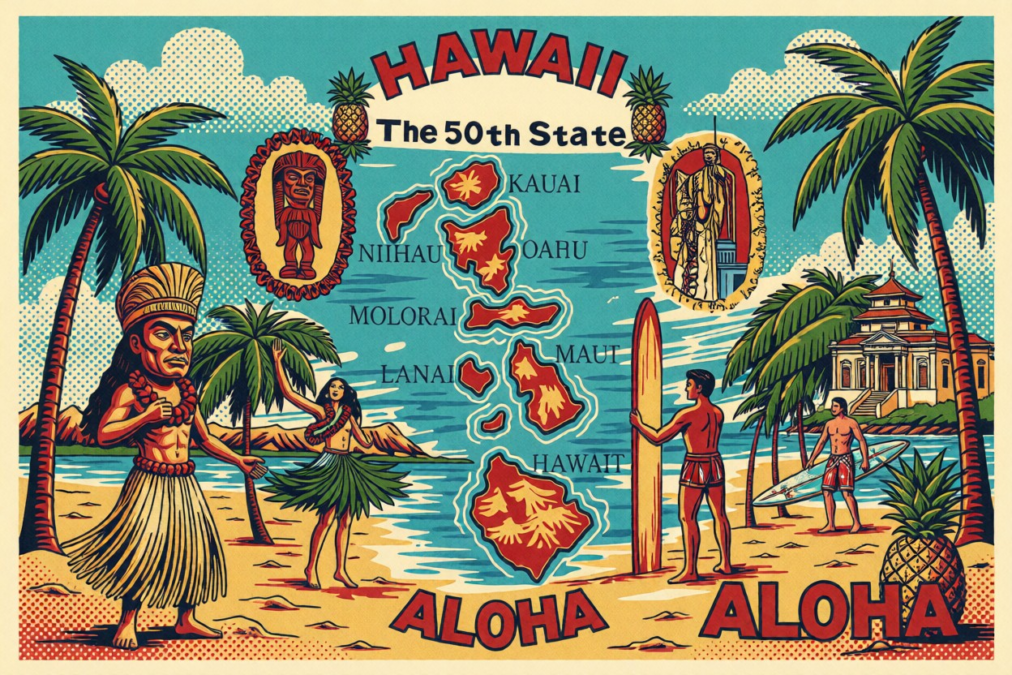
The road to statehood is its own story. Hawaii became a territory in 1900, with Dole as its first appointed governor. Statehood bills failed for half a century.
It finally passed in 1959.
There was no option for independence. Not “statehood, union, or restoration.” Just: do you want in? Voters approved it 132,773 to 7,971 (roughly 93 percent).
Niʻihau, an island that was almost entirely Native Hawaiian and comparatively untouched by statehood propaganda, voted against it, as did Lānaʻi.
The 1959 vote legitimized membership. It did not answer the 1993 finding about whether the sovereignty had ever actually been surrendered.
This is not a story about capitalism or colonialism as the enemies of the Constitution might try to frame it. It is a story about the kind of human nature the Framers of the U.S. Constitution warned us about using games to manipulate the political battlefield; acting like they are observing the law while its substance was violated.
The Marines never fired a shot. The whole thing cost one bullet and one wounded policeman. And a sovereign nation with ninety foreign legations and a seat in the community of nations was absorbed into another country without a treaty ever being ratified.
The lesson is not that America is uniquely villainous. It’s that when a government and the business world collude and want the same thing, procedures are no longer technicalities – they emerge as replacements for principles of the Constitution.
And the last word belongs where it started: with a woman who understood the machinery better than the men who took her throne. Liliʻuokalani didn’t sign a surrender. She filed a protest and appealed to a higher authority.
The appeal has never been formally answered. Congress admitted as much in 1993, in writing, and then let it sit.
— Political Pistachio Conservative News and Commentary