
By Douglas V. Gibbs
In today’s vernacular, it seems we have a problem with words. The enemies of liberty have a long history of playing with language usage, and this one definitely needs to be addressed. And it’s interesting, because the way our modern understanding of Nationalism and Federalism have landed, it turns out that today the two words actually mean the opposite of what everyone thinks.
The Founding Fathers debated over these words for a decade.
Nationalism seems to be in the news constantly, and we rarely hear “federalism,” and if we do, it is used in a context of federal supremacy. The words in question, here, as a result get used as insults, as banners, and as confusion often by the same people in the same sentence.
So let me illuminate the whole situation a little better by defining them the way the men who wrote the Constitution defined them, because the meaning is not a matter of opinion. It’s a matter of record. And the record is unambiguous.
In the founding era, a nationalist was a man who wanted a consolidated government; one sovereign power over the states, a single “nation” in which the states were subordinate. A federalist was a man who wanted a compact; a union of states that kept their separate sovereignty and delegated only specific, enumerated powers to a central authority. That was the fight. National versus federal. It was the axis of the Philadelphia Convention in 1787, and it was the axis of ratification in 1788.
And here is the detail that proves how real the fight was: the word “national” never appears in the Constitution. Neither does “federal.” The document names “the United States,” “the Union,” a Congress, a President, courts. It refuses to name it a nation. That silence is deliberate. The men who wrote it knew exactly what “national” meant, and they would not concede it in the text. They left the argument open on purpose.
Now understand that the consolidation party did something clever. They called themselves the Federalists.
Think about that. The men who wanted a stronger central government (Hamilton, Jay, Madison in his early nationalist phase) branded themselves with the word that meant the opposite of what they were. The actual federalists, the men who wanted the states to keep their sovereignty, got stuck with the label Anti-Federalists, as if they were the negative, the obstruction, the “anti” party. The consolidationists stole the federal label and have never given it back.
So when you read the Federalist Papers, you are reading the nationalist argument wearing a federalist name. Hamilton in Federalist 78, for example, was arguing for a strong central government, and was selling it under a banner that promised the states would keep their power. It was marketing, and it worked so well that two centuries later we still can’t tell the words apart.
A founding nationalist wanted one thing above all: consolidation. Madison’s Virginia Plan, Hamilton’s June 18 plan, the whole thrust of the strong-government camp was to reduce the states toward subordinate corporations, give the central authority a veto over state law, and make the union a nation. Hamilton openly admired the British model and wanted America to resemble it.
A true founding federalist wanted the opposite: keep the states as the primary political bodies, keep the central government small and enumerated, and treat the union as a compact between sovereign states… which is exactly what Article VII says it is, ratified not by a national plebiscite but by “the Conventions of nine States.”
The winner was a compromise, which is why the Constitution reads the way it does: a federal structure with nationalist machinery built in only for external issues. But, somehow, the nationalist machinery has taken over and has been winning ever since.
Now here’s where the confusion compounds. In the last decade, as a reaction to the rise of Donald J. Trump on the political scene, those who were already standing against constitutional originalism began to throw around a new word: “nationalism.” And there intent was for it to mean something far from what the Founding Fathers meant.
Founding nationalism was about domestic consolidation: one government over the states. The modern usage of the term “nationalism” is about trying to connect it to authoritarianism. Fascism. Identity. Resistance to globalism. Some kind of Master-Race, White-Supremacy racism. That’s a very different idea than what the word “nationalist” meant to the Framers of the Constitution.
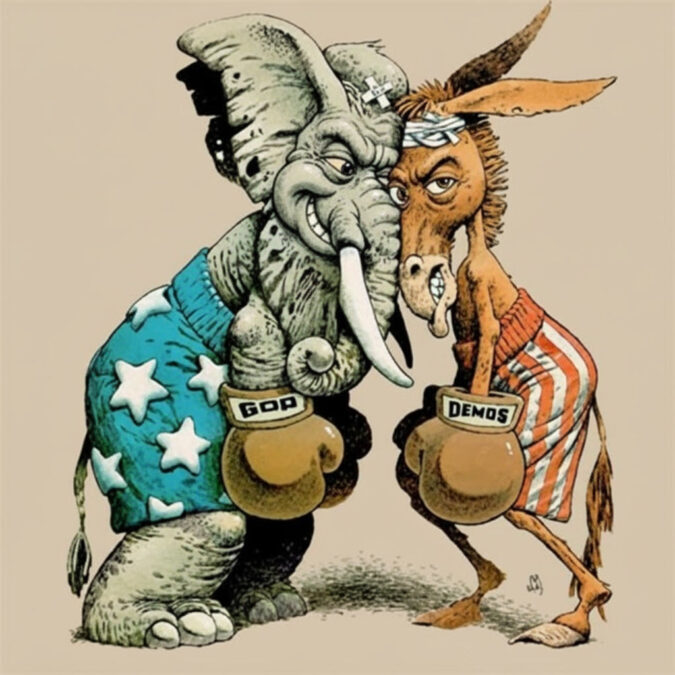
Which means the modern Republican who is willing to call himself a “nationalist” is making a claim about foreign policy and identity. Sure, it’s a reaction to being accused of nationalism by their opponents, but both sides are mixing two vocabularies, and the result is that the Democrats claim nationalism is a form of racism, and the Republicans claim nationalism is basically another way of saying “Patriotism,” and they’re both wrong.
An interesting twist for the GOP is that embracing “nationalism” is reversion to type, not a rebellion.
The Republican Party’s direct ancestor is the National Republicans. The party of John Quincy Adams and Henry Clay, and ultimately the one that rose in 1854 to serve as an opponent to the pro-slavery Democrats. Those early National Republicans, and the Republican Party that emerged just before the War Between the States was the party of protective mercantilist tariffs, a national bank, federal funding of internal improvements, and a consolidated economic policy. That is the anti-Madison and anti-Jefferson position. The small-government strand in the GOP is the aberration. The nationalism, as defined by the founders, is essentially the birthright of the Republican Party. So when the party picks up the word, it isn’t capitulating to an attack from the left. It’s remembering what it has always been.
And the progressives already owned the word. Theodore Roosevelt literally named his 1910 Osawatomie platform the “New Nationalism.” His brand of progressivism consolidated federal power over the economy, the states, and the individual. Herbert Croly’s The Promise of American Life, published a year earlier, said the quiet part out loud in six words: “Hamiltonian means to Jeffersonian ends.” That is the progressive creed, and it is a confession that the progressives are the heirs of founding nationalism, not its enemies. Woodrow Wilson’s “New Freedom” was the ruse that got a lot of it in motion. The administrative state came bounding in after (not that it was anything new, either). The nationalism machinery won regardless of the label.
Now put it on a map. When it comes to the political spectrum, the “left-right dynamic” if you must, if the Constitution is the fixed mark (the standard that sits at the middle, neither left nor right, then “left” and “right” aren’t absolute positions. They’re directions away from the document. To the left of the Constitution is consolidation: more central power, more national government, the states reduced. To the right of the Constitution is a government more limited than the document allows – a stricter reading than the founders wrote. And the modern GOP? It sits between the progressives and the Constitution. Right of the Democrats, yes. But left of the document. Which means the honest label for the modern party is not “constitutionalist,” not “rightwing,” and not even “right.” It’s nationalist, in the founding sense, exactly as Clay meant it.
And on trade, the same precision applies. Free trade is not the founding position, and neither is a reflexive tariff war. The founders wanted fair trade. Reciprocal, protective of the country (not certain industries) when necessary, open when it profited. The modern fight between globalism and protectionism is a fight between two extremes, and the Constitution sits in the middle of it too.
None of this is word games. The whole reason the consolidation of the last century went down so easily is that we lost the vocabulary to describe what was happening. When “nationalist” means “patriot” instead of “consolidationist,” you can’t see the consolidation. When “federalist” means “big government” instead of “compact,” you can’t see the compact being dismantled.
The founders argued over these two words for a decade, and they knew exactly what was at stake. Restore the definitions and the whole history becomes legible again: who wanted what, who won, and which word describes the men holding office today.
Nationalism is consolidation. Federalism is a compact that creates a republican form of government and system. Get those two straight, and you can read two hundred years of American politics in a single sentence.
— Political Pistachio Conservative News and Commentary