

Political Pistachio
By Douglas V. Gibbs
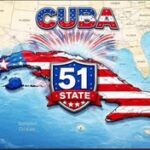
President Trump has been signaling that the communist dictatorship in Cuba is on its last legs. “Cuba is gonna fall pretty soon,” he told CNN host Dana Bash.
President Trump went on to explain that Cuba wants “to make a deal.” Cuba’s economy has been in a tailspin since its access to oil and money vanished when Maduro was captured and Venezuela became essentially an American ally. Cuba, as a result, has suffered from fuel shortages, power cuts and food scarcity.
Cuban President Miguel Diaz-Canel has confirmed he is in discussions with President Trump, but says any potential agreement remains in the early stages. The Trump administration is preparing an economic deal with Cuba, with U.S. Secretary of State Marco Rubio (whose family escaped the communist country) in secret talks with members of the Cuban regime.
Members of the Cuban populace have launched demonstrations against the ruling communist party. Energy shortages have forced the country to rely on a mix of natural gas, solar power, and thermoelectric plants, with two of the plants recently shutting down, and a recent blackout was blamed on a broken boiler at a thermoelectric plant, which led to a complete shutdown of Cuba’s power grid.
Coincidentally, within 24 hours of the electric grid shutdown, an 6.0 magnitude earthquake struck just off the Cuban coast. While there has been no immediate reports of damage, the earthquake served as an exclamation point regarding Cuba’s woes.
For nearly seventy years the communist regime has used terror to cling to power, but communism destroyed the economy of Cuba, with the regime’s elite consuming imported goods and leaving scraps to the people. As other communist regimes fall around the world, the hopelessness of the failed ideology is also falling in Cuba. While the rest of the world seems not to care about what is going on in Cuba, President Trump recognizes the needs of the people and aims to starve the regime of the resources it has been using to terrorize its own people.
President Trump is currenlty signalling that Cuba’s brutal regime will be falling soon, and it won’t even be a fight. The way President Trump has been talking, one wonders if he thinks the island nation is destined to be the 51st State… but remember, he negotiates high, and then works it out within reason.
But… one wonders.
— Political Pistachio Conservative News and Commentary

| Tuesday Online Constitution (and history) Class |
  3:30 PM Pacific Online Constitution & History Class |
| Online Mr. Constitution Class www.mr-constitution.com When the Vikings arrived to Conquer Britain. Untold History Channel – (locate the shows labeled “Learn the Constitution”): https://rumble.com/c/UntoldHistoryChannel |

By Douglas V. Gibbs
CEOs from several major U.S. airlines have jointly urged Congress to end the government shutdown that has left the Department of Homeland Security (DHS) partially unfunded. More than 300 TSA agents have left federal employment since the shutdown began, and with the first full paycheck now missed, more are expected to follow. In their letter, the airline CEOs explained that it is “simply unacceptable” to expect TSA personnel to work without pay.
This disruption to travel and security comes at a critical time, with spring break underway, FIFA World Cup 2026 travelers preparing for arrival, increased travel for America’s 250th birthday celebration, and a heightened potential for terrorist activity amid military actions in the Middle East.
At major airports, wait times have surged to multiple hours. While airlines are attempting to mitigate the disruption by holding flights for late passengers and rebooking others, the impact is proving unacceptable, affecting not only passenger travel but also cargo carriers.
Even the mainstream media, which typically runs interference for Democrats, is questioning the wisdom of their holdout. NBC’s Kristen Welker confronted Adam Schiff about the shutdown, asking if it was responsible for Democrats to hold up DHS funding with the threat of terror attacks looming during the current conflict in Iran. CNN’s Jake Tapper pressed Democratic Senator Cory Booker with the same question: “Isn’t it time for Democrats to reopen DHS?”
In both instances, the Democratic senators blamed Republicans. They failed, however, to acknowledge their direct responsibility for the heightened threat of terror attacks in the United States; a consequence of their open-border policy and their attempts to stop ICE from deporting the criminals and terrorists the Biden regime allowed into the country over the previous four years before President Trump took office.
Despite their anti-Trump antics and the idiotic belief that “resisting” is working in their favor, 60 weeks into President Trump’s second term, his approval rating is higher than both Barack Obama’s and George W. Bush’s at the exact same point in their second terms.
Polls show that 97% of voters support the effort to deport illegal aliens convicted of violent crimes, terrorism, and child rape. An overwhelming majority of GOP voters approve of President Trump’s military operations against Iran, and more than fifty percent of all likely voters approve of the strikes against Iran. The inflation rate have dropped, gas prices were falling and will drop again once Operation Epic Fury concludes, tariffs have leveled the international trade playing field, and a manufacturing resurgence is on the horizon.
Unfortunately for Democrats, it is all falling apart. They are unwilling to adjust because their primary positions no longer matter; their current stances exist only to fuel their anti-Trump madness. The war will end, gas prices will come down, inflation will continue to improve, Cuba will fall without a shot fired, and China will retreat as its energy imports from Iran and Venezuela dry up through cooperation with the United States. Voters will remember that Democrats were willing to hold DHS hostage to double down on the very policies that caused these problems in the first place: their refusal to act in America’s best interest.
— Political Pistachio Conservative News and Commentary

By Douglas V. Gibbs
In the grand theater of geopolitics, few alliances are as steadfast, as passionate, or as misunderstood as the one between American Christians and the state of Israel. To secular observers, it can seem like a curious anomaly; a political loyalty rooted in ancient texts and prophecies. But to understand this bond is to understand a powerful worldview that sees history not as a random series of events, but as a story with a divine author, and it places the Jewish people and their nation at the very heart of the final chapters.
The foundation of this support is a theological conviction forged in the opening pages of the Bible. It begins with a promise made to a man named Abraham, a covenant that many Christians believe is as eternal and unbreakable as God Himself: “I will bless those who bless you, and whoever curses you I will curse.” For believers this is the operating principle of history. To stand with Israel is to align with God’s plan, and to oppose it is to court divine judgment.
This belief frames the modern state of Israel in a unique light. It is seen not merely as another nation-state, but as the miraculous fulfillment of prophecy. It is a promise to a people gathered back to their ancestral land after millennia of dispersion. Yes, Israel today is a largely secular nation, often at odds with the very God who, in this view, called it into being. But this is not seen as a reason for abandonment. It is the story of the Old Testament playing out in real time. It is the story of a father and a prodigal child. A child may be disobedient, may even reject their father, but the father’s love and his promises remain. The periods of Israel’s disobedience, followed by divine correction, are seen not as rejection, but as the painful process of a loving Father bringing His wayward child home.
This perspective creates a crucial distinction between the people and the land of Israel, and the universal message of Christianity. Bible-believing Christians recognized that through the blood of Jesus Christ, the Church, composed of both Jews and Gentiles, has been “adopted” into God’s family. This adoption grants believers a spiritual inheritance: the promise of Heaven. But this spiritual adoption does not overwrite God’s physical, national promises to the descendants of Abraham. The two covenants can coexist. One is a promise of individual salvation through faith, open to all; the other is a promise of national destiny for a specific people, tied to a specific land. To conflate the two is to miss the point entirely.
This is why the rise of “replacement theology,” the idea that the Church has permanently replaced Israel, is viewed with such alarm. It is seen as a satanic deception designed to sever the Church from its roots and, historically, has been the theological wellspring of anti-Semitism. From this viewpoint, the growing global hostility toward Israel is not merely a political dispute over borders or policy. It is a spiritual battle. The Devil has always sought to destroy what God loves, and Israel sits at the center of that affection. As the clock winds down on this era, the opposition intensifies.
For the secular reader, this may all sound like a private religious affair. But it is not. This theological conviction has profound, real-world consequences. It is the engine behind America’s most reliable pro-Israel voting bloc. It explains the unwavering financial, political, and spiritual support that flows from American churches to the Jewish state. It is a force that shapes foreign policy, election outcomes, and the global balance of power.
You don’t have to share the prophecy to appreciate the passion. You don’t have to read the Bible to recognize the power of a belief that has sustained one people through exile and persecution, and now motivates another to stand with them against all odds. In an age of shifting alliances and transactional politics, the evangelical Christian commitment to Israel is a reminder that for millions, the most powerful forces in the world are not the ones you can see, but the ones you can’t. And whether you see it as faith, folly, or fate, it is a force that is here to stay, shaping our world in ways we are only just beginning to understand.
— Political Pistachio Conservative News and Commentary

 |
For the Republic
Sunday 5:00 – 7:00 PM Pacific
Hosts: Douglas V. Gibbs
is solo, this week
While Alan is gone, I will break down the stories of the week.
By Douglas V. Gibbs
Today’s Democratic Party’s plan for the 2026 Mid-Terms is to create as much frustration with President Donald Trump as they can, hoping their “hate Trump” platform can lead to picking up enough additional seats in the upcoming Mid-Terms to then use their legislative power to stop his agenda. Quite a test considering that many of those battles will need to be won in challenging environments.
The Federalist Party was never properly named. Federalism originally referred to those who supported the principles of the Constitution, yet the Federalist Party believed the Constitution did not go far enough. Convinced that survival in a world of empires required America to become an empire itself, Federalist leaders pushed for a strong national government with firm, centralized authority. In truth, the party would have been more accurately labeled the National Party, the Nationalist Party, or even the Unitary Party.
Created by Alexander Hamilton, the Federalist Party produced only one President: John Adams. A brilliant revolutionary but a less‑adept politician, Adams embraced Hamilton’s authoritarian tendencies and applied them through policies that expanded centralized power during his single term. The American people rejected this bureaucratic centralism, and in 1800 the Federalists lost both houses of Congress and the presidency to Thomas Jefferson and his limited‑government Republican Party. Once in office, Jefferson and his congressional allies repealed many Federalist laws and dismissed half of the federal bureaucracy – the Federalist half.
Although the party retained influence in the judiciary through Chief Justice John Marshall and the so‑called Midnight Judges, the loss of Congress, the White House, and the bureaucracy left the Federalists withering on the vine. By the 1820s, they were no longer competitive in national elections. Soon after, Jefferson’s Republican Party fractured between those pushing for greater democracy and those determined to preserve the constitutional republicanism of the Founders. The party evolved into the Democratic‑Republican Party and ultimately the Democratic Party, which today advocates a level of bureaucratic centralism far beyond anything the Federalists ever envisioned.
Andrew Jackson, the father of the modern Democratic Party, was himself accused of concentrating too much power in the presidency. His critics even dubbed him “King Andrew.” In response, the Whig Party formed in 1834 to oppose Jackson’s expansive view of executive authority. While the Whigs resisted a stronger presidency, they supported an active federal role through Congress, embracing many Hamiltonian policies: a national bank, protective tariffs that mirrored mercantilism by favoring certain industries, and federal funding for internal improvements.
The Whigs produced four presidents: William Henry Harrison, who died a month into his term; John Tyler, expelled from the party for adhering too closely to constitutional limits; Zachary Taylor; and Millard Fillmore. Yet the party could not survive the growing national divide over slavery. The Compromise of 1850, the Kansas‑Nebraska Act of 1854, and a devastating electoral defeat in 1852 shattered the Whigs. Northern Whigs gravitated to the newly formed Republican Party, while Southern Whigs joined the Know‑Nothings or the Democrats.
Today, the modern Democratic Party appears to be repeating the same pattern of political overreach that doomed both the Federalists and the Whigs. While the country calls for border security, affordable energy, and a return to common sense, Democratic leaders cater to their most radical factions, advancing cultural and policy positions that many Americans reject. They have become associated with open‑border policies, controversial gender‑identity mandates, and efforts to sideline parents from decisions about their children’s education. In doing so, they have distanced themselves from the working‑class voters of Ohio, Pennsylvania, Michigan, and beyond – voters who once formed the backbone of their coalition.
Just as the Federalists alienated the public with centralized authority, and just as the Whigs collapsed under the weight of internal contradictions, the Democratic Party risks becoming a regional party of coastal elites and ideological activists. Their growing disconnect from everyday Americans mirrors the historical missteps of their predecessors. And as history has shown, when a party becomes too enamored with its own ideological purity, it often fails to see the political reckoning approaching. The American people are preparing to deliver a message; one that may render the fall of the Federalists and the Whigs little more than a footnote by comparison.
— Political Pistachio Conservative News and Commentary