
By Douglas V. Gibbs
This date in history, on October 16, 1777, a British raiding force marched into Kingston, New York and put most of it to the torch. It was the day the young state of New York lost its first capital, and it happened almost as an afterthought.
Kingston was an old Dutch-founded village in a region formerly known as New Amsterdam on the west bank of the Hudson, about 90 miles north of British-occupied New York City. When the war drove the provincial government out of Manhattan, the legislature settled there. The New York State Constitution was drafted and read aloud in Kingston in 1777, and the first State Senate convened in the home of Abraham Van Gaasbeek (now the Senate House). By default rather than design, it became the capital of New York.
The raid was a footnote to the Saratoga Campaign. General John Burgoyne was bogged down and losing near Saratoga, and General Henry Clinton, commanding in New York City, finally moved north up the Hudson in early October to try to relieve him. Clinton stormed and captured Forts Montgomery and Clinton in the Hudson Highlands on October 6. Rather than push on to Albany himself, he sent a flying column under Major General John Vaughan further upriver to burn and plunder.
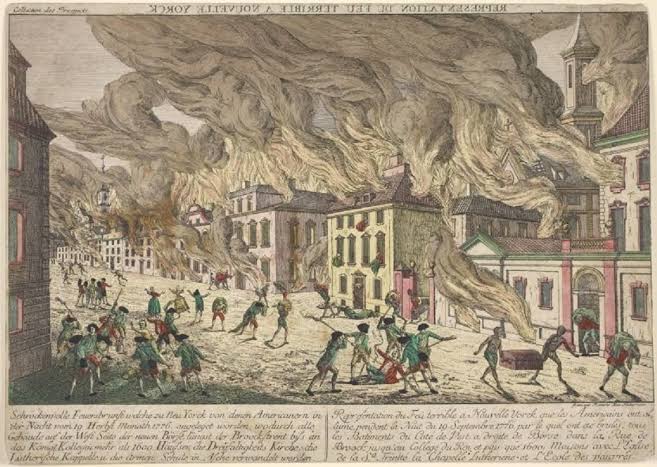
Vaughan’s force of roughly 1,200 regulars and Hessians landed at the mouth of the Rondout on the morning of the 16th. Kingston’s defenders were about 150 Ulster County militia, who were brushed aside quickly. The British set fire to the village, and with it some 300-plus buildings (homes, barns, stores, and public buildings). Vaughan reported destroying a quantity of American war materiel as well. He also torched farms in the surrounding countryside before re-embarking and rejoining the fleet.
Kingston was largely empty of civilians by then. Gouverneur Morris, who would become the father of the Preamble of the United States Constitution, had written a week earlier that the legislature was “hellishly frightened,” and the government had already scattered. The state government fled to Hurley, and Ulster County’s records were hauled to a stone house in Kerhonkson. Casualties on both sides were minimal.
Militarily it accomplished little. The British never occupied Kingston, so they gained no lasting control of the strategically vital river corridor between Albany and New York. Clinton’s diversion also came too late to save Burgoyne. General Burgoyne surrendered at Saratoga on October 17, the very next day.
What the burning did do was gut a capital. The state government never returned; the seat of power shifted north and eventually to Albany. Kingston rebuilt on the same street pattern, and parts of the Stockade District still stand, including the Senate House, which is now a state historic site. The burning is reenacted in Kingston to this day, and a 1778 British cartoon depicting the raid is one of the era’s better-known satirical images.
So, exactly 249 years ago, a “victory” for Britain on paper, a genuine trauma for New York, and a strategic dead end for the men who lit the torches.
— Political Pistachio Conservative News and Commentary