
By Douglas V. Gibbs
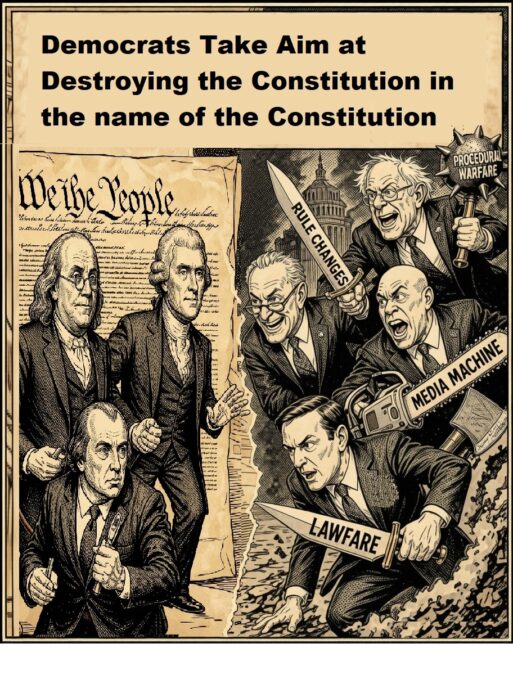
They say they’re going to subpoena like beads on Mardi Gras. Fine. The problem is, there is no oversight clause in the Constitution. Not one word. The only thing either House is expressly empowered to compel is the attendance of its own absent members. Everything else is inference stacked on inference, and the Democrats are about to run a country on it.
Robert Garcia’s entire transition message was two words. “Lawyer up.”
Emily Randall says they’ll pass out subpoenas like candy. Analilia Mejia says they’ll toss them like Mardi Gras beads. Ed Markey says they’ll need to plant new forests to print them.
And it’s being sold to you by both sides that the other is engaging in an unprecedented assault on the democracy, or the republic, or whatever they think this country is supposed to be. It isn’t unprecedented. And on the leftist side of things, all it really is, to be honest, is a temper tantrum with a printing budget. That doesn’t mean it’s harmless. It also doesn’t mean we should answer it by doing the same thing back.
Let’s examine the proposed lawfare by the Democrats as they approach a coming two year span in control of both chambers of Congress by looking at what the Constitution actually says, what should happen, and what almost certainly will.
Every one of the quotes by the Democrats is about volume. Candy. Beads. Forests. Not one of them is about a statute. Not one is about a bill number. Not one is about an enumerated power.
Volume is not legitimacy. If the squeaky wheel gets the grease, then a cacophony must get much more, or at least that’s their theory. It’s a theory of attention, not a theory of good governance or operating under the authorities of the United States Constitution.
The part we need to understand for the next two years is that every subpoena issued to harrow a man rather than to inform a statute is an unconstitutional use of Article I against Article I.
The Democrats are wrong, constitutionally. And, the loudest voices in the GOP are also getting this wrong. One camp says oversight is a coup that can’t be stopped. The other shrugs and calls it theater that’ll pass in the night. Both are lazy. It can be resisted, it should be resisted, and it will not pass in the night.
The Constitution does not contain a general grant of inquisitorial authority. Not a single word. Not a single phrase. Not a single clause. The word “oversight” appears nowhere in the document. It’s a coinage from the Legislative Reorganization Act of 1946. A statute, not a clause. I don’t care how much they argue about it, pieces of legislation don’t make something constitutional when the power doesn’t appear in the text of the Constitution. Only amendments to the Constitution make things constitutional, if the thing in question was not enumerated in the original seven articles in the first place.
They will tell you they are operating under the Constitution. “It’s right there,” they say as they point to text that says nothing of the sort. Count the hooks, because every one of them is a reach at best.
Article One, Section One: “all legislative Powers herein granted.” That says that the Constitution enumerates that the authority to make law, modify law, and repeal law belongs to Congress. Nothing more. They have legislative powers, and what they are planning on doing is not that kind of animal.
Article One, Section Eight, Clause Eighteen: The Necessary and Proper Clause (or as some of the members of the political class and judicial class likes to call it, The Elastic Clause… because they like to stretch it like it has the elasticity of rubber). By its own words it’s auxiliary: means to an end. Congress may make law to make sure the laws that are authorized by the Constitution are able to be carried into execution. It does not mean “implied powers” as the establishment swamp creatures who wear Alexander Hamilton Halloween masks will argue.
Article One, Section Five, Clause Two: The rules power, which is why this whole apparatus gets rewritten every two years with an election.
There’s the impeachment clauses, which grant a power to indict for a political trial (not a criminal trial), and remove if the U.S. Senate convicts – but none of those clauses say anything about the machinery of gathering evidence, preparing mob-squads, and operating like these congressional committees are miniature bubbles of judicial activity with judicial powers.
Article Two, Section Three: The President shall from time to time give information. A duty to speak, not to produce documents because an investigative congressional hit squad is working to make sure members of other branches of government are compliant with all of the legislature’s wishes and demands.
And Article One, Section Nine, Clause Seven: statements and accounts of receipts and expenditures, which is about transparency to the people more than it is about congressional oversight and micromanagement by desk jockeys who have likely never been more than a political hack during most of the moments of their otherwise pitiful life.
And, if we want to be serious about the text of the United States Constitution, and if congressional oversight in its current form is constitutional or not, then we need to simply realize that if a general power to extract information for the purpose of the kind of oversight the Democrats are seeking existed, the Opinion Clause would then be redundant.
Article Two, Section Two, Clause One: the President may require the opinion, in writing, of the principal officer in each executive department. Not the files. Not the emails. Not the staff. Their opinions. And note whose power that is. His. Congress isn’t even listed as a secondary beneficiary.
The only thing either House is expressly empowered to compel is in Article One, Section Five, Clause One: a House may be authorized to compel the attendance of absent Members. That’s it. Members. Not citizens. Not cabinet secretaries. Not the President of the United States or any member of the judicial branch. Only their own members. Their oversight powers, their investigative authorities, their little committees that look into wrong doing are only authorized to look into their own behavior.
You know, because there is this little thing known as a Separation of Powers. But, we’ll get to that.
Any compulsion they might have over everybody else, anyone who is not inside their legislative tent of power, must come by statute, and be associated with the Article I, Section 1 vested powers of legislation. Be it oaths in 1798, or criminal contempt in 1857, or a bunch of temper tantrums in 2026, their claims that they have this immense power that had to be legislated into existence is not a power that was enumerated.
The Tenth Amendment closes the category. And Thomas Jefferson gave us the test in 1791, in his bank opinion: “To take a single step beyond the boundaries thus specially drawn around the powers of Congress, is to take possession of a boundless field of power, no longer susceptible of any definition.” Their powers were never intended to be limitless, or to possess functionalities that belong to other branches of government.
Otherwise, they would be all-powerful. Kings in a legislative chamber, rather than on a throne.
A single step. Not a balancing test. Not “as penetrating and farreaching as the power to legislate,” which is what the Court said in 1959 and what has been the operating rule ever since.
Now, I can hear my opponents crafting a counterargument as I type these words on the page. Trust me, they are out there, and they’ve already launched their arguments that they think are so scholarly, and so historically sound, and so… shall I say it with a little bit of a snicker under my breath? … constitutional. Remember, to them the Constitution is not what the text on the pages of that document says, and what the original intent was based on according to those men who said it during the convention and during the ratification conventions. Their constitution is based on what their allies in the courts and past legislatures say it means. You know. Interpretation. And this one’s a doozy. In 1792 the House voted that it could investigate St. Clair’s massacre. The founding generation did it. Doesn’t that settle it?
No. The founding generation giving itself a power through a piece of legislation is not the same as the Constitution granting it. Remember, despite the statesmen of that time being much more honorable than the donkey jockeys we have today, they were also at each other’s throats. Each of them had their own political ideas, and many of those people felt like the Constitution didn’t go far enough in centralizing power. They believed the document fell short. And they were going to stretch its reach through language, judicial rulings and opinions, and legislation as best they could. Some of them were, if I may say it out loud, the earliest lefties in American History.
George Washington drew the line himself in 1796, when the House demanded the Jay Treaty papers. Read his message. He concedes the House may ask where a treaty requires a law to execute. So: Inquiry incident to an enumerated function is permissible. Inquiry as a freestanding power to expose is not.
That’s the line. Everything since is a trespass on the far side of it.
War Hamster and I in our latest episode of our jaunt through Madison’s Notes of the Philadelphia Convention talked about how the Framers told us which branch they were most afraid of. Yes, yes, they didn’t want the president to be a king. Well, some did. But the general opinion was that the president was to be very limited, and Article II accomplishes that. But he was also expected to be energetic, firm in his handling of foreign affairs, and not micromanaged by Congress. On July 21st, 1787, Madison, in his own notes wrote where the real tyrannical danger lurked: “a powerful tendency in the Legislature to absorb all power into its vortex. This was the real source of danger to the American Constitutions.”
RELATED: WAR POWERS LESSONS FROM THE REVOLUTIONARY WAR
In other words, they were more fearful that the Congress would act like the British King and Parliament combined more than they were worried that the President of the United States might turn into some authoritarian dictator-king-ruler.
Gouverneur Morris, on the same day Madison made the comment I provided above, said the Legislature “will continually seek to aggrandize & perpetuate themselves; and will seize those critical moments produced by war, invasion or convulsion for that purpose.”
In 1800, in the Robbins case, John Marshall (a broken clock that found the truth a couple times every once in a while) argued the House was not the grand inquest of the nation. He was right then. He’d be hooted at now.
One more, and this is the argument nobody makes. If Congress can subpoena, and punish you when you don’t comply, then Congress is acting judicially. A legislative body imposing a penalty, without a jury, without an Article III judge, without due process, and without an appeal. That’s not a check. That’s a courtroom with worse rules and a rabid mob swinging the gavels.
One of Congress’s own statutes confesses it. The 1857 contempt law hands its process to the executive to prosecute, because Congress can’t execute the law. The executive power, according to Article II, belongs to the President. Every contempt referral is a confession that they need somebody else to do the judging.
In 1881, Kilbourn v. Thompson, the Supreme Court struck down a House investigation of a private bankruptcy for exactly this reason. Congress had wandered out of its department and into the judiciary’s.
Here’s what should happen.
One rule, and it’s simple enough to put on a card: every subpoena names the bill it is associated with. The pending bill number, the appropriation, the article of impeachment. On its face. No bill, no compulsion. Congress may ask and be refused. If they want subpoenas issued that must be complied with as subpoenas from the courts are, then they need to make it an Article Three case and have those subpoenas issued by the courts.
Where they want standing access, they legislate a reporting duty. That’s Article One, Section Nine, Clause Seven. A publication duty on the Treasury. That’s the constitutional form.
And look at how the Framers handled the military, because it’s the model. They didn’t hand Congress a subpoena. They didn’t tell Congress that they have the power to micromanage the military from their desks on the chamber floor. They gave it Article One, Section Eight, Clause Fourteen: to make rules for the government and regulation of the land and naval forces. A rulemaking power. Congress oversees the army by writing rules, and then the Commander in Chief executes. And, by the way, those rules must be signed by the President of the United States, or override a veto with 2/3 vote of each House of Congress, to be in effect.
Legislation. That’s their battlefield. Information flows through lawmaking. Their duties flow through lawmaking. It always did.
And when a President genuinely runs off the rails, there are two tools and only two: defund the operation, or impeach him. That’s it. Those are the checks by Congress. What there is not, and has never been, is a power to force his hand because a committee would have done it differently.
Now the part that should really get into your nightmares even more so than what we’ve talked about so far.
They take the gavels January 3rd. Roughly 255 seats and 55 in the Senate. Gavels in both chambers mean subpoenas with no floor vote at all. The Republicans have no way to stop them, is their theory. Here’s the sequence they are expecting, in order: They will target in the name of justice Homeland Security, the Office of Management and Budget, and the White House staff. Then we’ll see criminal contempt referrals under Title 2, Section 192, to an Attorney General they’ll call compromised. Then civil enforcement when Justice slow-walks. Then talk of inherent contempt and fines – the most extraconstitutional piece of the whole thing, a legislature fining a man with no jury, last used in 1935 – and it is as unconstitutional now as it was then. Then cabinet-level impeachment articles as mini-impeachments: cheap, repeatable, and each one generates its own discovery. And all of it timed perfectly for 2028.
Here’s the proper strategy, and the White House should hear it. I hope the Republicans are reading this, and the administration is taking notes – but I won’t hold my breath on that one.
Do not refuse process. Steve Bannon and Peter Navarro went to federal prison for refusing. Refusing is principled, but it costs you your liberty.
So: Document everything. Put out there all of it. Negotiate scope. Produce the tedious material. The calendars, the schedules, the routine paper. Assert deliberative process and presidential communications privilege over the rest. And force the contested demands into Article Three (the courts), where the executive has won before and where the clock runs in its favor. Every month in litigation is a month not spent on a hearing.
Keep the objection in writing. Produce and preserve. And pick a clean issue to be the test case. Don’t produce everything and litigate nothing. Then, you never establish the principle at all.
And then the politics writes itself.
They promised you cheaper gas. Their record says otherwise. They want expensive gas, and they create higher prices in everything they touch. They’ve been showing us that screenplay for as long as I can remember. The price signal is the policy. That’s the Low Carbon Fuel Standard, that’s cap-and-trade on fuel, that’s the boutique blends, and that’s the taxes. In California the price is built in on purpose, and it’s the highest in the country. You don’t get cheap gas and a carbon price at the same time. They want us out of our cars because gas prices are too expensive so then we’ll drive electric cars, ride the bus, or ride a train. They don’t, suddenly, care about gas prices. They lied about the affordability crisis because an affordability crisis is their aim. It was projection. That way, when the prices go up, and the weapon that caused it is in their hands and is plain to see and still smoking, they can still say, “see, we told you the Republicans want you to pay more on gasoline.” And the worst part of it is that there is a very large segment of our population that will respond, “Okay. Republicans bad, Democrats good, because you said so.”
Winston Churchill, understanding the difference between a republic and a democracy, once said that the best argument against democracy is a five-minute conversation with the average voter.
APPRECIATE THE COMMENTARY? DROP A FEW BUCKS IN THE TIP JAR.
Jesse Watters put the fault line better than I can: “Swing voters think they won cheap gas. The radical base thinks they won blood. Somebody is going to get let down, and one side isn’t going to take it lightly.”
The scalps come first. The scalps are always first. And every week of Epstein and Nvidia is a week not spent on the cost of living, which was the only thing they ever actually ran on.
Greg Gutfeld asked the question that ought to be carved over the Oversight Committee door: “The point, if the point is obstruction, is what are you obstructing?”
And remember the arithmetic. Fifty-four seats, maybe fifty-six. Not sixty. They want statehood for the District of Columbia, a packed Supreme Court, and a federalized election code that sticks a knife in the neck of the Electoral College. Every one of those dies at the cloture vote unless they first blow up the Senate’s own rules. They will try. The Republican job in the Senate isn’t to win arguments. It’s to hold sixty, and to make the price of losing it visible to everybody.
Two years is a long time to hold a hearing. It’s a very short time to build a country. And as mindless as voters can sometimes seem, they are watching.
So don’t panic. Let them print their forests. Answer the subpoenas. Keep the deadlines. Litigate the scope. Put two years of receipts on the table next to their hearing transcripts.
Because a Congress can compel a man to appear. It cannot compel the country to care.
That’s done by results. And results are the one thing on the docket that the party of power-seekers cannot subpoena.
Notes:
Brutus XI, 1788: “Every body of men invested with office are tenacious of power… they will be interested to extend the powers of the courts.”
Anderson v. Dunn, 1821: “the genius and spirit of our institutions are hostile to the exercise of implied powers.”
Washington, March 30, 1796: the request would “establish a dangerous precedent” if granted as a matter of course.
The Court’s power to void a statute isn’t in the text either. You can’t bootstrap one implied power with another.
Like Congress, the judiciary also has no executive or enforcement power. The enforcement power for anything belongs to the executive branch. John Marshall challenged the courts and told them they had no enforcement power. Granted, the quote often repeated, “John Marshall has made his decision, now let him enforce it” is Horace Greeley’s wording, thirty years later. But, the quote captures what Jackson meant, and what he intended.
A friend of mine once said, “For God so loved the world that he didn’t send a committee.”
I am beginning to see the wisdom of that statement clearly.
— Political Pistachio Conservative News and Commentary