

By Douglas V. Gibbs
There is a fork in the argument that nobody on the left will acknowledge, because acknowledging it would cost them the argument.
Either America is a theocracy, or religion belongs in a box behind the church doors. Either the church is running the state, or the church has no business in the public square at all. There is no third option in their taxonomy. A politician bowing his head is establishment. A cross on a teacher’s desk is establishment. A pastor mentioning a bill is establishment. The word “theocracy” gets stretched until it covers a nativity scene and a school board prayer, and then it gets applied to anybody who won’t stay in the box.
It is a false binary, and it is false by roughly fifteen centuries.
A theocracy is rule by God’s direct representatives. The law is received, not enacted. There is no document standing above the magistrate, because the magistrate’s authority is the document. Calvin’s Geneva came close. Rushdoony’s theonomy wants it. And it exists, but it just isn’t what most American Christians are asking for.
Christians don’t want a theocracy, they don’t want a Holy Roman Empire, and they don’t want Christian Nationalism… despite what the leftist establishment will tell you. The Holy Roman Empire was not a theocracy, by the way. It was something worse: a merger. Emperors convened synods and installed bishops. Under the Ottonian and Salian houses the imperial church system made bishops into administrative officers of the crown. Lay investiture was the whole fight, and it ran for centuries, because both sides understood that whoever appoints the clergy owns the clergy. The church got the state’s sword. The state got the church’s blessing. Each corrupted the other, and Voltaire’s gibe – neither holy, nor Roman, nor an empire – was accurate on all three counts.
And the Reformation didn’t break the merger. It changed who held the pen. Cuius regio, eius religio – whose realm, his religion – meant the prince now chose your church, and if you were an Anabaptist you got drowned by the magisterial Protestants as cheerfully as by Rome. Augsburg in 1555 is the Holy Roman Empire’s logic with a Protestant face on it.
So, the accusation by today’s left has the polarity exactly backwards. The thing American Christians are supposed to want is the thing that produced the wars. Nobody in his right mind wants an established church.
RELATED: RENDER UNTO CAESAR
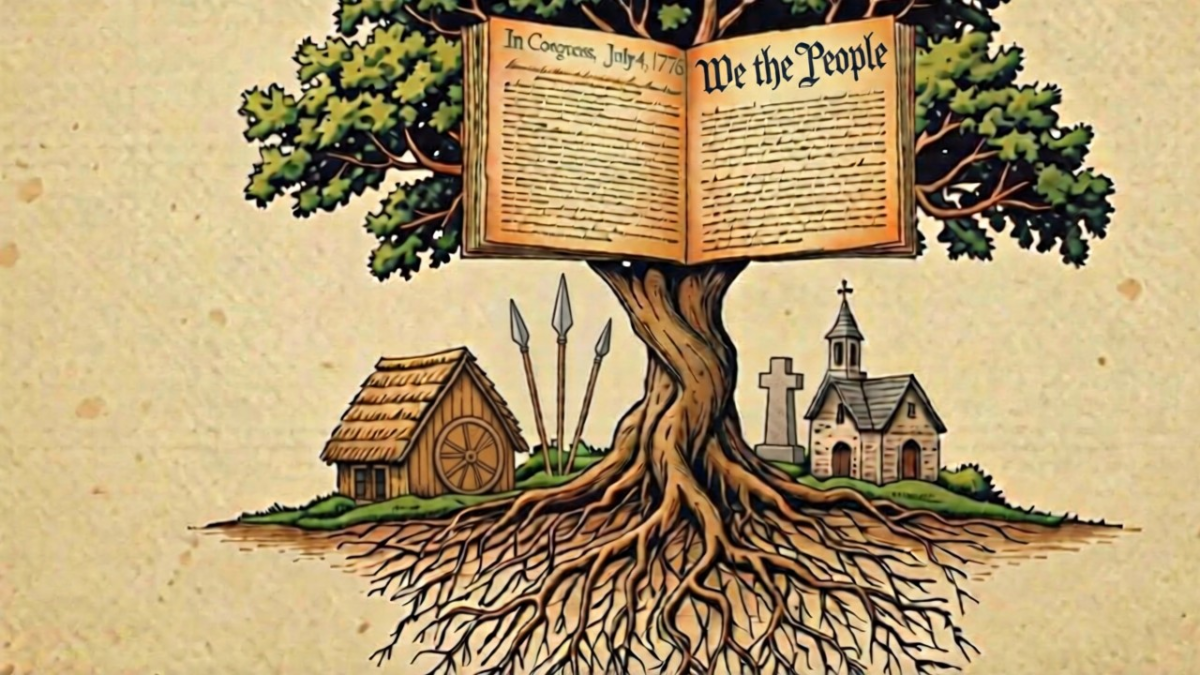
And, we need to remember that here in America, our root is not Romanized Europe. The American system doesn’t descend from that world. It descends from the northern one, the Saxon customary law of the folkmoot and the hundred, natural rights, consent of the governed, representative assembly, presumption of innocence, and trial by jury. Rome gave Europe the Corpus Juris and the translatio imperii, the notion that authority is a single pipe running down from the top. The northern tribes gave it juries and the idea that a free man has standing.
And the same smear was run on the Saxons that gets run on us. They were the barbarians, the lawless ones, the people without civilization; as though a man who governs himself by custom and consent is a savage, and only the man with imperial paperwork is civilized. Jefferson knew the move. In A Summary View he traced American liberty to “their Saxon ancestors” and their “system of laws which has so long been the glory and protection of that country,” and then added the line that matters: “America was not conquered by William the Norman.” He was saying the root never took.
The Founding Fathers were not building a Christian version of the Holy Roman Empire. They were building the opposite of it, out of materials that never had a bishop in them.
As for those of you out there screaming that Jefferson is the father of the modern notion of a separation of church and state, let’s also realize that he never said what the leftist establishment says he said. The Danbury letter is among the most abused documents in American history, and the abuse depends entirely on stripping the context.
RELATED: REGARDING THOMAS JEFFERSON’S ACT FOR RELIGIOUS FREEDOM
In 1801 the Danbury Baptist Association wrote to congratulate Jefferson and to beg for help. Connecticut was still an establishment. Congregationalists held the state, tax money went to their church, and Baptists could not vote or hold office. Jefferson’s reply? That there was a wall of separation. But, that statement was not a philosophy. It was a jurisdiction ruling. This is a state matter. The federal government cannot topple the Connecticut establishment for you. He had already fought that fight at home and won it with the 1786 Virginia Statute for Religious Freedom, which disestablished the Anglicans. Nine of the thirteen states had establishments at the beginning of the American Revolution. Pennsylvania, Delaware, New Jersey, and Rhode Island had religious freedom. Connecticut didn’t disestablish until 1818.
So the wall was a hedge drawn around religion to protect a persecuted minority sect, not a cage built to contain it. And the man who wrote it, as president, sat through Sunday services held in the chamber of the House of Representatives.
Try to reconcile that with “keep it inside the four walls.”
An argument often used against me is Romans 13, and it is not the blank check the left believes it to be. It gets read as though Paul were describing passivity.
Look at what Paul actually says. Authority is appointed by God, but the ruler is God’s diakonos, His servant, for your good. That is a standard, and a standard can be failed. Paul wrote it under Nero, which is the whole point: this is not a theory composed under a friendly administration. Submission is to the office, not to the incumbent’s preferences. Pay your taxes, obey the law, and when the law commands what God forbids, obey God – which is exactly what Peter said in Acts 5:29, and what the man who wrote Romans 13 did when he was beaten in Philippi.
The early church lived under one of the most brutal regimes in history and did all of this simultaneously: paid the tax, kept the peace, and refused the incense. Meekness was never weakness. It is power restrained until the moment it must be used. And the men who wrote the American founding concluded that a people can live under a government for a very long time before they must conclude they are living under absolute despotism.
The pulpit belongs where the public is. John MacArthur is right about the church’s institutional mission: it is the gospel. But the gospel gets preached in the public square, because that is where the public is. Preaching is not just “Jesus saves” and a benediction. It is the whole counsel of God applied to the whole of life, and a pastor who will only speak inside a building is a man the world has learned to route around.
Besides, you cannot preach expository through Leviticus, the prophets, Romans 13, or Revelation without preaching politics. The text forces it. So “no politics from the pulpit” either means “no politics except the ones in the text,” which concedes the argument, or it means skipping the text, which violates the method.
And the fear behind it is largely a tax fear. The Johnson Amendment, a 1954 code amendment, not a constitutional principle, supposedly forbids it. In seventy years exactly one church has lost its exemption: the Church at Pierce Creek, after a full-page ad in USA Today and the Washington Times four days before the 1992 election. One. It took a newspaper ad. The IRS does not want the fight and no pastor should want it either. And if they ever do come, pay the tax and keep preaching. The message outranks the deduction.
RELATED: CHARLIE KIRK – CHRISTIAN PATRIOT
What a healthy pulpit does is not dictate votes. It teaches the moral status of acts, and then it says plainly: vote your faith, and here is what the faith says. In 2020 my own church, 412 in Temecula, sued the state over the COVID shutdowns and won at the Supreme Court. I stood arm in arm, so to speak, with Tim Thompson through that. One Sunday during that period, leaving service, an NBC Palm Springs correspondent put a microphone in my face and asked what I thought about the dangerous situation inside: nobody masked, nobody distanced. I told her the only danger to the church I saw there was her and the anti-church media. I don’t think it made the broadcast.
As for the accusers that Christians want “Christian Nationalism,” it is pure projection. They, themselves, already have a magisterium.
The left is not describing a theocracy. It is remembering one. Its own. They have bishops. They just don’t call them that. They have a magisterium and it lives in foundations, and it issues rulings through compliance officers instead of encyclicals, and it has no elections, no appeals, and no due process whatsoever.
We have just watched it work. As I recently wrote, the Office of the Comptroller of the Currency found that four of the nine largest banks cited the Southern Poverty Law Center by name when denying loans or closing accounts. They followed the lead of the SPLC, a private nonprofit in Alabama with no rulemaking authority and no obligation of fairness to anyone it grades, functioning as a credit rating agency for ideology. PNC turned down a line of credit because an owner’s foundation gave to Christians. Chase’s payment processor screened for the word “MAGA.” Not one of those files asked whether the customer could repay.
That is a magisterium, and it has been rented out to the banks. So when they warn about clergy in the public square, understand what they are actually protecting: a rival.
Christians are not asking for the things the left claims. No ecclesiastical courts. No tithe collected by the state. No religious test for office. No bishops in the Senate. No power to excommunicate a citizen. No privileged denomination. The First Amendment still restrains Congress, and should.
What we are asking for is smaller than what they fear. That we be left alone to bring our convictions to the same square everyone else brings theirs to. That a cross on a desk not be treated as a statute. That a pastor be allowed to say what the Bible says about a bill without a lecture on the Enlightenment or secular cultural preferences. That is all.
The real question is virtue, not law. This was never primarily a legal argument. Franklin: “Only a virtuous people are capable of freedom. As nations become corrupt and vicious, they have more need of masters.” Adams: “Our Constitution was made only for a moral and religious people. It is wholly inadequate to the government of any other.” Tocqueville came here to find out why the thing worked and reported that religion “takes no direct part in the government of society, but it must be regarded as the first of their political institutions.”
ENJOYING THE CONTENT? DROP A FEW BUCKS IN THE TIP JAR
That is the whole architecture. Not a church with a state, and not a state with a moat. A culture that forms the kind of people a republic can survive, and a Constitution that keeps the government off the culture’s back while it does.
And note the order of operations. Culture is upstream of politics. Politics is downstream of culture the way a creek is downstream of a spring. Which means if the culture lets go of the foundation, the legal and political machinery will not save itself. It will simply administer the decay with great procedural regularity.
I am not a Christian nationalist. I am a Christian Constitutionalist, and the two words are in that order. A theocracy has no charter above it. We do. That founding document is the answer to the charge, and it presupposes exactly the thing the critics keep insisting we want to legislate.
We are not asking for the Holy Roman Empire. We are asking to be left alone in a country we helped build, governed by a document that assumes we are the sort of people who can be, and active in the public square because without a moral compass the country is directionless.
— Political Pistachio Conservative News and Commentary