
By Douglas V. Gibbs
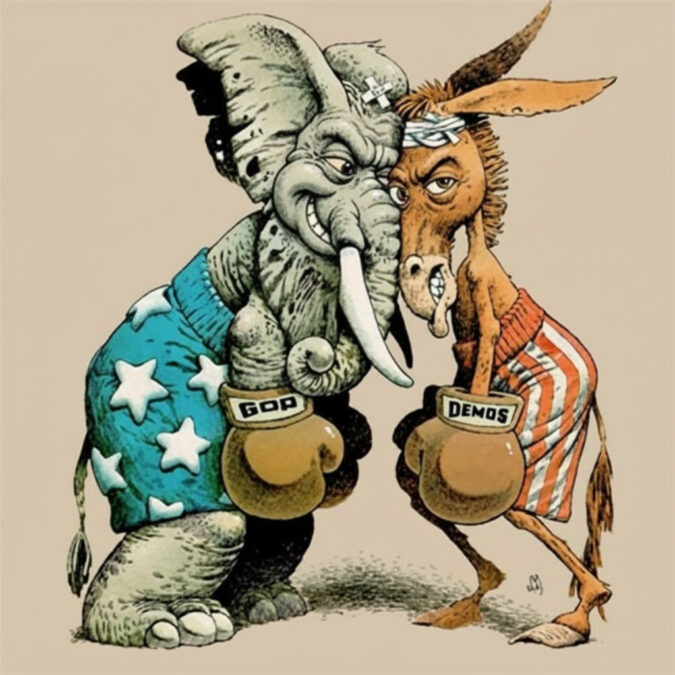
Democrats and Republicans are not two sides of anything. When it comes to the machine, the leviathan that has been growing for over two centuries, they are nothing more than two uniforms on the same side of the only fight that has ever mattered. I have voted Republican my entire adult life not because I am a Republican, but because the party’s platform is closest to what I believe. But, when it came to the establishment, I never once believed the Republicans were my side.
That confuses people, so let me be plain about it. My side is a document. It is the Constitution of the United States as written, and as the men who wrote it understood it. When a party is with the document, I am with the party. When it isn’t, I’m not. And our system has been outside the Constitution plenty. So, understand, I have no illusions about the GOP and never have.
Which is why I want to say the thing that gets you shouted at. When it comes to the governmental machine, there is no red team and no blue team. There is one team, and there is a current running against it, and the whole drama you watch on cable is a fight over who gets to hold the oars while the boat drifts.
The two parties fight like brothers over the furniture in a house neither of them built. Both feed from the same trough — the same donors, the same consultants, the same foundations, the same revolving door, the same appetite. The differences were real. There are issues that they differe on. Abortion, guns, taxes, judges: real. Those things are also small. Beneath all of them resides one unexamined premise, held by both: that the federal government is the engine of American life and the only live question is whose hands belong on the throttle.
The axis is not left and right as much as it is liberty and power. Don’t get me wrong, there is a left and right on the political spectrum, but both parties reside to the left of the Constitution. When one looks at the true political spectrum, anarchy sits at one end and the fully administered state at the other. The Constitution sits near the middle; a system built to make government fight itself, because its authors had read their history and knew what consolidated power does to men.
The parties both sit to the left of it. Measure them against 1789 and the modern GOP is a big-government party: income tax, Federal Reserve, standing army, Social Security, Medicare, federal land, the drug war, the surveillance state. It is not on the right side of anything, except their extremely leftwing neighbors in the Democratic Party. The GOP is on the left, just not as far as the Dems. The GOP is Democratic-Light, one might say. A kind of moderate version of two lefts.
The hard left has many names and one family. Socialism, communism, fascism, corporatism, mercantilism. They differ only in who collects and by what method. They agree on the mechanism: the price signal replaced by an authority’s judgment, and private title preserved or abolished while private autonomy goes either way. Mussolini edited the socialist party paper before he invented fascism. Fascism keeps the letterhead and kills the veto. It is not the opposite of socialism. It is socialism with different typography.
The drift leftward did not begin with the New Deal, or with Wilson, or with Obama. It began before the ink was dry on the Constitution; with a Judiciary Act that handed the lower courts jurisdiction the Constitution never gave them, and with a chief justice (John Marshall) who spent thirty-five years reading the document more generously than he had promised to when he was campaigning for it.
It continued through a war between the states that established the Union as prior to the states and the federal government as the judge of its own necessities. Through 1913, when the sixteenth amendment, the seventeenth amendment, and the Federal Reserve all landed in the same year and took the states’ voice out of Washington. Through 1883, when a well-meaning civil service act created a permanent class that outlasts every elected official and answers to no voter. Through 1964 (Reynolds v. Sims), when the Supreme Court told the states they could not organize themselves on the same principle the federal government was organized on.
No single villain. No ranking. A movement, assembled gradually, one reasonable-sounding step at a time, each step made by men who were certain they were improving things.
And here is the comfort everybody reaches for: the pendulum. It will swing back. It does indeed swing. Party control, fashion, cultural mood, all of it. What it never does is return to where it started, because the thing it is swinging on is itself in motion. That is the illusion. Change feels like correction, and the axis creeps on while we watch the swing and feel reassured.
No constitution can hold a people who have stopped being able to hold themselves.
Franklin said it plainly: “Only a virtuous people are capable of freedom. As nations become corrupt and vicious, they have more need of masters.” He was not being pious. He was being mechanical. A republic runs on restraints that no statute can supply. Keeping your word, doing the work, telling the truth, minding your own business, raising your own children, and helping the neighbor before he asks. Take those out and the government does not shrink. It grows to fill the hole, because somebody has to do what nobody will do for himself.
That is why the parties cannot save us and why elections alone never will. The men who wrote the Constitution knew it. They gave us a republic, not a democracy, because they understood that consent is not the same as a show of hands. Consent of the governed runs through juries and petitions and state legislatures and the amendment process, and that a people who reduce it to voting every other November will get a government that reflects exactly that much thought.
So what does a constitutionalist do, knowing the falls are downstream and the leftist current under the boat never rests?
Not pull the rug. Nobody in his right mind ends Social Security on a Tuesday. It took two and a half centuries to get here; the way back is generational, and the method has to be gradual even while the aim stays structural. Gradualism in method without structure in aim, after all, just loses to the current, which does not pause while we are being patient.
The tools exist and they need no permission from the people who benefit from the drift. Repeal the Seventeenth Amendment and give the states their voice back. Reverse Reynolds v. Sims and let the states govern themselves again. Use Article V, which is the one mechanism that lets the states route around a Congress that will never voluntarily shrink itself. Rotate the policy bureaucracy so it answers to elections. Restore the nondelegation principle so Congress has to legislate again. None of it happens in one term. All of it is available.
And it will not hold unless the virtue comes back underneath it. Which means the work is not only legal. It is in classrooms and kitchens and churches and county committees, in front of students and radio audiences and anyone who will listen, one generation at a time, until enough people want the document again for anyone to hand it to them.
I have been asked what I would do if I turned out to be the last man in America who believed in liberty. The answer is nothing dramatic. I would simply keep saying what I say, and standing firm on the rock of liberty.
The current does not stop. It was there in the good times and it is stronger in the bad. We will not beat it. We must not lose to it. And a republic is not saved by the crowd anyway. The mob is the problem. Our republic’s salvation will arrive by the hands of the remnant who refuses to stop rowing against the current, away from the devestating falls, while the crowd is watching for the swing of a pendulum.
— Political Pistachio Conservative News and Commentary