
By Douglas V. Gibbs
A modern secular version of a scene in St. Matthew 22:21, where Jesus responds to a question by the Religious Leaders about taxes, “Render therefore unto Caesar the things which are Caesar’s; and unto God the things that are God’s” misinterprets it completely. Their claim is Jesus was asked a question about the boundary between religious obligation and political obligation, and he answered by drawing a line. Religion goes in one box, the state goes in the other, and each stays in its lane. Therefore Jesus founded the separation of church and state. Therefore the church should not legislate, the state should not preach, faith is a private matter, and any Christian who brings his convictions into the public square is violating a dominical command. The verse becomes the proof text for secularism, quoted, invariably by someone who has no interest in the rest of the Sermon on the Mount.
You can hear the shape of it in the paraphrase most people actually carry around: “Give to Caesar what is Caesar’s, and to God what is God’s.” Note that the second clause has quietly become decorative. The operative half is the first, and “the things that are Caesar’s” is treated as a large, expanding, self-defining category.
This way of looking at the verse is not ancient. The instinct behind it is Luther’s two-kingdoms doctrine: the realm of the sword and the realm of the Word, each with its own authority, Christian liberty interior and civil obedience exterior. That’s a belief that was paraded around by some religious leaders in 1523. Martin Luther, however, still had both realms under God, and the prince was a Notbischof, an emergency bishop, with real religious duties. The secular version strips that out. It’s a child of the Enlightenment, where the battle spilled blood in the field.
In 1802 The Danbury Baptists wrote to Jefferson because they were a minority sect under the iron fist of the Congregationalist establishment in Connecticut. They wanted a wall to protect the church from the state in Connecticut, and they wanted the federal government to enforce that wall. The wall was originally a hedge drawn around religion, not a cage built to contain it. Jefferson said, “No,” there is a wall between the church and state, but the federal government has no authority to get involved in religious feuds. Religion, he explained, is a state issue. Within a couple of generations that explanation has been turned around and is being used to keep religion out of public life. The metaphor changed direction, and with it the politics.
The secular misinterpretation of what Jesus said, “Render unto Caesar,” is what you say to a Christian who is being inconvenient. “Pay your taxes, follow the rules, stop making a fuss about abortion or school curricula or drag queen hour.” It functions as a “know your lane” argument. It presumes the state has already defined its own jurisdiction and that the church’s job is to ratify the map.
In another words, the secular version is saying to Christians, “you must be neutral in the public square. Keep your religion inside the four walls of the church.” After all, we are taught since childhood that it’s rude to talk about politics and religion. If there version was hypothetically correct, then Jesus divided the realms. The public square is a secular space by divine appointment, and religious arguments are guest arguments that need translating into secular terms to be admissible. It treats the state as religiously unaffiliated, which is a very modern thing to be.
If Caesar’s realm is legitimate and God’s is elsewhere, then political obligation is basically settled and the interesting Christian business is interior. Render, and get on with your soul.
The first problem is that Jesus never draws the line. He says “the things that are Caesar’s” and “the things that are God’s” and leaves both sets undefined. That silence is deliberate. It’s what makes the answer unanswerable. But it means anyone who comes along afterward and supplies a fixed jurisdictional boundary is doing eisegesis, reading a modern constitutional arrangement back into a first-century exchange.
The second problem is anachronism. There was no secular sphere in AD 30 to retreat into. Rome was a religion. The emperor was pontifex maximus, and the coin itself said so: “son of God,” “high priest.” Caesar made theological claims as a matter of course. So “render to Caesar his realm and to God God’s” could not have meant “politics here, religion there,” because in the first century those were the same territory. If the secular reading were correct, the coin would have been a bad choice of prop: it’s a religious object with a religious inscription, and the whole reason the question was live is that it blurred the boundary rather than illustrating one.
The third problem is the direction of the argument. The image clause is the engine of the passage, and it runs against the state. The coin goes back to Caesar because it’s stamped with Caesar. But the man holding the coin is stamped with God, and can’t be handed over. That establishes a permanent reserve the state cannot reach, which is the seed of Peter’s “we must obey God rather than men” in Acts 5:29, and of every martyr who ever told a magistrate no. The secular reading borrows the verse’s authority while amputating its sharpest edge. It turns a doctrine of limited sovereignty into a doctrine of settled sovereignty, and a doctrine of resistance into a doctrine of compliance.
The fourth problem is the infinite expansion of Caesar’s column. Because “the things that are Caesar’s” is undefined, whoever holds the pen fills it in. In practice the modern state fills it in, and it fills it in generously: healthcare, education, welfare, licensing, speech, family structure, and lately the definition of the human being. God is left with a residual Sunday slot and a private feeling. That is not a division of realms; it’s a division of realms where one party has already claimed the field and the other has agreed to be a hobby.
It’s worth noting that many make the identical mistake in reverse; “render unto Caesar” as the reason the pulpit should say nothing about immigration or war or economics. Same flattening, different politics. And a smaller camp makes the third error, reading it as though Caesar has no claim at all, which collapses the first half of the sentence and gets you something like what the Democrats claim to be Christian Nationalism.
The verse does establish that the state is not God, that its authority is real but derivative, and that it has no right to absolute allegiance. Secularists are right that a Christian owes the magistrate something, and right that the magistrate is not the church. They’re just wrong that the something is bounded by the magistrate’s own preference, and wrong that the coin’s other side is empty.
The honest summary is that the secular version makes the verse a divorce decree when it’s actually a rank ordering. Caesar is a tenant. He gets the coin because his face is on it, but the silver was God’s before Rome existed, the face on the coin is God’s image (because man was made in God’s image (Genesis 1:26-27), and the hand that hands it over is God’s too. The lease is real, and it expires.
Here’s a proper look at the verse about rendering to Caesar.
It is found in Matthew 22:15-22, with parallels in Mark 12:13-17, Luke 20:20-26. The Pharisees sent their disciples together with the Herodians, which was an unusual pairing, since the two groups hated each other (kind of reminds me of hard-leftists and Muslims pairing in today’s world). The Herodians were the collaborators, the party of the puppet dynasty, pro-Rome. Sending them alongside the Pharisees means both flanks were covered. They opened with flattery: “Teacher, we know you are truthful and teach the way of God honestly, and you don’t curry favor with anyone.” Then they presented the question that was meant to be a trap: “Is it lawful to give the census tax to Caesar, or not?” The Greek is kēnsos, a transliteration of the Latin census, the direct imperial poll tax, the one that had triggered armed revolt under Judas the Galilean in AD 6. To pay it was, for a zealot, to concede that God was not your king.
From the Religious Leaders’ point of view, Jesus only had two exits, both bad. Say “pay” and you lose the anti-imperial ground, the crowds who cheered a prophet who told Rome to shove it. Say “don’t pay” and the Herodians have grounds to report you to Pilate as seditious. There is no safe binary available.
Jesus asks them to produce a denarius, and note that he doesn’t have one. Judas carries the purse. He makes them dig one out of their own pockets in the temple precincts, which is the first quiet humiliation: you’re the ones who claim to be scandalized by idolatry, and you’re the ones walking around with this in your belt.
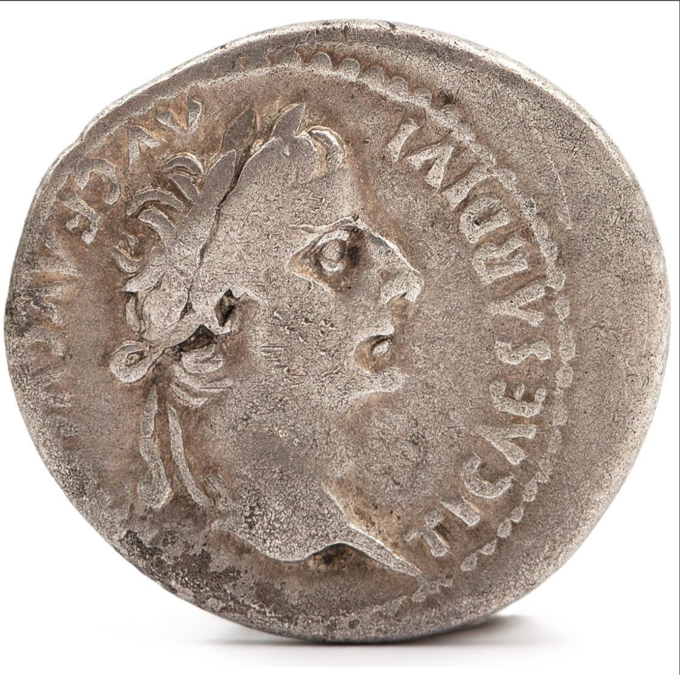
The coin they handed him was Roman. Its obverse read TI CAESAR DIVI AVG F AVGVSTVS: “Tiberius Caesar, son of the divine Augustus, Augustus.” The reverse read: PONTIFEX MAXIMUS or “high priest.” So the thing in their hand claimed, in stamped metal, that Caesar was a son of a god, and that he held the supreme religious authority. It is not merely a picture of a man. It’s a theological document. A graven image with a blasphemous caption, in a Jewish hand, inside the temple courts.
Jesus asked, “Whose image and whose inscription?” They answered “Caesar’s,” and in doing so they’ve already conceded the case before they know what they’ve conceded. The words used by Jesus in his question were eikōn, which was the exact word the Septuagint used in Genesis 1:26-27 for man made in the image of God. “Let us make man in our image (eikōn).” And epigraphē, which appears in the Gospels only twice: here, and on the placard nailed above the cross. The man asking the question is himself the eikōn of the invisible God, and the inscription over his head reads “The King of the Jews.”
So, the coin bears Caesar’s image, so hand the coin back to Caesar. But you bear God’s image, and you cannot be handed back. You don’t return a coin and walk away; the coin can be deposited, you can’t. That’s the asymmetry, and it’s the whole point.
In the bible there is a line “the silver is mine and the gold is mine.” It is Haggai 2:8, spoken about the rebuilding of the temple; God declaring that the nations’ wealth is already His and will be brought in. The broader principle is Psalm 24:1 (“the earth is the LORD’s and everything in it”) and Leviticus 25:23 (“the land is mine; you are strangers and sojourners with me”). In addition, we can look at Micah is 3:11: “her leaders judge for a bribe, her priests teach for a price, her prophets divine for money, yet they lean on the LORD and say, ‘Is not the LORD among us?'” This was precisely the Pharisees’ portrait. Micah 4:13 can be added, where Zion devotes the spoils of the nations to the Lord. The greed theme is Micah. The ownership-of-metal line is Haggai.
The logic they’re describing holds. If all silver and gold is already God’s, then Caesar’s claim on that denarius is not ownership. It’s a delegated, provisional, revocable stewardship. He didn’t make the silver. He didn’t make the man whose face is stamped on it. He stamped a claim onto a thing that was never his, and the claim is only as good as his stewardship of it. “Render to Caesar the things that are Caesar’s” is therefore not a partition of sovereignty into two autonomous zones, which is the modern reading, which turns the verse into a charter for the secular state. It’s a hierarchy. Caesar gets his due, and his due is finite and specified. God’s due is total and unspecified.
“Render” is debt language. Apodidōmi: give back, repay what is owed. Both halves of the sentence are debt. Repay Caesar. Repay God. But the debts are not the same size. You owe Caesar a coin. You owe God the hand that holds it.
And the trap closes on them. They marvel and walk away. It failed so badly that at his trial they had to lie about it: Luke 23:2 has the prosecution claim he “forbade” paying tribute to Caesar, which is the opposite of what he’d said. The answer was remembered, and it was remembered as unanswerable.
One more thing. There’s a rabbinic coin metaphor in the Mishnah, Sanhedrin 4:5: a human king stamps many coins from one die and they all come out identical, but the Holy One coined every human being from the die of the first man and no two faces are alike. The tradition already had the vocabulary: God is the one who mints, he minted man as the coin bearing the King’s image. Jesus is using a coin to answer a question about a coin, in a culture that already knew what a coin with a king’s face on it meant.
The sting, in the end, is that Caesar’s face is on the money, but Caesar’s face is itself stamped with God’s image. So even what you hand to Caesar was never really Caesar’s. He’s a middleman holding stolen property, and the bill comes due for everyone.
— Political Pistachio Conservative News and Commentary